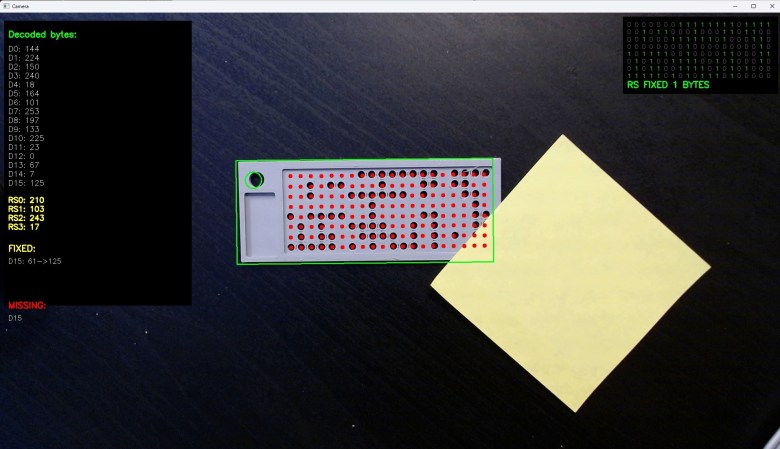
What a punch card looks like to openCV

21st Century Punch Cards Are 3D Printed And Read By OpenCV

While a punch card is perhaps the lowest-density storage medium available, it has some distinct advantages. As [Bitroller] points out in the write-up of his punch card project, if he was using stainless steel instead of PLA his 3D printed punch cards would likely outlast everything he owns, and survive a five-alarm fire to boot. If you have 16 bytes you really, really don’t want to forget — or are willing to store your private key in a shoe box — this project might be of interest.

The nice part is that he’s built a handy Python script to generate printable files for the punch cards, which encode 16 bytes of information and 4 bytes of error correction using the Reed-Solomon algorithm. That’s just enough for a password and the error correction means up to two bytes can be recovered in the case of read failure.

The reading is where this gets interesting — again, [Bitroller] provides a handy script, but this one uses OpenCV to read the entire punch card at once from a webcam image, using the contrast between a black table and the light-colored PLA cards. It’s massively overkill and would have needed a supercomputer in the days when punch cards were common I/O, but that’s what makes this a great hack.

We only have one quibble: if you use additive manufacturing, can you still call it a punch card? Nothing was punched out, after all.

If you think punch cards are totally irrelevant in the modern day, well, you might be right– but that doesn’t stop us from playing with them. If punch cards make you think of Big Iron in the early days of computing, maybe think further back– they were used for everything from Jacquard looms to the original MIDI.

Inside A Dutch Street Organ: The Art Of Mechanical Music-Making

[James]’ Mechanical Organ of Dutch origin has been around longer than he has, but thanks to being rebuilt over the years and lovingly cared for, it delivers its unique performances just as well as it did back in the day. Even better, we’re treated to a good look at how it works.

The organ produces music by playing notes on embedded instruments, which are themselves operated by air pressure, with note arrangements read off what amounts to a very long punch card. [James] gives a great tour of this fantastic machine, so check it out in the video embedded below along with a couple of its performances.

Continue reading “Inside A Dutch Street Organ: The Art Of Mechanical Music-Making”

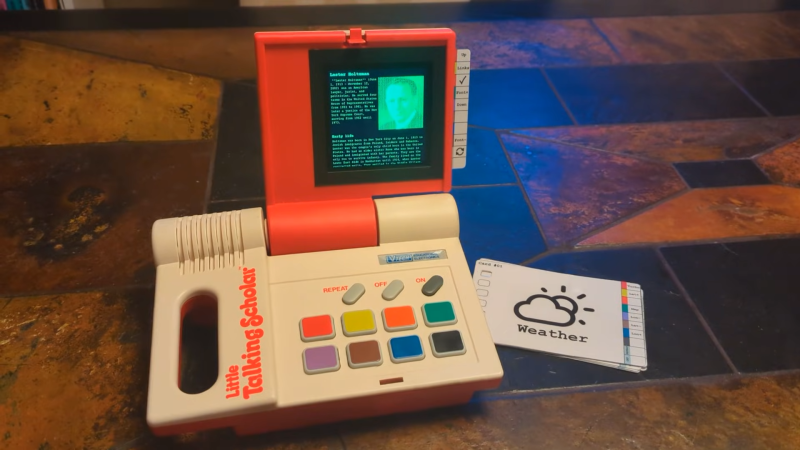
Punch Card Controlled Cyberdeck Lives In 80s Toy

Have you ever seen a toy and said “That wants to be a deck”? [Attoparsec] did, when his eyes fell upon the Little Talking Scholar, a punch card driven toy from the 1980s. It’s now a punch card driven cyberdeck.

The punch card interface on the toy is only six bits, but sixty-four application cards are probably more than parents would have wanted to keep track of in 1989. Originally, they cued up simple matching games on an anonymous epoxy-coated microprocessor; after [Attoparsec]’s surgery, they do the same thing, cuing up custom Python applications on the Raspberry Pi Zero he’s implanted into this thing.

Continue reading “Punch Card Controlled Cyberdeck Lives In 80s Toy”

On The Original Punched Cards

If you mention punch cards to most people, they’ll think of voting. If you mention it to most older computer people, they’ll think of punching programs for big computers on cards. But punched cards are much older than that, and [Nichole Misako Nomura] talks about how the original use was to run looms and knitting machines and — thanks the Internet Archive — you can still find old cards to drive modern machines.

According to the post, a dedicated group of people own old commercial knitting machines, and with some work, they can use archived punch cards with patterns that predate the computerized world. The Jacquard loom was famously the first machine to use cards like this, and it is no secret that they were the inspiration for Hollerith’s use of cards in the census, which would eventually lead to the use of cards for computing.

Continue reading “On The Original Punched Cards”

Paper Punching Machine Looks Like Cute Piece Of Computer History Past

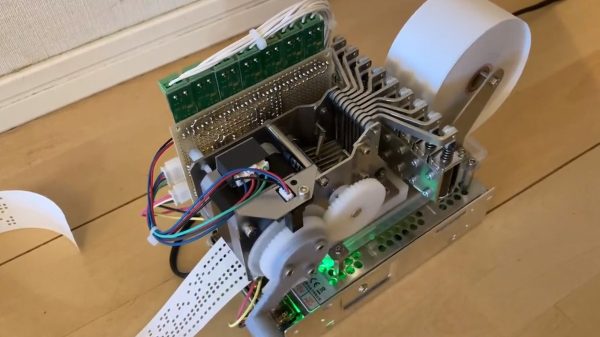
Computing used to run on punch cards. Great stacks of cards would run middling programs, with data output onto more punched cards in turn. [Nii] has built a machine in this vein, capable of punching binary into paper tape. 

The machine is run by a stepper motor, which is charged with feeding the paper tape through the machine in steady steps. A series of vertically-actuated solenoids punch holes in the paper tape as directed. The machine buzzes and clicks away like the best electromechanical computing devices of the mid-century era.

To what end, we couldn’t possibly say. One user noted the machine was punching seemingly random binary into the paper tape, and [Nii] has not provided any explanation as to the machine’s higher purpose. Regardless, whatever it is doing, it looks like it’s doing it well. Feel free to speculate in the comments.

Impressively, the petite device will be demonstrated at MF-TOKYO, the 7th Annual Metal Forming Fair in Tokyo this year. We’re sure the clickity-clack will be muchly appreciated in person.  Video after the break.

Continue reading “Paper Punching Machine Looks Like Cute Piece Of Computer History Past”

I’ll See Your Seven-Segment Mechanical Display And Raise You To 16 Segments

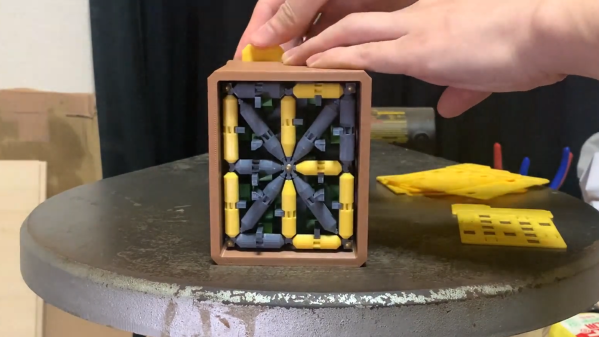
Mechanical multi-segment displays have become quite a thing lately, and we couldn’t be more pleased about it. The degree of mechanical ingenuity needed to make these things not only work but look good while doing it never ceases to amaze us, especially as the number of segments increases. So we submit this over-the-top 16-segment mechanical display (Nitter) for your approval.

The original tweet by [Kango Suzuki] doesn’t have a lot of detail, especially if you can’t read Japanese, but we did a little digging and found the video shown below. It shows a lot more detail on how this mechanism works, as well as some of the challenges that cropped up while developing it. Everything is 3D printed, and flipping the state of each of the 16 segments is accomplished with a rack-and-pinion mechanism, with the pinions printed right into each two-sided cylindrical segment. The racks are connected to pushrods that hit a punch card inserted into a slot in the rear of the display. The card has holes corresponding to the pattern to be displayed; when it’s pushed home, the card activates a mechanism that slides all the racks that line up with holes and flips their segments.

This isn’t the first multi-segment mechanical masterpiece from [Kango Suzuki] that we’ve featured, of course. This wooden seven-segment display works with cams rather than punch cards, but you can clearly see the hoe the earlier mechanism developed into the current work. Both are great, and we’re looking forward to the next segment count escalation in the mechanical display wars.

Continue reading “I’ll See Your Seven-Segment Mechanical Display And Raise You To 16 Segments”

Taking A Walk Down [Computer] Memory Lane

There’s nothing quite like going to a museum and being given a tour by a docent who really knows their way around the exhibits. When that docent has first hand experience in the subject matter, the experience is enhanced even further. So you can imagine our excitement when hacker, maker, and former DEC mainframe memory engineer [Ned Utzig] published a tour of what he calls “Memories of Weird Memories of Computers Past.” [Ned] expertly guides us through each technology, adding flavor and nuance to an already fascinating subject.

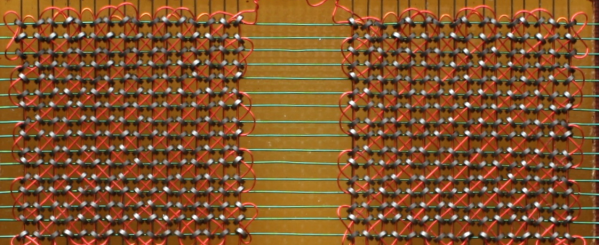
The tour begins with early storage media such as IBM punch cards, and then walks us through time to the paper tape, vacuum tubes, and even complex vats of mercury — all used for the sake of storing data either permanently or temporarily.

Next in the exhibit is an impressive CRT hack that isn’t unlike modern DRAM. The tour continues on to ferrite core memory such as that used on mainframes, minicomputers, and even the Apollo Guidance Computer. Each type is examined for its strengths and weaknesses and its place in computing history.

We really appreciated the imaginative question posed toward the end of the article. We won’t give it away here- it’s worth it to go give The Mad Ned Memo a read.

Is obsolete technology your cup of tea? Perhaps an Arduino based experiment with core memory will scratch the itch, or maybe storing data in thin air will bring back memories of computers gone by.