Scientists Create Hexagonal Packed Ice At Extreme Pressures

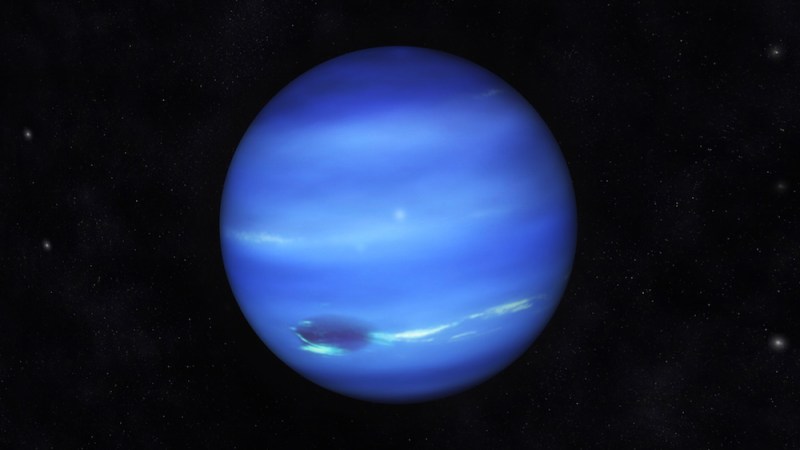
One of the problems with planetary science is that you generally cannot easily investigate the exact conditions in their interior, so you’re left to extrapolate what is happening inside them based on surface scans. One of the resulting questions is what ice giants like Neptune and Uranus in Earth’s solar system have exactly at their core. We do know that it is mostly rocks and ice, but what kind of ice you end up with at these intense pressures is a good question that [Alexis Forestier] et al. set out to answer, with their results published in a Physical Review Letter paper (ArXiv preprint).
It’s noteworthy that there isn’t just water ice at these planetary cores, with this study only investigating water ice specifically. In order to get the water to the pressures it would experience courtesy of ice giant gravity, a diamond anvil was used, with synchrotron x-ray diffraction allowing for the changes to the sample to be observed.

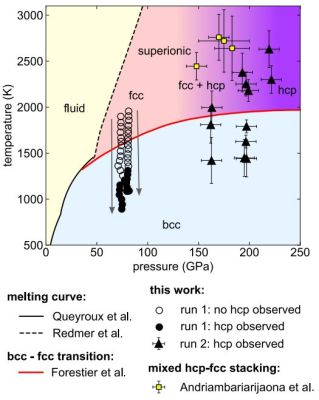
The phase diagram of water includes a number of phases beyond what us Earth-dwellers would call ‘ice’, with at higher pressures above about 80 GPa the formation of ice X, featuring a body-centered cubic (BCC) oxygen sublattice. Subsequent discovered phases were face-centered cubic (FCC) and now hexagonal close-packed (HCP) ice, all differing in the packing of the oxygen sublattice.

In addition to extreme pressures, temperatures also had to be increased by using the laser heating feature of the diamond anvil. At around 2,000K and over 200 GPa the HCP phase was found, with a mixed FCC-HCP phase at intermediate pressures.

Although not immediately providing answers to questions pertaining to the aforementioned ice giants, it gives planetary scientists yet another clue that they can use in future investigations, as well as provide more insight into this most fascinating phase of water that’s actually its own little galaxy of phases.
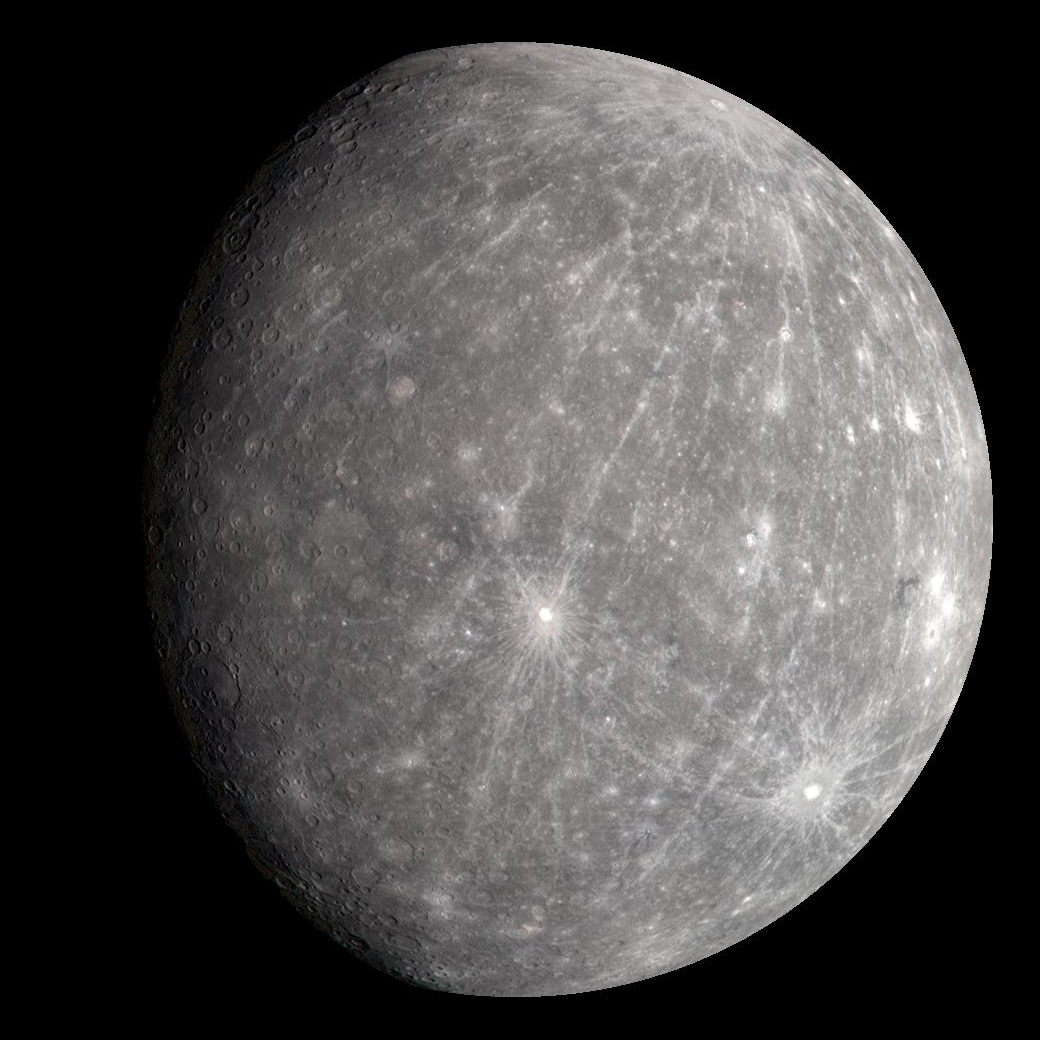
A Mercury Rover Could Explore The Planet By Sticking To The Terminator

The planet Mercury in true color. (Credit: NASA)

With multiple rovers currently scurrying around on the surface of Mars to continue a decades-long legacy, it can be easy to forget sometimes that repeating this feat on other planets that aren’t Earth or Mars isn’t quite as straightforward. In the case of Earth’s twin – Venus – the surface conditions are too extreme to consider such a mission. Yet Mercury might be a plausible target for a rover, according to a study by [M. Murillo] and [P. G. Lucey], via Universe Today’s coverage.

The advantages of putting a rover’s wheels on a planet’s surface are obvious, as it allows for direct sampling of geological and other features unlike an orbiting or passing space probe. To make this work on Mercury as in some ways a slightly larger version of Earth’s moon that’s been placed right next door to the Sun is challenging to say the least.

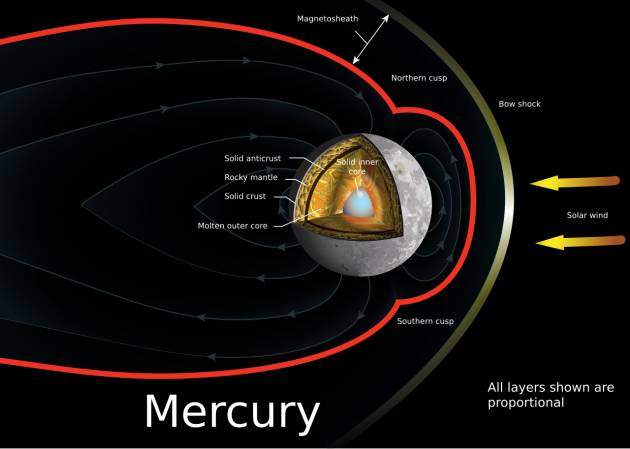
With no atmosphere it’s exposed to some of the worst that the Sun can throw at it, but it does have a magnetic field at 1.1% of Earth’s strength to take some of the edge off ionizing radiation. This just leaves a rover to deal with still very high ionizing radiation levels and extreme temperature swings that at the equator range between −173 °C and 427 °C, with an 88 Earth day day/night cycle. This compares to the constant mean temperature on Venus of 464 °C.

To deal with these extreme conditions, the researchers propose that a rover might be able to thrive if it sticks to the terminator, being the transition between day and night. To survive, the rover would need to be able to gather enough solar power – if solar-powered – due to the Sun being very low in the sky. It would also need to keep up with the terminator velocity being at least 4.25 km/h, as being caught on either the day or night side of Mercury would mean a certain demise. This would leave little time for casual exploration as on Mars, and require a high level of autonomy akin to what is being pioneered today with the Martian rovers.

Top image: the planet Mercury with its magnetic field. (Credit: A loose necktie, Wikimedia)

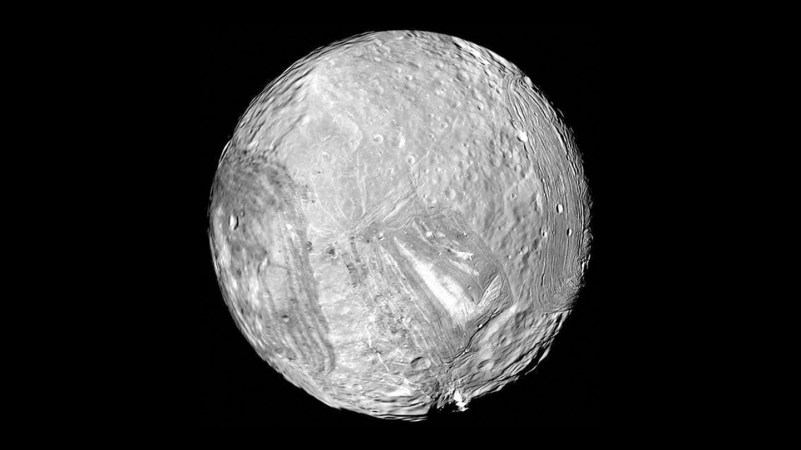
Miranda, as imaged by Voyager 2 on Jan. 24, 1986.

Miranda’s Unlikely Ocean Has Us Asking If There’s Life Clinging On Around Uranus

If you’re interested in extraterrestrial life, these past few years have given an embarrassment of places to look, even in our own solar system. Mars has been an obvious choice since before the Space Age; in the orbit of Jupiter, Europa’s oceans have been of interest since Voyager’s day; the geysers of Enceladus give Saturn two moons of interest, if you count the possibility of a methane-based chemistry on Titan. Even faraway Neptune’s giant moon Triton probably has an ocean layer deep inside. Now the planet Uranus is getting in on the act, offering its moon Miranda for consideration in a kinda-recent study in the Planetary Science Journal.

Continue reading “Miranda’s Unlikely Ocean Has Us Asking If There’s Life Clinging On Around Uranus” →