
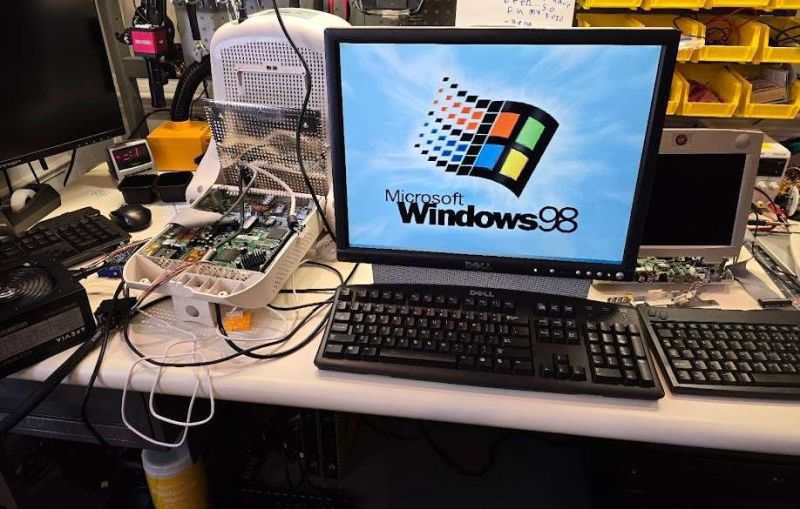
Devices that were limited to only run a web browser were relatively common around 2000, as many people wanted to surf the Information Super Highway, but didn’t quite want to get a regular PC — being in many ways the retro equivalent of a Chromebook. The Compaq iPAQ IA-2 from 2000 that [Dave Luna] got is no exception, with a Microsoft CE-based OS that is meant to be used with Microsoft Network (MSN) dial-up, which amusingly is still available today.
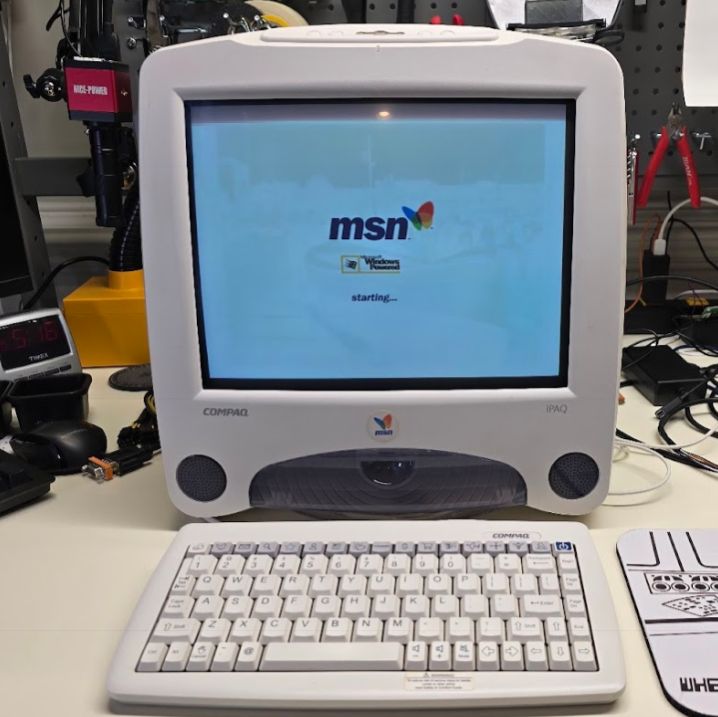
In order to get a more useful OS on it, like Windows 98, you have to jump through quite a few hoops, as [Dave] found out. Although there is an IDE connection on the mainboard, this cannot be booted from, likely due to BIOS limitations. This means that he had to chain boot via the 16 MB NAND Flash drive that the original OS booted from, which was done by writing MS-DOS to the Flash drive using another workaround as it’s not a standard IDE device either.
From this you can then boot Windows 98 from an IDE drive by pretending that it’s an ATAPI IDE device to dodge a limitation on IDE devices. The system’s hardware isn’t really going to make it into a blazing fast retro computer. It only has a 266 MHz Geode GX1 CPU and supports up to 256 MB of SDRAM. The IA-2 is also limited to 800×600, which required the use of an external monitor (as seen above) hooked up to the internal VGA port to set the proper resolution in the OS.
But at least it can run DOOM, so that bare minimum requirement can be ticked off.












Somewhere in the attic, I have a 3Com Audrey.
Sounds like a fun escapade and a little bit like trying to get GNU/Linux to boot from a USB stick on an old IGEL thin-client (socket 370, Intel P3 area, 15-20years ago).
The board did have a 44pin miniIDE connector on board but I didn’t have enough cables/adapters/HDDs I think and the BIOS couldn’t boot from USB at all (or only USB-floppy or something).
So the bootorder turned out sth. like this:
1. BIOS
2. (free?)DOS on an M-System 32MiB DOC (DiscOnChip) module (with dos drivers?).
3. grub4dos
4. kexecloader
5. kernel+initramfs on the USB drive (which made updating the Linux distro a little difficult when it changed related stuff).
I tried the PLOP boot manager as well.
And if I wanted to I could stay in DOS and surf the web with Arachne.
To be fair the original OS was a LINUX too I think but I didn’t even try to figure out how to do that (get information from IGEL).
Well, running Win98 for games like Doom is “retro cool” now. But back then, the fun was adapting Linux, and even earlier, NetBSD: the project’s motto is “Of course it runs NetBSD!” Trading one stinky MS OS for another gave no geek cred. The hacking scene used to be all about running a FOSS OS. But retro gamers seem to be more into reliving their childhood. Even youtuber LGR always chooses MS-DOS 6.22 over FreeDOS(Arrgh!). But How about ReactOS or Haiku or Minix3 or KolibriOS? Android x86??? I understand why the younger set doesn’t fee it makes a big difference. The old Windows is basically abandonware. Free as in beer. maybe I’m just getting old.
What’s the point of FreeDOS if you just want to run old software and as close as possible to “how it used to be back in the day”? You could go for DR-DOS for a change, FreeDOS will just lower compatibility (SHSUCDX is great but not compatible with some games) for unclear advantages (USB and FAT32 support on a 486?). Same for ReactOS, you might as well run 9x, NT4 or 2000.
Old Unices are fun, I use them myself, but rather than the free/open stuff which I was running also back then I prefer to try the commercial stuff (SCO’s offering is a favorite) or very niche things, that I had no way to obtain 30 years ago.
Um, it’s same as with Linux, I think. 🤷♂️
FreeDOS at its heart is a kernal (and the FreeCom CLI).
While FreeDOS as a complete distribution comes with the current developments in the DOS scene.
Drivers, utilities, games and so on.
In the DOS community, there are many users which use FreeDOS files on MS-DOS 6.22 or 7.1 (Windows 98 DOS).
Or interchange DOS files of various DOSes in general.
FreeDOS also supports LBA (LBA aware) and FAT32, which the old MS-DOS 5/6.x doesn’t.
It’s like MS-DOS 7.1 in many ways here.
Please, not another ReactOS criticism. 😢
It’s free and no one’s forced to use it, so please everyone don’t talk it down every time.
Just because it’s officially still in “Alpha” stage doesn’t mean it’s broken.
I already ran it 15 years ago and to me it wasn’t worse than WINE.
Personally, I think it’s good that ReactOS exists and that it might be an possible update to aging NT4 systems.
It can do USB and other modern things that are beyond the capabilities of NT4, yet ReactOS can use NT4 device drivers.
Last but not least, it doesn’t send telemetry to MS and needs no activation.
It might be much safer to use on modern internet, all in all.
+1
To be clear: I have no problem with ReactOS conceptually and I’m happy it exists, I just think it does not make much retrocomputing sense.
But you do you, I was just reacting to someone who decided that running 9x on an internet appliace is not cool enough because it’s not ReactOS or minix. Relax man, it’s all cool, and it’s a Geode CPU, you don’t actually want to use it anyway.
“I don’t like thing, so other people shouldn’t like thing, either!”
Not just “now”.
Windows 98SE, when new, had always been liked for its low requirements and good software compatibility.
Both Windows 98SE and Linux used to be the favorite OS for roadside PCs.
Because they both had great support for dumpster hardware.
Except that Windows 98 could do USB properly and needed no manual mounting of drives (I still remember auto-mounters being newfangled and a sacrileg).
To the cellar children, I suppose.
I never found it exciting to get Linux running, because everyone knew a toaster could run it.
The lack of binary compatibility made it worthless in my eyes.
What’s the point of running something that’s without its own personality, that’s so bland and interchangeable?
To me, Linux seemed like a tool. A rusty wrench. Something to get rid of after work was done.
Because everything was a moving target, it made no sense to invest into it (source code and dependencies on very specific versions of very specific libraries).
If you bought a book for a Linux distro it was instantly obsolete the next version came out.
Linux devs at the time didn’t care about consistency, at all.
So every serious thought on Linux was wasted, basically, because things constantly changed anyway.
Looking online was no real alternative, either, because help documents that fixed a printer problem on, say, Kaputtus 1.2.5 nolonger applied to Kaputtus 1.2.7b.
In short, Linux at the time was the OS for the masochist. IMHO.
That would make a cute X-terminal. Use your Desktop PC remotely at your garage workbench or something like that.
Might be cool for an NES emulator. Being a CRT maybe the gun will work. Maybe… I don’t really know… The monitor probably has a different refresh rate than an old TV, does that matter?
That Virgin Webplayer tho!