
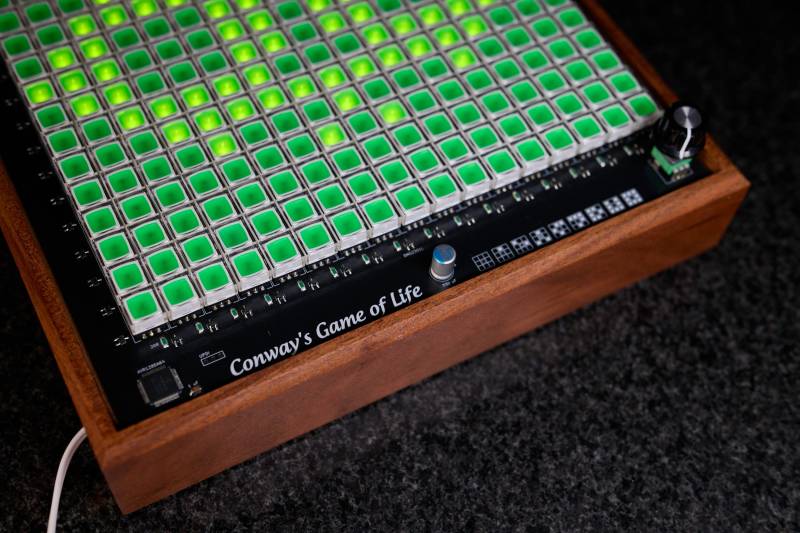
Conway’s Game of Life excels in its simplicity, creating a cellular automaton on a 2D grid where each cell obeys a set of very simple rules that determine whether a cell is ‘alive’ or ‘dead’. After setting an initial condition the ‘game’ then evolves naturally from there, creating an endless series of patterns as a simplified form of bacterial evolution. Of course, setting an initial state and then watching cells light up or fade away seems like a natural fit for light-up buttons. After struggling with intrusive thoughts related to such a project for a while, [Michal Zalewski] finally gave in, creating a pretty amazing looking result.
Although there is no set size for the game board, [Michal] was constrained by his budget for the selected NKK JB15LPF-JF tactile buttons, resulting in a 17×17 matrix. That’s 289 buttons, for those keeping score, which comes down to over $1,000 over at e.g. Digikey even with quantity-based pricing. Add to this the custom PCB and a Microchip AVR128DA64 squeezed in a corner of said PCB to run the whole show and it’s quite the investment.
Finishing up the PCB, driving the lights is done with a duty cycle as the matrix is scanned along with detecting inputs in a similar manner. This required the addition of MOSFETs and transistors, the details of which can be found in the downloadable project files, along with the firmware source code. In the article a video of the board in action can be watched, allowing one to admire the very pretty wooden enclosure as well.












Looks nice. I would have considered doing it more affordably with a PCB capacitive sense switch matrix and SMD LEDs.
I think the physical buttons not only work better with the concept they are just darn cool.
One button for Frank Langella of course…one of Charles Dance, Richard Basehart, Michael Ansara…
Tiny Tim is the mine…
wait…what?
Even then there are cheaper options than this.
If you google Simone Giertz – THE EVERY DAY GOAL CALENDAR
You’ll see an example of a habit tracker made with capacitive sense matrix.
It may be interesting to you !
I’m curious why they didn’t go for cherry mx clone switches for massive cost savings and having simple 0805 or whatever individual LEDs
Very cool project, I’ve wanted to make something similar but needless to say, it just doesn’t have much practical use. And I’m getting more “everything i design or make must have a practical use, or it’s garbage” as i grow older
Author here. The article talks about it toward the end, but in essence, there’s a cost / time trade-off, and the project was time-consuming even without iterating through various keycap designs and then manufacturing ~300 of them.
As for the utility… we’re on Hack-a-Day, right?
Beautiful build!
I find the AVR-Dx family of microcontrollers underrated. They are probably the easiest microcontroller one can use nowadays as they require no external components and can be programmed from a CH340 with a diode and a resistor. While being comfortably familiar for anyone who grew up with the ATMega found on the Arduino.
So to see one of them getting used for an elaborate, awesome looking version of Game of Life gets a thumbs-up from me! Also the debouncing and the pausing before resuming simulation on input goes impressively smooth!
I wonder how hard it would be to have the logic deciding if a cell is alive or dead in each cell and do without a separate microcontroller? (They would still need a common clock ofcource.)
NIce.
I first discovered Life as a teen in Martin Gardner’s Mathematical Games column in Scientific American. It seems to pop up in the most unexpected places. Screensavers are popular, but I’ve seen it on displays out in the Real World (though I can’t remember where).
I, too, was an avid reader of “Mathematical Games” as a teen. Remember palindromic numbers? I burned a load of IBM 360 time searching for the palindrome of 196. They still haven’t found it and have gone a lot further than a 360 ever could.
Cherry key switches with leds would have been so much cheaper… but I do think the final design looks better.