
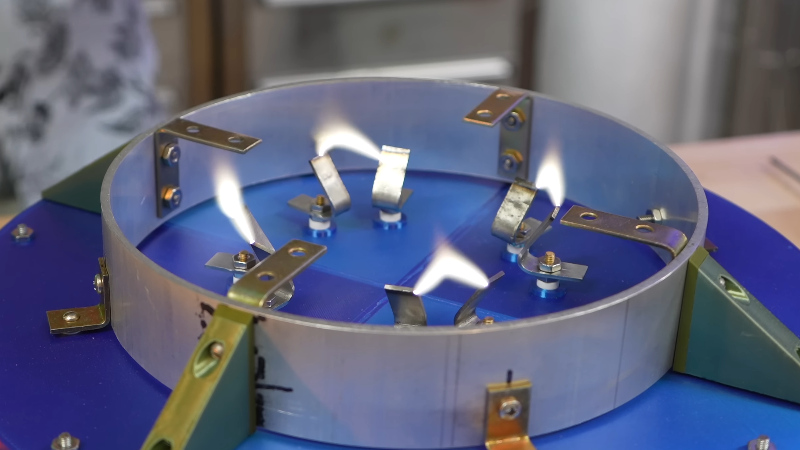
Cooking food with fire is arguably the technology that propelled humans to become the dominant species on Earth. It’s pretty straightforward to achieve, just requiring a fuel source, a supply of oxygen from the air, and a way to initiate the reaction; then it self-sustains. You wouldn’t think there’s much to improve, but what about cooking with plasma? [Jay] from the plasma channel is no stranger here, and he thinks that there may be something in this idea, certainly enough to actually build something.
Now, let’s be straight with you, this isn’t a new concept, and you can buy a plasma-based cooking appliance right now. But they are all AC-powered devices. What if you want to go camping? [Jay] attempts (and succeeds) in building a portable, rechargeable 600W plasma cooking device that can actually cook food, but it was not all plain sailing.
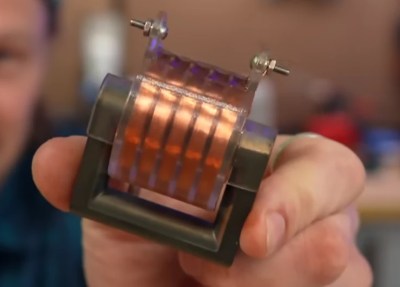
The existing off-the-shelf ZVS driver modules available were a bit weak and unreliable, and the required flyback coils were hard to find with the right specs, so he needed to get down to work building custom parts. First off, the coils. Custom formers were resin-printed and machine-wound with 4000 turns of fine wire, and then resin-sealed into the former. [Jay] takes care to explain that it is crucial to get all the air out of the windings, or else local flashover breakdown will occur and wreck the coil in a short time. We reckon the resulting coils look amazing in their own right!
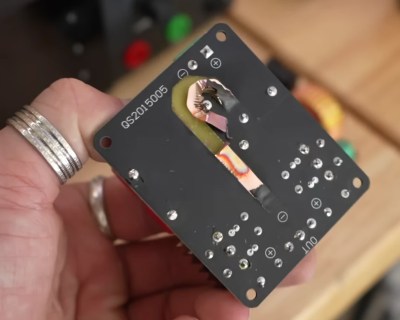
Next, the ZVS drivers on hand had low-quality capacitors (well, not enough capacitance anyway) and cheap driver transistors, so both were upgraded. The initial plan was to have four driver/coil pairs, each driving a single pair of electrodes, with a common ground ring connecting them all. It turns out this was a terrible idea: the drivers were not synchronised, so they were pulling on each other, causing catastrophic damage to the PCBs in a very short time. The solution was more complicated wiring, to give each coil secondary output a dedicated electrode pair, so there was no direct electrical connection between neighbouring coils and no coupling between them. A clever electrode arrangement meant that a pan would sit on top of a ring of electrodes, causing plasma discharges to jump directly to the pan, thereby concentrating localised heating there. We were wondering how this new direct connection (the pan is now a common connection!) didn’t also cause backfeeding and kill the ZVS drivers again, but it didn’t seem to happen.
Anyway, [Jay] demonstrates what is possibly the world’s first rechargeable, portable plasma cooker capable of making breakfast. Which we think is very important in its own right, however, we would like a plasma-based solution to making toast next, perhaps a plasma knife that cooks the bread as you slice it?
If this plasma cooking lark rings a bell, yes, we did touch upon this way back in 2017. And whilst not strictly plasma cooking, you can make an amazing microwave plasma in this ridiculously upgraded appliance. Definitely do not try that one at home.












Probably not as efficient as inductive cooking, but definitely cooler.
For the same input power, by definition.
For much less effort you can make fire much cooler.
Starts in the reloading isle at the gun store.
Fire is just intrinsically cool.
Recall the ‘pyromania’ and ‘explosive pyromania’ phases of your own psycho-social development.
Regarding the blown MOSFETs, I’m wondering if he could have kept his original scheme by injecting a small signal from one of the oscillators into the other three – or by having a master oscillator feeding all four oscillators.
I’ve injection-locked RF oscillators this way, and I’m thinking it might work for the plasma generators as well. There would be a slight loss of efficiency, because each generator is being forced to run at not-quite its resonant frequency; but with careful winding and close-tolerance components it might work.
I would love to actually cook with one of these, but the whine of that fan would put me over the edge. Also, I’m wondering about ozone generation…
Never mind – on further reflection I think I answered my own question. The highly variable plasma paths will change the natural – and most efficient – resonant frequency, probably by quite a bit. Forcing a generator to work so far away from resonance could cause problems, anywhere from large efficiency loss to magic smoke emission.
Isnt fire a form of plasma?
Depends on what you mean by “fire”. Is it the burning or the flame?
Cool idea and execution.
But the efficiency claim seems hard to believe – some heat will go around his pan (like with gas) and some heat will be carried away by his fan. I’d like to see some numbers before believing this
Plasma torches for pellet induration are a thing, might be worthwhile copying the design.
Mmmmm, portable bacon cooker !!! sounds good …… I wonder how much RF it generates ??
Could you modulate the signal so it can broadcast smooth music ??
Pretty much all the power not being turned to heat is being blasted off a RF, probably a bit illegal.
For a more practical portable bacon cooking solution, a pair of cordless hair straighteners would likely be your best option.
When he mentioned not wanting air near the high-voltage turns in the flyback transofrmer and thus adding resin, I expected putting it in a vacuum to remove bubbles.
Nah. Only a professional would do that.