
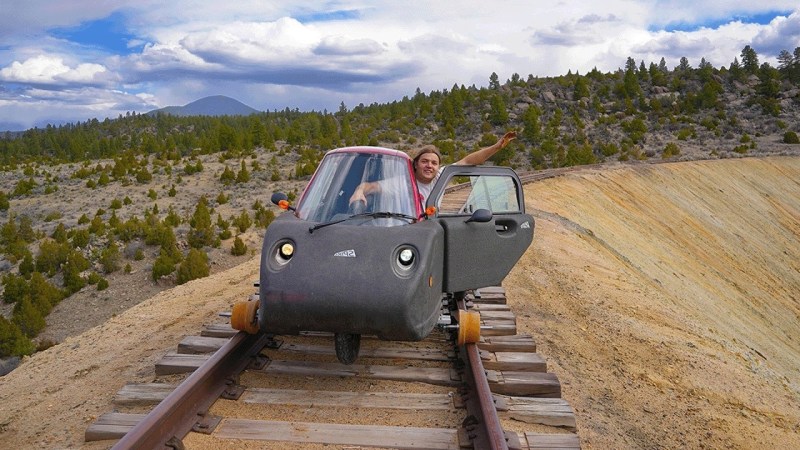
We wouldn’t be surprised if you’d never seen the Spira before. The lightweight three-wheel vehicle is closer to a go-kart than a traditional car, and that’s before you even get to the foam body panels. But even the most niche of products enjoys a certain fandom, and [Matt Spears] certainly seems to love working on his Spira. His latest video documents the new modifications he’s made to the car in an effort to ride it on abandoned railroad tracks in the western United States.
His first attempt at riding the rails worked pretty well but he hit an obstruction at high speed which destroyed his front axle and damaged a few other parts on the vehicle, which gave him a perfect excuse to make some upgrades. He swapped the old rear axle out with one from a go-kart, complete with custom wheels and a new braking system. The drivetrain received an upgrade with a 5 kW electric motor, and although [Matt] planned on casting new wheels for the higher speeds, the chemicals he needed didn’t arrive in time. So, to test the new vehicle he repurposed some old wheels just to get the Spria back out on the tracks.
The test run went so well that [Matt] ended up pushing the vehicle farther than he had ever been on this abandoned rail, including over a questionable trestle and far out into the wilderness. Hopefully we’ll see more videos of [Matt] taking this car to explore even more remote places. In the meantime, take a look at some simpler, non-electric vehicles that are often used to explore abandoned rail lines in California.












I am surprised the rails survived. Here in Britain when railways were closed the tracks were always torn up for scrap. Old railway tracks frequently become walks or cycle paths instead.
I’m not sure if these tracks have truly been abandoned, in the sense of being “permanently closed down,” because there isn’t enough rust visible in the relevant areas. It could be due to the climate, though.
They could be “mothballed”, but judging from the wooden bridge I’m betting they’re actually really old and preserved simply because of the dry climate. Such structures tend to rot really fast unless the whole place is arid.
Creosote soaked wood lasts a long time
Near me there are old timber trestle bridges still in use (pnw oregon)
Yeah, the bugs and mold won’t eat it, but sunlight degrades exposed wood and frequent rains turn it into mush. In coastal regions I read it may be 5-7 years without maintenance, at worst, in drier regions 20-50 years.
@Dude Creosote Soaked Bridge/Marine Timbers have an estimated lifespan of 40 to 75 years DESPITE sun and water exposure. Heavy-duty timbers used in bridges and trestles often exceed 50 years due to deep, pressure-treated creosote applications,
Then I stand corrected.
Sometimes they remove the rails even while the track is still in use. Usually they steal from service depots, but there have been cases where criminals took to less used railway sections and simply cut and lifted the rails off in 2 meter sections.
The dumber ones try to steal copper from electric substations, digging up and cutting the grounding electrodes while the transformers are operating.
“while the transformers are operating” upon reading that part I could not resist instantly thinking: “Transformers!!! More than meets the eye.”
More like “more than meats that fry!” if they are attempting to steal copper from a live transformer.
Remember America is really big, and quite empty – lots of old/underused railway that would have had the Dr Beeching treatment and then get converted to something else in the UK are so far away from anything else that just leaving them to rot is more cost effective than recovering materials and land for other uses – a footpath in the middle of nowhere isn’t worth building..
The cost of transporting the old rail 500 miles to the recycler does make salvage less attractive.
Dunno. If the track is still operable, you could start peeling it up from the end and simply cart it down the tracks. Of course it costs something to get the rail cars in there, but at the end of the job you just scrap those as well.
Depends which state you are in. Local bylaws may be different and some places they simply let them stay where they are.
Indeed, it would be wise to check beforehand. Where I am there’s a $10k fine for riding vehicles on abandoned/disused rail lines. I know people who did so, and were thus made aware.
When a rail line becomes economically unviable, the owner (or the remnants left after the bankruptcy) may choose to leave the rails in place for decades because it preserves their land rights in some manner. If the rails are removed then it becomes more likely that the land will be reclaimed by local governments (emanant domain). And if some future buyer wanted to use the route for a road or rail, the permitting process is likely much easier if there is still rotting rail in place.
My grandmother has a piece of land with a 2-story house that collapsed probably 50+ years ago. She was advised not to clear the rubble, because the permitting process for rebuilding is much easier than for new construction. So the rubble pile actually adds value for a future buyer.
They may also have a duty to maintain the line in a condition where it could be restored to use, or “mothballed”, for national defense etc. purposes.
I vibration weld the tanks for that chainsaw.
At stihl?
To all the people across the pond, Yes the U.S.A. has lots of abandoned rail tracks. Some of the time in residential areas they pull the tracks and put down limestone to make walkways for bicyclists and pedestrians. Alot of the tracks are in desert or temperate climates and exist for a very long time. The theft of rail tracks is very low because of scrap value being right now at USD$ 260/NT. NT is net ton U.S. = 2000 LBS. In the U.S. mainline track is 43 LBS per foot. 1 LB = .4535 KG for conversion purposes.
For the other thing, railroad tracks are usually made of specific alloys that are easily identified for where they came from, so track thieves usually get caught on trying to sell the scrap.
It may not be the case in the US, but in the UK and in the EU the recycling yard that accepts the metal has to be licensed and they will want your photo ID in case there’s any trouble, and they won’t pay you in cash to keep everything documented. That means they won’t even buy it from you unless you can show some proof that you got it legally – like a demolition contract or a note from the city that you were allowed to pick it up. Sometimes people will try to forge the documents or claim that it was from abandoned property with no claims, but if you show up with ten miles of old rail, that won’t fly very easily.
In many of the states in the Eastern US, once the rails are removed, the right of way automatically reverts to the original land owner. For that reason you’ll see places where a road is paved right over the old tracks. Then, if that rail segment is to be reused, right of way negotiations are not needed. (I’ve seen this is cases where the rails have not been used for over 50 years!)