

Humanity first reached the moon in 1969. We went back a few times, then lost interest within three short years, and we haven’t been back since. NASA has just flew a quartet of astronauts around the moon last week, and hopes to touch lunar soil by 2028. But the American space program is no longer the only game in town.
China has emerged as another major player in the second race for the Moon. Having mastered human spaceflight 23 years ago, the country’s space program has been moving from strength to strength. A moon landing is on the cards, with the country hoping to plant its boots, and presumably flag, in 2030.
Red Moon
Over the past two decades, China’s space program has racked up a number of impressive feats. It sent rovers to the far side of the moon, landed a rover on Mars, and constructed a liveable space station in Earth orbit. The next obvious crowning achievement would be to land on the Moon, a feat humanity hasn’t accomplished in over 50 years despite endless advances in our technology since.
The China National Space Administration (CNSA) stated late last year that it was on track to land astronauts on the Moon by 2030. It’s an ambitious timeline, just four years away.
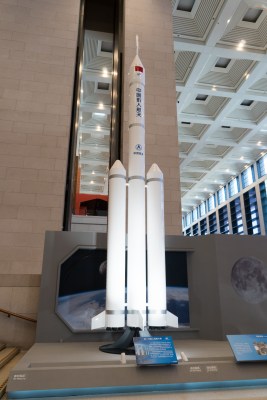
Core to the Chinese effort is the Long March 10 rocket. Developed from the workhorse Long March 5, the super-heavy-lift launch vehicle is to be capable of delivering 70 tonnes of payload into lower Earth orbit, or 27 tonnes on a trans-lunar injection (TLI) trajectory. These figures are comparable to NASA’s Space Launch System (95 tonnes LEO, 27 tonnes TLI), though somewhat in the shadow of the mighty Saturn V that launched the Apollo astronauts to the Moon (140 tonnes LEO, 43.5 tonnes TLI).
In standard configuration, the Long March 10 features two boosters, along with first, second, and third stage rockets. Each booster, along with the first stage, features 7 YF-100K rocket engines burning RP-1 and liquid oxygen, for a total of 21 engines firing together at liftoff. The second stage features just two YF-100M engines, again burning RP-1 and liquid oxygen, while the third stage has three YF-75E engines burning liquid hydrogen and liquid oxygen.
A test launch of the first stage of the Long March 10 rocket, sans boosters.
Thus far, the Long March 10 has not yet been fully launch tested. A test launch took place in February to verify the performance of the first stage, with the rocket successfully splashing down in the South China Sea after reaching an altitude of 105 km above the Earth’s surface. The first full orbital flight of the Long March 10 is scheduled for later this year.


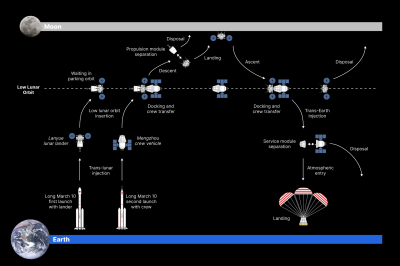
Of course, the rocket is just one part of the lunar mission. The Mengzhou spacecraft is the analog of the Apollo Command and Service Module (CSM), responsible for putting the crew in orbit around the Moon, with a crew of up to six or seven depending on configuration. It’s designed to then deploy the Lanyue lander, which will actually carry astronauts to the Moon itself.
It will also potentially carry a lunar rover to give Chinese taikonauts the ability to explore a broader area of the Moon. Notably, Lanyue and Mengzhou are designed to be delivered by separate Long March 10 launches. They are intended to rendezvous in a low lunar orbit, with crew transferred from Mengzhou to Lanyue for lunar landing, and then transferred back to Mengzhou for the journey back to Earth. Landing will be akin to the Apollo program, with the crew section of Mengzhou descending under parachutes to an ocean splashdown.
The Same Stuff
The Chinese mission does not differ so severely from any other plan to get to the moon. This is not particularly surprising. The basic physics of the problem has not changed in 50 years, it’s just a matter of building the vehicles to actually do the job and get there. Which is not the same as saying that it’s easy: there is still plenty of work to be done to get the Long March 10, Lanyue, and Mengzhou all ready for the big trip up, and whether or not that can be completed in the next four years remains to be seen.
The timeline might be optimistic, but in some ways, it still sounds more realistic than NASA’s previous 2028 target. Time will tell whether the flag that next waves on the Moon is red and yellow, or red white and blue. Or, perhaps even green, lest one of the countries randomly change their flag in the intervening years. Anything could happen.












I kept telling folk from the US (im a leaf) that India and China are really pushing hard into space and they kept laughing, joking and acting like it was totally impossible.
Then they were “surprised” the US did their little trip around the moon and asked out loud why and I informed them a second time that China and India are both extremely interested in branching out into space.
sigh
as a Canadian I really wish US folk wouldn’t brush off everything other countries set out to do as an impossibility. i often feel like i’m screaming at a brick wall.
Opposition to the US is completely fair at this point in time. However the biggest argument I have for you to ponder, NASA data is public domain. Chinese and Russian space agencies feign no idealism about openness, and so disappointingly for astronomy enthusiasts we learn so little from their missions. And to agree with you, Russias images of Venus surface still have me dumbfounded and awestruck. It is a literal image of a hellscape.
Does not matter since what he said is also not true at all.
Just because you have trouble finding things does not mean the Chinese are not open and sharing science.
China does publish its data. It’s just that a lot of it is published in Chinese, which you can’t read, so it doesn’t seem that way.
No, it isn’t. What space mission do you think has flown that China hasn’t published data in English on a reasonable timeframe? This stuff is prestige for a country. Hiding things doesn’t help your prestige.
I will say in general the technical details are less available. NASA missions also have much stricter requirements on openness, although I’m not sure it makes much difference in practice: I don’t think any of the experiments I’ve been on have received requests/etc. for data.
its not opposition, hes just reminding his American friends there are other places on earth. America landed on the moon back in the 60s and 70s, allot of other countries had texh better than the 1970s now, so its confusing people dont think if they wanted to and had the money they might do it too.
I also knownthe secret of the maple tree
I say this as my spell check has a sezure
Not so much country-related. People usually try to convince themselves ( and others ) that things are “very hard to do”, “nobody can do that”, “it´s so complex that nobody can understand all of that anymore” , etc.
Then, as you saw, they act surprised when someone just went and did that “impossible” thing.
Not a new thing also : Columbus probably heard that his trip was impossible and he would fall of the border of the world. And just look at the couple of flat-earthers hiding in your city.
Some Old Saying ( TM) that appears in many cultures/languages : “When there is will, there is a way”.
Um thanks for the arm. You are welcome for your space program…
India I am all for. China’s stuff will fare as well as whomever they stole the plans from lol.
The ISRO launches are cheap, but it’s not 1/100th, and it’s difficult to directly compare because the mission goals aren’t equal and when it’s all governmental organizations it’s tough to say what actual costs are. I mean, ISRO’s budget is $1.6B USD/yr and NASA’s is $24.4B USD/yr, so you’re only talking a factor of ~15 in total budget, period. Again, it’s not like it isn’t impressive and cheap, but a factor of 100 is very overstated.
Yep, I am making it into a cheap sensation. Guilty as charged : – ] Comparing apples and oranges is not my fruit pie I am afraid.
NASA should have learned from ISRO the same way ISRO already learned from NASA, that WAS the point. International cooperation.
JAXA, too, is accomplishing things on similarly smaller budget regularly trimmed by all kinds of financial issues. That JAXA is never in the US news is unrelated, some things don’t need huge headlines to exist in reality.
On the topic of “other things” ESA had long figured out that it is not worthy being a sole monopoly and built a Soyuz launchpad in French Guiana. Because that’s how it works, cooperation. Again, not in the US news, so be it that way.
(US taxpayer who regularly witnesses regular/planned squandering of my taxes on largely meaningless and pointless s**t of mostly no merit).
You do realize ISRO and NASA are cooperating, right?
Like, it’s literally the reason for the first letter in the NISAR satellite.
Do people just not realize how much NASA does? Like, the original Explorers program were a ton of what NASA did. Then when the.budget went down, they switched to SMEX and MIDEX. Plus you had flagship programs.
Those guys are absurdly huge in funding size now. Instead you’ve got Pioneers class missions at $20Mish (50M? Ha! That’s a massive budget), and they’re just starting up more programs slightly above that.
NASA does so much small stuff that it’s crazy. And a lot of the major programs aren’t even what they choose to do – it’s forced on them by Congress for separate reasons, and instead of saying “hey, we really need a government driven rocket design program, period” everyone ends up being “why is NASA wasting all this money?”
I literally just put in a proposal for a $20M satellite mission. The fact that I can say that and not laugh is just crazy. NASA isn’t the one wasting money.
I seem to recall that the first trip to the moon was because of having been caught by surprise of another nation’s unexpected forays into space.
You know what? You’re talking to a very limited subset of 340+ million people. The rest of the US followed that little trip around the moon with a Canadian on board and were enthusiastic to watch it.
Don’t mistake whatever press you’re seeing with the enthusiastic approach a lot of us have for the second phase of space exploration. It’s not a matter of us brushing off other countries’ attempts and accomplishments. We even enjoy collaboration, see the Europe designed living capsule on Artemis II.
Your view is skewed by the small number of Americans you know, or the press you see, or a combination of both.
I personally am excited about what’s to come… but anyone with any sense can see that further exploration will require a reevaluation of how we get there. It’s financially irresponsible to use the SLS to deliver such payloads at $2.4 Billion per launch on such bespoke designs of recycling old shuttle engines when both blue origin and spacex are close to having better and cheaper replacements. But that gets into politics and supporting the older obsolete systems of the past that didn’t recycle anything and had unlimited budgets. We’re all for other countries getting into the space exploration game, but few nations have the budgets to waste such expenditures when domestic needs are such a concern. We waste more money to fraud than most nations’ full budgets.
I would recommend talking to more people, and maybe broadening your news sources. We’re aware of other nations’ plans and seeking willing participants. We even had a pretty good relationship with Russia before it decided to invade Ukraine. But India hasn’t sought to join us, and China is a closed authoritarian society seeking no collaboration whatsoever. We certainly weren’t moving back into space until China successfully landed rovers on the moon. And now we’re actually motivated to go back. I think that’s a step in the right direction. Only a few nations have landed on the moon, and even fewer have probes that survived long enough to respond. I hope we move away from SLS, especially with our own rovers planned on/or around Artemis III.
How many Americans know that half of the artemis spaceship is actually European? All the service module is made by airbus aerospace.
Nothing went wrong with the ESA-supplied part, so it didn’t make the news.
If you look at US media, the most European thing on that cruise was a jar of Nutella. And most USAians wouldn’t even recognize it as European. (Though that particular jar probably came from Mexico, or maybe Canada. There is no Nutella factory in the USA.)
Helium leak. Not a trivial problem, and will require some modifications. Other than that, sounds like it did great.
It’s not trivial but it’s also not like, serious. Realistically if they wouldn’t have found a helium leak someone probably would’ve questioned the sensors.
Once again proving that Europeans can’t do anything big without the USA leading the way!
Those who can’t ride the coattails of those who can.
Nuf said…
You have a point here, actually.
ESA is more into robotic missions (space probes)..
Things like Rosetta/Philae, Giotto, Solar Orbiter, Juice, BepiColombo, Huygens, Gaia and so on.
In principle, NASA feels similar, I once read a few years ago.
It nolonger wants to construct things (shuttles, moon landers etc) but focus on to lead interesting missions.
About Europeans being unable to do something without “big brother”..
Yes and no, I’d say. To my understanding, ESA and other NASA partners do always take a step back on purpose, despite being capable.
But you’re right that we Europeans often in the role of the supporter, of the side kick.
I don’t exactly why. Maybe it’s that way to not steal NASA the show or something.
Might be because of contractual or political reasons here. It’s beyond my understanding, I’m afraid.
Canada (CSA) and Japan (JAXA) rarely do things all alone either, as well, or so it seems.
Then there’s the financial aspect, as well. Europe (EU) is a group of small independent countries that love to argue with each other.
They’re in a love and hate situation all the time, basically.
We Europeans have our national space agencies, too, which operate within ESA.
The budget for individual projects is smaller, thus.
In France, it’s CNES, the National Centre for Space Studies, for example.
Here in Germany, it’s the DLR. The German Centre for Aironautics and Spacetravel, basically.
Then certain components are made throughout Europe, too.
What comes to my mind, the optics for the star finder part of Artemis II was made by Jena-Optronik GmbH in former East Germany (in Jena), for example.
Jena is sometimes called the city of lights (“Lichtstadt”, light city) because of its focus on anything light and optics related.
As far as rocket launches goes, the French are the ones who have space ports over here.
The one that’s well known is in French Guiana, not far away from Kourou.
https://en.wikipedia.org/wiki/Guiana_Space_Centre
https://en.wikipedia.org/wiki/List_of_government_space_agencies#Overview
https://en.wikipedia.org/wiki/German_Aerospace_Center
“Yes and no, I’d say. To my understanding, ESA and other NASA partners do always take a step back on purpose, despite being capable.”
“Despite being capable?” ESA has no human launch capability. All of ESA’s astronauts have launched on either US or Russian flights. They’re looking into baby steps now, but it’s still just baby steps.
The scale difference between the US space programs and other countries is very big. What those countries still do is impressive! But NASA isn’t front and center of these missions because of ego. They’re front and center because they’ve got by far the most expertise and are covering by far most of the cost.
Well, The EU is getting more and more incentivised to do things without the US. And it’s about time. “The orange one” has expedited these efforts more than a bit.
Looking at space travel, the ESA has been around for about 50 years.
Canadarm’s spiritual successor(s), next step is for the EU to make an actual space program :p
The more moon missions, the better. There’s enough space for the all of us.
Hopefully, a couple of moon bases will emerge over time, thus.
If they become interconnected by tubes, eventually, we might see a luna city one day.
I hope not.
Who want to look at the moon and think it’s full of shitty humans?
And why?
A series of tubes? Just like the internet!
ISS on the moon. But this time with China too? I’m down.
if only NASA had an international plan for an orbiting outpost on the Moon that already had components built and would have enabled serious international cooperation and deep space exploration
oh wait
I really don’t think people realize how much losing Gateway hurts, and primarily because SpaceX lied to get funding for Starship. Sigh.
The international idea is interesting, actually. Thanks.
What if NASA would publish a plan for an international moon base, along with an open invitation to participate?
If all space faring nations would contribute, then the logistics and financial side would become less of an issue.
It also would Russia, India and China give a new mission goal.
These nations would then have something to spend resources on and would win sympathy of their citizens.
The war and steel industry could then produce space parts instead of weapons. It would keep their industry busy, in short.
NASA has had an open system to participate in Artemis for years. Everything they do is open to anyone willing to sign the Artemis Accords.
Guess which two countries haven’t signed on.
Hm. I don’t know, is that same thing as a heartfelt invitation?
So far, USA lead projects don’t seem to feel truely international anymore.
“Partners” are more treated or seen like some utility, like little minions/henchmen, or so it seems.
By international I mean that the USA do put their flag and ego on backseat and rather not to try to play main character.
Like make it a project on scale of the united nations in terms of seriousness and being thought through (in rememberance of 1967 space treatry).
For sake of world peace, for the greater good of humanity, for everyone’s benefit here on earth.
Doing so would be mature and superior on an ethically and morally level, maybe.
To just to do it because it makes sense and is pragmatic.
Without bells and whistles and sugarcoating.
It’s not like everyone would forget who initated the project whatsoever.
The USA/NASA would still hold credit for the visionary project.
The prestige would be even higher if it was received naturally and wasn’t being selfimposed.
What I’m referring to is this:
An international moon base is more than just some metal container on a dead rock.
It’s symbolic value is that of a (small) colony founded and operated by multiple nations, in peacful co-operation.
It holds so much potential! It’s a metaphor for co-existance and mutual respect!
It’s like populating an previously undiscovered island in perfect harmony and creating something phantastic out of it.
You’re saying that the space agency that literally has the most inter-agency missions – by like, many, many, many times – operates the most capable deep-space communications system and freely shares time on it with a no-cost basis needs to cooperate better??
I’m sorry, none of your arguments make sense here. Are you saying the ISS isn’t international cooperation because NASA always seems to be front and center with it? That’s because NASA is spending the money for the logistics to run and support it! It’s not “Trump Station One.” It’s not even “NASA Freedom.” It’s just the ISS. The US contributed nearly two thirds of the funding for the Space Station over time.
You want another example of “there is no ego here”? NASA and ISRO just launched a next-generation radar imaging satellite (NISAR). It’s literally called “the NASA-ISRO Synthetic Aperture Radar” satellite. Front and center, both agencies listed equally. You want to know what the cost split was on that satellite? About 93% NASA, 7% ISRO.
Oh, and the super-cheap ISRO Mars mission? Huge boost for India, they became one of the few countries to successfully send a mission to Mars! And so much cheaper than NASA, right? Of course JPL helped test and design comms and the DSN provided a lot of the tracking as well. But it’s not the NASA-ISRO Mars mission.
Every NASA mission I’ve ever been on has been multinational. Every one. Cost shares from other countries are great! But in terms of money spent on space programs, the US spends four times as much as the next nearest country.
I think they do, from a certain angle.
I’m not thinking in your kind of ways, you know.
I don’t think in terms of money, at all, for example.
On paper, yes. It has to be, I guess, due to certain components already being manufacturered in other countries.
So it’s more feasible to co-operate than inventing the wheel twice.
What I’m imagining for a future international moon base is a more, um, “under international law” kind of approach.
Not sure how to word that properly right now.
A plan or contract being signed and supervised by an international commitee, maybe?
Something more.. official, less commercial, less national.
With NASA in the role of a public federal agency rather than a profits oriented corporation.
In principle, doing it as if it was the 1960s/1970s, still.
Not just contractual, but also from a diplomatic point of view. Geopolitics.
Maybe the plan for an international moon base could be proposed on an international event?
Some sort of international conference or a forum, where scientist, researchers, philosopers and other types of individuals can meet.
In essence, something to participate, to give feedback.
To openly discuss the idea of the moon base.
That’s different to “hey guys, we make a great moon base (the way we want it). You can either join or stay away.”
I think the ISS is mainly an USA/Russia operated project, the rest are just seen as expendable supporters.
Otherwise, the decision to exclude China from participating could not have been single-handed made by the USA.
In a truely international fashion, all parties involved would have been give a voice for a votum instead.
In parts, I think, the reason ISS came to be was because MIR was EOL at the time and because already produced parts of MIR-2 could be re-used.
And because of keeping highly skilled Russian engineers from emigrating and working in, um, “bad” countries. My apologies for my poor wording.
In very simple words, ISS was the result of MIR-2 and Freedom Station being thrown into a blender.
The radio call signs did reflect this. US personell was still using “Alpha” for a while.
That was the project name that Freedom Station got later on.
https://en.wikipedia.org/wiki/Spacecraft_call_signs#International_Space_Station
https://en.wikipedia.org/wiki/Space_Station_Freedom
As the Wikipedia article hints, Freedom Station was planned as some sort of joint venture between “NASA (United States), NASDA (Japan), ESA (Europe), and CSA (Canada)”.
The way it reads, that station might have been planned to be created in a truely international fashion from the start, maybe.
The current ISS was not, originally, though.
The two powers that control and administrate the ISS are NASA and Roskosmos.
The Russian segment has total control over the engines, for examples.
ESA, CSA etc have little say in anything and do sit between the chairs, basically.
Right, that would have been Lunar Gateway. :)
On a second thought, I think that some of the differences in point of view might be rooted in how USA vs Europe or European countries do operate.
Besides me being rather weird to begin with, of course, I mean.
The USA is more like a co-operation than a country, with people being more like employes rather than citizens.
That would explain to me why there’s such a focus on money, taxes and profits even among simple people, rather than consideration for a common well being.
So everything must “pay off” in some way to be justified.
Under this aspect, it’s hard to imagine a non-profit project such as an international moon base, I guess.
As of today, without clear benefits for the US, such a project wouldn’t be founded, of course.
Or let’s put it this way, an international moon base could be seen as a multinational expedition.
Like, say, an antartic expedition that consists of many nations working together.
We already had many “bases” in antartica in 20th century.
They were isolated, however.
“As of today, without clear benefits for the US, such a project wouldn’t be founded, of course.”
The US contributed more than two thirds of the funding for the International Space Station and is the dominant contributor for its operation. Not just in dollars, but in people, and resources, and commitment.
I have no idea where your mindset is coming from, but it’s not reality.
That day will come—but when it does, someone will be holding a gun to your head, forcing you to emigrate to the Moon.
It will be a massive prison,
and everyone confined within it will share a single objective: to mine more minerals for the privileged elites back on Earth.
Nah, that’s the wrong moon, not Luna.
The moon you mean is Io, one of Jupiter’s moons. ;)
https://www.imdb.com/title/tt0082869/
The fact that China is so advanced in space is entirely the fault of the United States. The US, believing itself superior and vetoing China’s participation in the ISS and the entire space program, has been the reason for its development. Right now, China has a much more solid, structured, and straightforward program for sending people to the moon than the abomination that is the Athena program. And that’s not to mention that in 2030, when the ISS sinks into the sea, the only space station left in orbit will be the Chinese one.
Artemis, sorry, I don’t know what I was thinking.
The more all this goes on, the more I wonder if Space Force (TV series) is a documentary.
Humans do space stuff, is far more important than anything about those humans.
You been gone 50 year–we come now!
When the US gives dates, they’re generally “no earlier than” but when China says “by 2028” what they mean is it’s damn well going to happen by then, and as much before it as we think we can get away with. Unlike the US efforts, China’s rocket, capsule, and lander are in synchronised development, and build on earlier tested common systems. So when they start lofting stuff it’ll all happen in a remarkably short time period.
China also does not have to consider regime changes every 4 or 8 years.
I’m just wondering if Hackerday will pin the Chinese efforts at the top of the blog feed like they did with the USA / Euro one? Something to ponder in the next 4 years.
So what?
When they get there at great expense very publicly welcome them to the club we started 57 years ago and add that since it’s no longer the 1960s and there is absolutely no scientific or commercial value of putting humans on or even near the moon that even remotely justifies the vast cost of doing so, the actual reason why no one has done that in 54 years, we prefer to use robotics now.
Book: The End of Astronauts: Why Robots are the Future of Exploration (2022)
“when all you have is a hammer, everything looks like a nail”
becomes
“When all you have is robots, everything looks like something robots can do.”
When the Artemis proposals opened up for science instruments, they looked tremendously different because humans were available. Now there was suddenly no worries about large deployables, comms bandwidth, or even site location.
Sending people to space give more problems than solutions.
Take for example the toilet.
Engineering problems aren’t problems. They’re opportunities to learn.
Toilets are plumbing. If you can’t figure out how plumbing in space works, the robots won’t work either.
Robots don’t need shitters
This is just making my point. If you think missions get easier because you remove a toilet? That doesn’t make sense. The waste systems struggled because the liquid was freezing. This is not a human thing – managing liquid lines in space is a constant problem. Stuff freezing, or partially freezing and clogging lines, happens all the time. It’s engineering.
Life support for humans isn’t technology specific to humans. It’s gas and liquid management, and that exists on all spacecraft. If you say “we can’t get the plumbing to work so we’ll stop sending humans” you still have plumbing on other spacecraft.
And sending humans simplifies things for other experiments dramatically. Which I know, because the design space for Artemis manned mission experiments is so much different than for robotic landers.
Need a specific orientation at ground? Not a problem. Need an awkward deployment, like a multi-meter instrument deployment? Easy. High bandwidth links? No problem, the lander has Wi-Fi (that one was a big change in thinking).
Things having issues on Artemis II was expected. This was a test flight. Half the flight was systems checkout.
Lunar economics are really interesting and actually compelling: if we want to build [REALLY] big spaceships for [REALLY] big voyages, or [REALLY] big spacestations, the cost of materials from the Moon are way lower than Earth-sourced material raised out of our gravity well. (Rocket lifts are really expensive). So, actually big economic reasons for lunar activity.
First one to set up a metal shop on the moon wins.
Actually, the Moon has a secret benefit, too. Unlike Earth, where a space elevator is probably prevented by practical physics and engineering, a space elevator on the Moon is trivial. And because of the way a space elevator works, if you dock at the point that’s “in orbit” and climb up, you’re gaining velocity, and you just can… let go to leave the system.
The idea of space elevators was really hurt by the hoopla around an Earth one (which required materials that don’t exist), but a lunar one is probably a large scale project not far off in scale money wise from Starship (especially if Starship works). The numbers sound absurd, of course, but so did “10k satellite mega constellation” and here we are.
It’s not obvious how a space elevator on the moon is more physically possible than one on Earth. The moon rotation rate is soooo much slower that the tether must be much longer. Is it simply that the gravity is so low that a tether of the required length still can hold its own weight?
I’m guessing that the reasonable place to put this is at earth-moon L2 (with a counterweight some distance beyond). So, maybe 80000 km or so total length.
Maybe that’s the way to move high-value materials and people up and down, but I think a more cost-effective way to move bulk material off the moon would be a mass driver, as described in O’Neill’s proposals around 1970.
A mass driver on the moon would also make a nice tool to keep the threats from downhill under control, as proposed by Heinlein in 1966 :-) (By sentient computer Mycroft “Mike” Holmes, in The Moon is a Hash Mistress)
Thinking about it, there’s value in two elevators: one to L1 for Earth traffic, and one to L2 as a jumping-off point for further out. And redundancy is good.
Yes, and the benefit is you don’t actually need to go down to get from one to the other, since the Lagrange orbits have low delta-V transfers between them.
The distances for the Moon are actually way bigger than you’re thinking (it’s actually more like 150k miles, or close to 300k km), which, OK, seems completely absurd, but, uh… they actually produce way more than that per year already of these fibers.
Don’t get me wrong, it’s definitely not trivial (there are bodies in the solar system where it is trivial, like Phobos) but from an engineering perspective it’s possible, and even from an economic perspective it’s not absurd.
Uh. Yes it is obvious. There have been tons of papers on it. It’s material strength. Here’s a paper that’s fairly recent, but it’s by far not the only one.
https://arc.aiaa.org/doi/abs/10.2514/6.2017-5372
The material strength for an Earth space elevator is only reachable by theoretical or small scale carbon nanotube strengths.
For the Moon it’s kevlar.
Yes, it’s a ribbon to close to a Lagrange point. Yes, that’s a huge distance and seems ridiculous. So did a transatlantic cable in the early 20th century.
One of the biggest advantages that isn’t talked about with an elevator is that the launch stresses are effectively zero. You don’t need any supports. You could do ISRU at the surface and send up stuff in barrels.
Are you sure about the transatlantic cables? By the start of the 20th century, it was possible to point at one and say “look, here it is”.
Yeah, fair, I’m off a century. Early 19th would’ve made more sense. Especially because of the fits and starts the early telegraph cables had. Scalewise it’s probably similar though.
…wait for it…
The thing that Starship and the Hyperloop have in common is that they’re not going to work. Not physically and not economically. They do work for Musk to keep up the spirits of his minions, his believers and his VCs (a Venn diagram with lots of overlapping intersections). Starship has the need to do dozens of fuel runs (at least ~20, maybe more) by other Starships to feed cryogenic fluid into the tank of the space-bound Starship idling in orbit and gassing off liquids all the while. None of this has been proven to work (large scale fuel transfer under microgravity—like how do you convince the fuel to gather at one end? Acceleration, OK, but now you have two giant ballerinas in low-Earth orbit on top of everything else) and none of it sounds remotely economically viable. Yes, “the numbers sound absurd” is because they are.
I think you’re trying to say in your opinion that scalewise it’s probably less than Starship, then. :)
I don’t disagree regarding the concerns about Starship although SpaceX can’t really just say “oops our bad can’t do it” so even though their schedule might end up pushing them way behind Blue Origin, they’ll probably still throw money at it to deliver something. It just might end up scaling back or something after a number of years.
My personal concern isn’t with fuel transfer (they’ve demonstrated the microgravity part via in-vehicle transfer in flight 3. The propellant is transferred via the pressure differential. Instead, my biggest concern is with the flight cadence. Everyone focuses on Starship (the spacecraft), but you need an equal number of Super Heavy boosters, and I just don’t really see the evidence that they can build both of them with enough reusability reliability to support it. Although that’s partly related to your outgassing concerns – if you can’t get the fuel there fast enough due to turnaround times, it’s the same issue.
Starship wouldn’t be a requirement for a lunar space elevator, though, it’d just make it easier. It’s just not that much mass in total.
sorry, I should also point out there’s a difference between Starship HLS and Starship. If you’re just trying to deliver something else to the Moon, you don’t need tons of fuel. The goofball thing is trying to use Starship itself as the lander. Even if Starship HLS fails (and SpaceX frustratingly gets away with it), Starship could still end up being fine.
The US didn’t “lose interest”. The powers-that-be decided to listen to the malcontents whining and protesting that we could feed and house the poor for x-number of years for what Apollo cost. It helped that those same powers-that-be were also among those malcontents.
The more you feed them, the more come and/or forget how to work.
See also the UK, NYC, SF etc.
$100k$/bum*year will get you lots and lots of bums.
Politicians pretend they don’t know this.
Social safety nets do work and make perfectly sense. They’re not a waste of money, at all.
Here in Europe, by comparison, we don’t have that much homeless people.
And those who we have we do try to treat with respect and try to support.
“Illegal” immigrants are a special case, though, since they understandable try to avoid official institutions out of fear.
Which makes seeking help more difficult to them.
Still, they’re often being quietly being tolerated even though the rules demand them to be sent back “home”.
UK.. UK might be a special case, also. It has become less social in tbe past decades and is on the decline.
Which is a shame, because I think it has some really good and interesting citizens.
The current situation is not just because of Brexit, maybe, but that’s a part of it.
The UK of today is like a miniature US with lots of internal conflicts and not really a representation of Europe/EU anymore.
The picture is that of an empire on decline, with everything falling apart in slow-motion.
Foreigners and miniorities are being held at distance rather than being integrated.
Or so it seems from the outside. Since I’m not from the UK, but Germany, I don’t get the real picture, of course.
My point simply is that the UK is not exactly a positive example to begin with (neither is Germany anymore).