
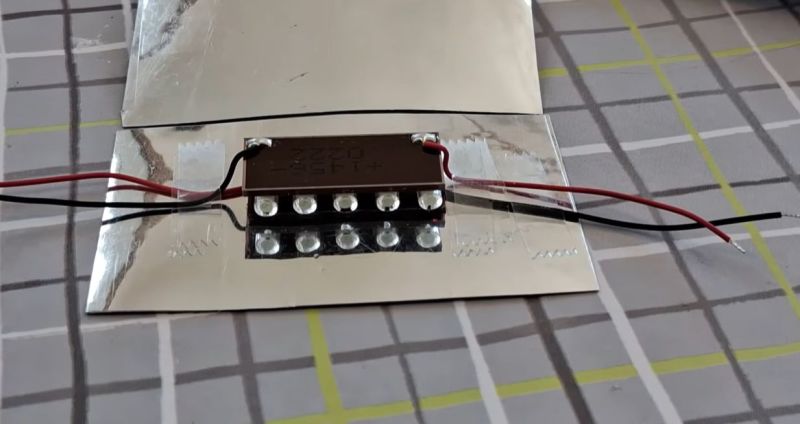
Nuclear batteries are pretty simple devices that are conceptually rather similar to photovoltaic (PV) solar, just using the radiation from a radioisotope rather than solar radiation. It’s also possible to make your own nuclear battery, with [Double M Innovations] putting together a version that uses standard PV cells combined with small tritium vials as radiation source.
The PV cells are the amorphous type, rated for 2.4 V, which means that they’re not too fussy about the exact wavelength at the cost of some general efficiency. You generally find these on solar-powered calculators for this reason. Meanwhile the tritium vials have an inner coating of phosphor so they glow. With a couple of these vials sandwiched in between two amorphous cells you thus have technically something that you could call a ‘nuclear battery’.
With an approximately 12 year half-life, tritium isn’t amazingly radioactive and thus the glow from the phosphor is also not really visible in daylight. With this DIY battery wrapped up in aluminium foil to cover it up fully, it does appear to generate some current in the nanoamp range, with a single-cell and series voltage of about 0.5 V.
A 170 VAC-rated capacitor is connected to collect some current over time, with just under 3 V measured after a night of charging. In how far the power comes from the phosphor and how much from sources like thermal radiation is hard to say in this setup. However, if you can match up the PV cell’s bandgap a bit more with the radiation source, you should be able to pull at least a few mW from a DIY nuclear battery, as seen with commercial examples.
This isn’t the first time we’ve seen this particular trick. A few years ago, a similar setup was used to power a handheld game, as long as you don’t mind waiting a few months for it to charge.












Long ago I worked on a project to load silica glass with high-pressure tritium (many, many atmospheres) along the same lines for making long-life, low-current batteries. The tritium will diffuse into silica under high pressure, and can then be locked into the glass matrix with exposure form a UV excimer laser. After the “laser encapsulation”, the glass wafer was considered “safe” and was then sandwiched between two PV cells and packaged in a hermetically sealed carrier to complete the battery (at the time we were using off-the-shelf chip carries from the semiconductor industry). The process here relied on radioactive decay of the tritium itself to generate voltage, rather than secondary emission from a phosphor.
Until there’s plutonium in this, this will be useless.
You could always start collecting ²⁴¹Am from smoke detectors
Or R adium from old wrist watches and then build a breeder reactor.
Wait, i can’t find this story any more? 2000-ish, in some US suburb?
You’re thinking of this guy: https://en.wikipedia.org/wiki/David_Hahn
Radioactive boy scout , is that the article by chance ?
Oh no, Rob Murray-Smith died… 🙁
yes. he was a great man.
I was heartbroken when I found out, he really tried but sadly succumbed to a broken heart.
With the half life being just 12 years, unfortunately it’ll never compete with a lithium coin cell but its nonetheless a fun experiment.
And of course it was necessary to prove the concept, but there’s still something funny about covering up the solar panel so your battery generates less power :)
Definitely funny. Especially because the solar power would probably be orders of magnitude greater.
But I guess this has the advantage of working underwater and underground?
Under water, but avoid heavy water.
Back when LCD watches had tritium back lights, I wondered if anyone would try something like this to power the watch.
I missed this horological epoch. What LCD watches had tritium backlights?
Seems like it was a thing in the 70s.
https://mb.nawcc.org/threads/what-happened-to-watches-which-had-a-radon-capsule-backlighting-the-lcdisplay.205581/
A quick Google search turned up a bunch on ebay. Of course the back lights are long past functional now.
It was a National Semiconductor LCD watch I bought from Jameco Electronics around 1977.
Really cool eerie green glow – but no glow now. Never tried putting a Geiger counter near it.
Watches was radium, not tritium. But there may have been different radio active substances used over the years.
https://en.wikipedia.org/wiki/Radium_Girls
Tritium has been used on watch dials since at least the 1960s as a safer alternative to radium.
The LCD watches of the late 70’s that [Bill] and other posters are referring to definitely used tritium.
These days you mostly see it in fancy (analog dial) dive watches. I don’t know of anyone using it as a digital watch backlight anymore, but since the tritium vials aren’t hard to get, a reasonably skilled person could roll their own.
Fun times, but a single CR2032 can supply a thousand times that much power for 5-10 years (depending on temperature) for a tiny fraction of the cost. If you want 20-30 years, you can still use a lithium thionyl chloride cell available for probably still less money than this lashup.
I couldn’t watch the video, so not sure if the statement about using amorphous cells is correct, but monocrystaline cells are far more efficient at low light fluxes — much lower leakage current. Monocrystaline cell would be much better in this application.
Why is this article focusing on he’s using a 170VDC rated capacitor? It’s never going to reach that, even a fraction of that …
It’s interesting to think about building a device with a power supply that could outlive you. But tritium is not going to cut it due to the 12-year half-life. Nickel-63 might work, with a 100 year half-life? It would cost a pretty penny (pretty nickel?) though.
Tritium might outlive you, depends on how hard you live.