
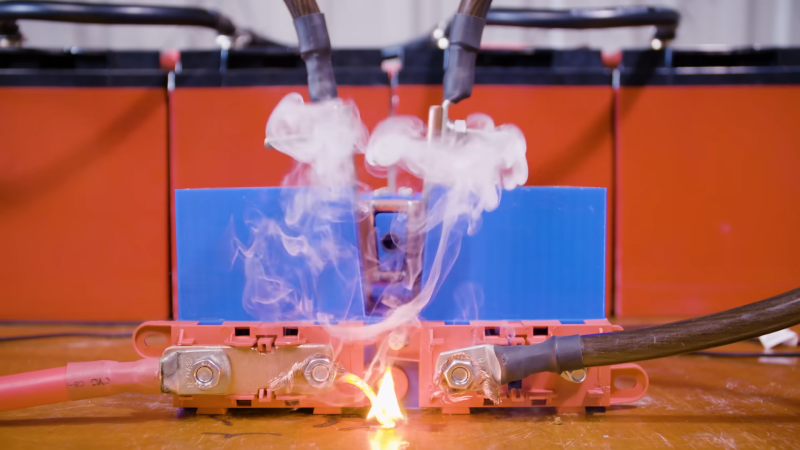
A switch is simple: connect two pieces of metal together and bam! Except, it’s not that simple at high currents. How much current? Just about 400 car batteries worth would certainly cause some issues. This is the issue that [Technology Hobby] hoped to fix with his clever switch design.
While many content creators are great at finding or making high-current sources (looking at you, Styropyro), their switches can’t always hold up to the abuse. [Technology Hobby] found that many of the switches used by these creators had issues based on an inconsistent and limited contact area. Making a bigger contact patch is always fairly easy; keeping those contacts from skipping can be a bit more difficult.
[Technology Hobby] found success in making a V-shaped channel formed from separated contacts where a matching contact would bridge the gap between, completing the circuit. The construction of the high-current switch was simply done with a 3D printed frame filled with concrete for stiffness.
There’s a lot of fun with high current, but sometimes you need something more practical. For those needing some practical current supply, check out this retro-modern power supply!












I was on a kick for a while of seeing what sorts of interesting plasma I could make by zapping various things with a 900uF 3kV capacitor bank made with low ESR film capacitors so I also found myself in need of a switch that could handle obscene inrush current.
What I ended up doing was going to the hardware store and buying the burliest rat trap I could find and shaping its jaws to hold a couple of beefy copper busbars and it worked surprisingly well (there was still a little bit of ablasion but it closed fast and forcefully enough that it was greatly minimized).
For those interested in making a big, loud, and bright orange ball of plasma, I found that a brush made of carbon fiber tow just touching an aluminum can clamped to the other pole made a satisfying and repeatable bang louder than a .44 revolver. Also those hair-thin gold plated tungsten wires used to wind certain kinds of light bulb filament will flash to plasma in a pretty spectacular way =;-)
halfway there. now think of a system to open it again during load. that is always the most difficult part.
Since the switch does not have melting parts fusing, should be as simple as lifting the wedge up again. Also voltage is low enough that there should be no arcing.
StyoPyro himself commented some good things on the video. TLDR, he actually had considered a design like this but while it worked great at the currents tested here, StyoPyro was pretty sure it would have some significant drawbacks at the absolutely bonkers currents he was running.
Still very cool, and definitely useful in some applications!
Since this was in response to StyroPyro and his 400 car batteries, it should be noted that his voltage was 4 or 6 times greater, not to mention his amperage was waay higher.
Principal is sound, wedging/scraping action is in fact a superior connection.
I am very curious to see how it would respond to being scaled up. Also when he started scraping it with a chisel I wondered why he didn’t use a file.
400 car batteries. 160,000 amps? How would the switch not spot-weld itself shut? 12v may not arc much but those moments while it’s shutting or opening. Also what on earth are you people doing for hobbies my god.
I would work on spring mechanisms to open and close the switch very rapidly and firmly. Reducing the time when the contacts are allowed to arc is very important. Also, what about submerging the whole assembly in some kind of dielectric fluid?
Ahem…
https://en.wikipedia.org/wiki/Knife_switch
If this was used for the big battery bank, it would probably explode apart because of the concrete splitting too easily.
That was StyroPyro’s exact response – he was pretty certain this design would definitely weld itself together at his scale.
Also, StyroPyro’s YT channel is a neverending list of “how is this guy not dead?” lol
What’s the voltage on a recently opened switch when the circuit has non zero inductance.
IIRC he want’s a piece of zinc attached to one side near the circuit break point.
It will grab the arc and kill it.
Either that or pee on the arc.
I hope he tries or anyways or has a sponsor to do so. This is perfect science we have the hypothesis let’s test it –
Submerging the switchgear in oil is done in high power utility applications. All of this is century-old technology.
Seems like a variation on the old knife (“Dr Frankenstein”) switch, which is still in use in my 75 year old former school building, in the form of fuse/disconnect panels, some rated at 400 amps continuous current, with interruption ratings of several thousand amps. A little investigation into the oil-submerged, motor-driven switchgear used by the utility companies will save some re-inventing of the wheel.
Submerging the switchgear in oil is done in high power utility applications. And to get an idea of the spring mechanism, look inside an old “Square D” (TM) fuse/disconnect panel of the 400 amp variety. All of this is century-old technology.
Lightning bolt time
Reply not in intended thread again award
Have the “axe switch” on a big wooden dowel about 6′ long, you open the switch by lifting up the end of the dowel. Well if it’s not on fire.
an alexanderson alternator build originally had compressed air to blow out the arc of the contactors.