
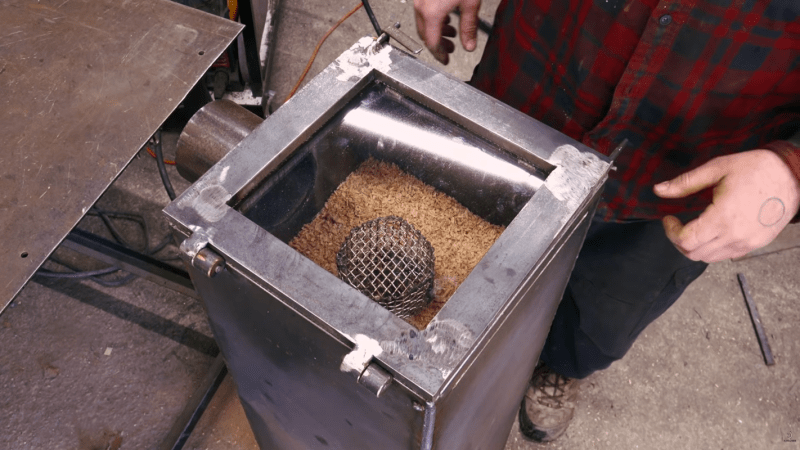
Most carpenters and woodworkers find themselves with the problem of disposing of all the sawdust they create when performing their craft. There are lots of creative solutions to this problem, such as adding it compost, using it as groundcover in a garden, adding it as filler in a composting toilet, or pressing it into bricks to burn in a stove. All of these have their uses, but involve either transporting the sawdust somewhere or performing some intermediate step to process it. [Greenhill Forge] wanted to make more direct use of it so he built this stove which can burn the sawdust directly and which provides enough heat for his woodshop.
The design is based on one which is somewhat common in Japan and involves building a vessel with a central tube for airflow, with the sawdust packed around it. The tube is made from a hardware cloth or screen to allow air to reach the sawdust. The fire is lit from the top, closed, and then allowed to burn through the stack. [Greenhill Forge] welded the entire stove from various pieces of sheet metal and bar stock, with a glass plate at the top of the stove to close off the fire and a baffle to control the airflow and rate of burn.
Initially, [Greenhill Forge] thought that the fire would burn from the top down, but this turned out to create a smoldery, messy fire instead of a hot, clean burn. Eventually, though, an ember fell down to the bottom and let the stack burn from the top up, and then it started generating serious heat. He estimates that with around 5 kg of sawdust burning for three hours that it’s about equivalent to a 6 kW stove. While a woodworker might not have enough sawdust to run this stove every day, it could be good to have on hand to use once every few weeks when the sawdust builds up enough. [Greenhill Forge] has been hard at work building unique wood burning stoves lately, like this one we recently featured which generates and then uses charcoal as fuel.












Not only do I not have a problem disposing of sawdust — I think of dog poop (can’t say the s word on HaD!) aas a resource. The latter gets buried in the garden, where it’s nutrient value is appreciated. Sawdust goes either into the garden or into the woodstove. When you have a woodstove, a lot of things we think of as troublesome trash becomes a resource. I don’t burn plastic, but, judging from the smell of things in India, they do there.
PLA makes excellent kindling if you have a cardboard or wood substrate to catch and absorb the dripping. It burns smoke-free and leaves no ash. It behaves a lot like paraffin wax.
Now I wonder how well it will work to print a candle. (scurries off to put “candle wick” on the shopping list)
Best kindling I have found is the waxed – cardboard vegetable boxes my CSA keeps throwing at me. (The original plan was to reuse these nicely durable boxes, but during the plague years people lost their taste for that, so the boxes tend to pile up and using them as far as starter is actually the best application I have found.)
Ah so close! I read your reply expecting to read that PLA makes an excellent binder for wood particles.
I think it should, and with hot pressing, one can perhaps reconstitute a bag of sawdust and pulverized 3D prints into new blocks and particle board of some sort.
Hot kneading would be even better, but then we’re already deep into Notworthit territory.
To be clear, you do not have to press sawdust into bricks to get it to burn in a woodstove.
Have you ever seen loose sawdust catch? It’s explosive, quite literally. There’s no way you’d want to burn it in its raw form unless you had a death wish.
I roll it in newsprint to make small logs.
Wood burning, while saving you a bit if money, is pretty bad environmentally. In fact, burning anything is bad. Pumping extra crap into the air.
There are really only two ways wood burning is bad: air quality and deforestation
One is fine in low quantities (like not going back to the age of exclusive fireplace usage) or with modern cleaner burning technology.
The other is fine for scrap wood or sustainably sourced wood.
I always wondered about blowing sawdust into a furnace, like rocket combustion.