
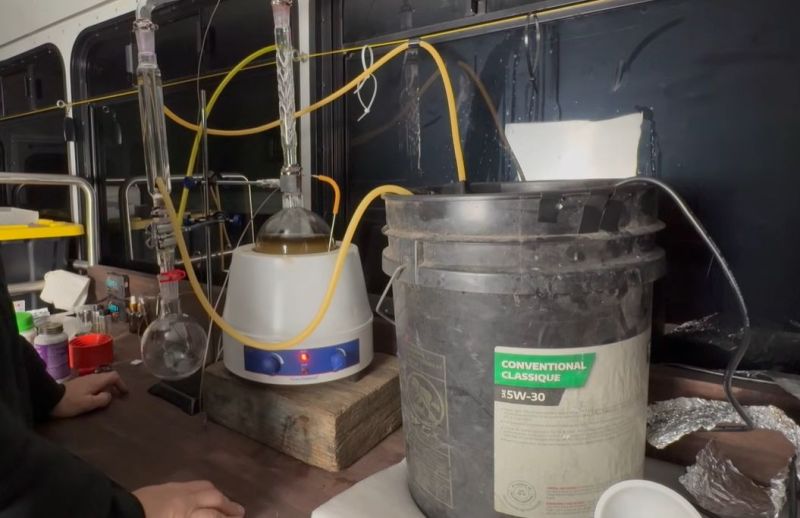
The propensity of gasoline to ‘go stale’ through the process of oxidation is the reason why gasoline that has been stored for a long period of time is considered to be unusable, as it will no longer combust property. Since this process creates the sludge that you find in the bottom of an old gasoline canister, it follows that you may be able to distill out the still good gasoline. With this reasoning, [Joel] over at the [Lowered Expectations] channel set to work to try out this theory.
As part of his job of maintaining things like pressure washers, he got access to many grades of stale gasoline to experiment with. After a short demonstration of how poorly these grades of stale gasoline burn it’s on to the main distillation event. To the stale gasoline aluminium oxide is added as both a catalyst and to create nucleation sites that will prevent ‘bumping’ where you suddenly get a surge out of the heated flask.
Of course, that this is incredibly dangerous should be obvious, and the lack of PPE on the side of [Joel] is somewhat worrying. On the positive side, he does take it easy with ramping up the temperature on the gasoline to try and find the sweet spot where production seems sufficient. This turned out to start at 70°C in the flask when the condenser began to receive its first load of presumably clean-ish gasoline.
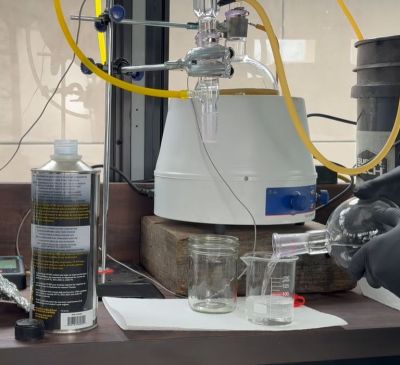
The goal here is of course to approximate the function of the fractionating column (‘distillation tower’) at refineries at smaller scale, which [Joel] appears to be doing correctly with what looks to be a Vigreaux column. Since the base product is gasoline with oxidized contaminants this process is of course quite different, so he goes through the different temperature ranges to see what kind of distillate he gets, up to nearly 200°C before calling it.
Ultimately 880 mL of the initial 1 L was collected, with the various distillates combined for testing. Unfortunately none of the testing is actually covered in the video, but it is mentioned at the end that a second batch of the distillate was used to power his car, so presumably it works.
Suffice it to say that ‘works’ doesn’t mean that it is safe, of course. Heating such stale gasoline produces many highly flammable and combustible substances, along with many that are just downright bad for your health to be exposed to. The plethora of very short-term to all the way to very long-term health effects this may cause should be obvious.












My experience is that several years old non-ethanol gas burns just fine. You just make sure it doesn’t stay in the carburetor to dry out and leave sludge. I let the engines run till they’re empty before letting them sit for an extended period. The containers I leave the gas in are those newer unvented types that swell up like overripe fruit when they get warm. I figure that keeps most of the more volatile molecules in the mix. I don’t use any of the stabilizers either. YMMV.
I mixed in some stale gasoline to new at a 1:4 ratio to get rid of it, but it was clear. I certainly wouldn’t do it with some of what was in the video which was a murky black similar to beer.
The lack of ethanol isn’t what’s saving you; your containers must just seal better and your carbs must be more forgiving. I’ve used ethanol free in various things, but unfortunately even running the carb dry every time often isn’t good enough, it still clogs eventually. Maybe removing the bowl and blowing it clean with compressed air after every time would be enough, but that’s silly. I’ve had gas go bad in the tanks of cars too, probably again because they weren’t fully sealed. The only difference with ethanol is, when oxygen gets into regular gas you might get sludge and you definitely lose volatiles (which can mess with your octane number). But when water gets into ethanol gas then if there’s not enough alcohol it can separate, so you’ll have to add even more alcohol (heet or high-percentage bathroom isopropanol) to reabsorb it. I consider that easier to deal with, and it also makes up for some octane loss as long as the afr doesn’t become problematic.
190 proof everclear works.
So does 189 proof rum. Ask me how I know lol
While you can “clean” the fuel by removing sludge and heavy contaminants, the distillation process does not regenerate the volatile “light ends” that evaporated when the gas went bad. The resulting distillate often still struggles to combust properly in an engine.
In any case, reducing process temperature by employing a vacuum distillation apparatus seems like a good safety measure.
I suppose doing it under argon might also work? And maybe safer still (no implosions), if not as efficient as boiling under vacuum.
Good skill to have in the Mad Max era we’ve entered.
A common, often repeated stupid internet conversation
Red) And how will you charge your EV when the grid is gone?
Blue) Solar panels, Wind, maybe a small dam on the creek out back. If i get desperate I could even tear the motors out of the dryers that no one will be able to use anyway to use as generators.
Red) Oh yah? Well I… I have a hand pump. I can take that to the gas station and just fill my car easy
Blue) Cool. I guess. If the owner of the station is just going to let you take their gas, sure. But.. what are you going to do in a few months when any remaining gas starts to go stale?
It always ended here but now it can continue:
Red) I’ll distill it just like Joel!
Blue) Really? You can do that? Show me.
Red) Kabooom!!!!!!!
Solar panels and dryer motors are going to go away first because those are manufactured overseas with materials sourced from the same place. Once they break, you can’t get a replacement because you can’t manufacture neodymium magnets, lithium batteries, or refine silicon to the required purity to make good solar panels.
Meanwhile, people will still be able to make and run engines as they’ve done for a hundred years. If you can’t get gasoline, you run it on moonshine or wood gas, or peanut oil, turpentine, whatever you got.
Dryer motors? What? Have you ever seen a dryer motor? You can rewind that by hand though it’d take a while. And they were probably thinking of washing machine motors anyway. Beyond that, you realize car engines require starter motors, not to mention an ECU? I’m not saying that EVs would be a good idea in an apocalypse, just that you’d be better off building a go-kart than a car. And at that point you could make your own motor and lead-acid batteries.
You can wind the wires, but you won’t be able to buy the magnets after the slow boat from China stops coming.
No they don’t.
@Dude “You can wind the wires, but you won’t be able to buy the magnets after the slow boat from China stops coming.”
So in your imaginary scenario all existing electric motors are magically destroyed? If the slow boat stops coming we will have to stop living like everything is disposable and start repairing things when they break again.
Also you do realize that rare earth magnets are a luxury not a necessity. Powerful electric motors exist that do not rely on them already
Nissan Ariya: Uses an Externally Excited Synchronous Motor (EESM). This design provides competitive horsepower (up to 239 hp on front-wheel-drive models) and avoids rare-earth metals by using copper coils to create electromagnetic fields in the rotor.
BMW iX3 and Newer Models: BMW’s Gen 5 and upcoming Gen 6 eDrive architectures utilize a separately excited synchronous motor design. Instead of relying on magnets, they use an external power source to transmit electrical current to the spinning rotor via brushes or contactless technology.
German automotive supplier ZF developed the In-Rotor Inductive-Excited Synchronous Motor (I2SM). It generates a magnetic field using an inductive exciter inside the rotor, making it uniquely compact and competitive with traditional permanent-magnet machines.
Mahle Contactless Motor: Mahle’s motor utilizes wireless power transmission to energize the rotor’s electromagnets, eliminating the need for slip rings or magnets. It runs continuously at peak power without overheating and delivers up to 95% efficiency.
Valeo has developed an electric motor using hairpin stator technology that operates completely without rare-earth elements, reducing the carbon footprint compared to standard motors.
As a prepper, it doesn’t have to be EITHER EVs OR gas engines. BOTH have a place in my plans.
Washing machine motors are plentiful in the junk yard, so I’m not worried about running out. But not a lot of horsepower. Good for small motorized pusher bike trailers.
Old lead batteries can be refurbished. Place on the bike trailer.
My solar panels are a target to get stolen (boo), but so would panels at municipal projects (interesting). I believe the muni panels run at a different voltage that does not match the charge controllers most home users have, so they might be widely available on a black market. If you know how to use them, they’d be gold. As for my panels, I’m securing mine with a steel cable.
Gasoline engines of all kinds should be plentiful (think also of lawn mowers, go-karts, generators, etc.) and modifying them to run home-made alcohol/ethanol is as simple as partially obstructing the air inlet with a piece of duct tape. This changes the fuel-air ratio to be more suitable for alcohol. Can also install onto a bike trailer.
Or some engines can handle wood gas; burning wood for the flammable gas vapors that are piped into an engine. This was used often in WWII.
I love the idea of charging an EV with home solar or wind, but if the crisis goes on long enough I definitely don’t want to be the only one on the roads with a working vehicle. That’d instantly make me a target for all kinds of ambushes. Must move with stealth, which needs to be slow.
Diesel engines from the junk yard are an option if you can find a source of used motor oil or vegetable oil.
And yes, this article interested me because re-refining stale gas was a conversation I had with Gemini AI a few weeks ago. Crappy gas beats no gas.
No, but the magnets will become more and more expensive and rare as time goes by.
You can of course construct all sorts of clever electronic machines, but under the same scenario where the slow boat stops coming, you also lose the supply of other advanced semiconductors like power transistors to make the inverters and ESCs to run them. The system starts to collapse without replacement, and recycling trash only lasts so long.
Props to those who aspire to rebuild an agrarian society to distill biofuel. But I take some comfort that my solar panels will keep my refrigerator and EV will working while they chug away on that.
Your EVs usefulness will be shortlived without road crews.
Your solar panels will only be yours as long as your ammo supply lasts.
Fortunately the pending apocalypse is always cancelled and rescheduled for a future date.
I doubt other people will be interested in stealing your solar panels, if they can’t maintain the infrastructure to use them in anyhow. Then again, in a few years, neither can you.
https://india.mongabay.com/2021/12/solar-power-station-at-bihars-first-solar-village-is-now-a-makeshift-cattle-shed/
You can still get diesel tractors that run without electronics. They have a lot of modern features but underneath they are a copy of Italian machines from 50 years ago. They could end up being some of the last machines running in a permanent grid-down scenario, and you definitely can grow fuel for them.
Bright side of the current situation is no fuel will be sitting around for long.
How many months/years before it gets stale ?
What other (non dangerous) use cases for stale gasoline ?
Modern ethanol and other bio based “gasoline”? 2 or 3 months especially here in the EU. After that it’s basically a cleaning product and not a fuel. You can then use it in a parts cleaner, if it still burns then you can light a campfire with it.
Actual properly made gasoline? I got some that’s probably 15 years old. I’ll let you know if I ever find out how long it can last. I can probably store it for another 50 years as long as it doesn’t evaporate.
Funny how drinking ethanol doesn’t do that… almost like it’s not so simple.
The mandatory 5-10% additive can be anything from acetone to isopropanol and other stuff. It’s not pure ethanol, it’s whatever they can scrape up on the cheap to meet the regulation.
I buy petrol for my lawnmower once every couple of years. It runs just as well on the dregs of the previous purchase as it does on the new stuff. It doesn’t seem to deteriorate at all. This is regular unleaded in the UK. YMMV.
Same here. E10, two years old. Lawnmower doesn’t miss a fart.
What happens to the anti knocking agents (that prevent damage to the engine over time), I am guessing that they remain in the distillation side.
Danger is my business, but I have my limits.
I’ve seen claims that old gasoline can be used to thin used (filtered) motor oil for use as diesel fuel. I have yet to try it myself.
If you have the option you can partly prevent it. You do need a large separatory funnel. You throw new gasoline in there, as much as fits. You add water and mix it in the gasoline. You then let it sit for a while and the water sinks to the bottom. You then drain the water. The water collects all the ethanol, purifying the new gasoline a bit, making it last longer and makes your engine happier, makes it consume less fuel, provide more power and makes your vehicle last a lot longer.
Lowering the octane by deliberately adding water that you then contaminate, while also removing anything else that has a small nonzero solubility in water, and also leaving behind a small nonzero amount of water in the part that doesn’t separate either initially or ever. If you’d like to have to add an octane booster later, why not add a stabilizer now?
“this process creates the sludge that you find in the bottom of an old gasoline canister”. In 65 years of being old enough to use gasoline I have never had a problem with old gas, and I have never seen this “sludge”. Maybe ethanol and biofuel mixes, like California Mix, have a problem but I avoid those. They are a scam virtue signal anyway and collect water. I live near a few stations used by a lot by boaters and by pilots with planes that can burn mo-gas. The fuel has no ethanol and is good for many years. In a sealed can there is very little oxygen. I can not picture a mechanism for oxidizing or degrading more than a tiny amount. And what would these carbon/hydrogen chains degrade into that doesn’t burn well?
I often buy too much gas for my lawnmower. So it sits too long. I do notice that it does not run as well.
I could dump it into my car’s tank now and then and buy new so as to keep it fresh. But with all the anti-siphoning measures, or maybe it’s evap recycling or I don’t know.. something about modern car’s gas intakes. It’s hard to get it to go down from a can rather than a real gas pump and takes forever.
So I just keep using old gas in the lawnmower. The spring time is the worst, when I still have last fall’s gas in my can. But it still runs. It still gets the job done.
I’m just buying regular gas as it’s sold in US gas stations. Mostly gasoline but with some ethanol added.
My next lawnmower will be electric. My next car… might be.
Cars on the other hand… Most cars I have owned really don’t like old or low quality gasoline!
“..as it will no longer combust property”
Best typo so far.
I think the shelf life figures for pure gasoline quoted on the Internet are WAY too conservative and not based on real world testing.
I grew up riding old go karts, mini bikes, dirt bikes and ATVs. My friends and I would often find old bikes and 3 wheelers in sheds and barns that had been sitting for 5 to 10 years. The fuel in the old metal tanks would be look like chocolate milk. We’d simply pull the carburetor, drop the float bowl, remove the needle valve and clean it out with carb cleaner. Pull the spark plug and kick it to check for spark then just top it off with fresh gas leaving the old fuel in the tank. We’d push start them while the rider sprayed starting fluid in the air filter and they’d fire up and run after a few tries. I don’t recall ever needing to drain a tank.
I think a lot of the information online about gasoline going bad after a few years is just people copy-pasting what they’ve read elsewhere online. The later addition of ethanol absolutely did make stored gas go “old” due to water contamination but straight gasoline is good for much, much longer than is commonly cited. Especially if you mix in some “fresh” fuel.
My 2 cents
Your examples share one commonality. Carburetors. Injectors are less tolerant of fuel varnish. Additionally, modern automotive engines rely on sensors that can be thrown off by degraded, separated, and/or water logged fuel. Finally, theres the issue of catalytic converter fouling caused by poorly combusted degraded fuel.
All of these factors are why your experience counters the advice on fuel freshmess which has been tailored to modern cars sensitivities.
Not to mention that the composition of gas has changed and now includes ethanol.