
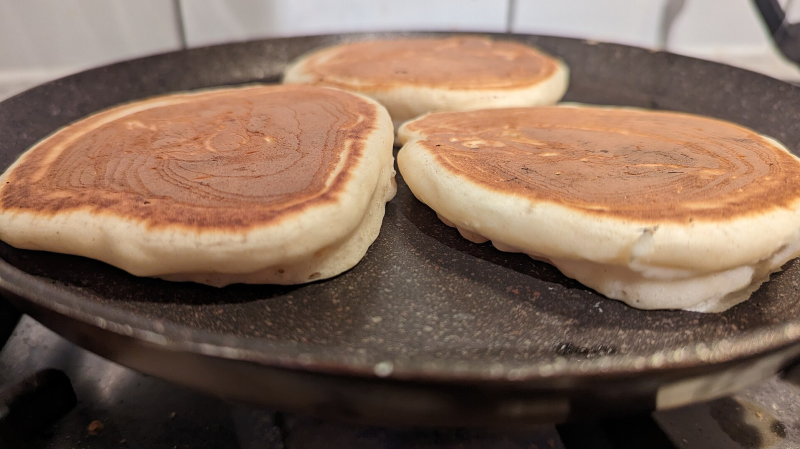
Although parents and teachers like to point out the deep link between cooking and chemistry, most people don’t deliberately apply any chemical principles beyond acid/base reactions to their recipes. Not so [Ben Kazez]: he’s written a thorough exploration of the chemical journey to the perfect pancake, and made a calculator for others to use with their own ingredients.
The goal is to optimize the pancakes along four dimensions: interior texture (light and smooth), a tangy flavour, rise, and a crisp, brown exterior layer. The tang comes from residual acids, and since lactic acid produces the best taste, dairy-based acid sources (such as Greek yoghurt or buttermilk) are preferable. Acids also react with baking soda to release carbon dioxide, making them a part of one of the four rising agents. The other three are carbon dioxide released when double-acting baking powder is heated, steam released from the batter, and air bubbles stabilized by egg white foam.
Dairy products, besides contributing acid, also provide a protein structure to keep the interior smooth. In a normal wheat-heavy pancake, two proteins (glutenin and gliadin) interact to form tough strands of gluten. Fats bind to hydrophobic amino acids in these proteins and shorten the gluten chains, hence the name shortening. Adding ricotta cheese also replaces some of this gluten network with a smoother structure of previously-denatured dairy proteins. Dairy products also contribute to the Maillard reaction between reducing sugars (such as lactose, glucose, and fructose) and amino acids, which causes the browning of the pancake’s surface. Besides being brown, the surface should be crisp; since amylose, found in corn starch, forms a brittle, glassy, crackly network when dehydrated, corn starch was added.
The result is a set of chemical equations which can be tuned to create perfect pancakes, combined in the calculator. This summary doesn’t do justice to the depth of the research here; [Ben] also investigated optimal batter resting times, fermentation, cooking fats, cooking surfaces, and spatula properties. If all this has you interested in more about dairy proteins, check out our article on cheesemaking.
Featured image: “Buttermilk pancakes from a recipe by Darina Allen” by [Didym].












Everyone knows that the optimal way to make pancakes is however MY parents happened to make them when I was a kid.
i don’t think either of my parents has ever made me pancakes and i confess to a deep indifference about the different kinds of pancakes…seems to support your claim
This is true. And because of that, one of the OP’s axes of pancakieness (tangy?!?) is totally lost on me. Some people really like the loads-of-baking-powder taste. I grew up without it, and don’t.
We do a half-whole-wheat pancake around here, and it helps keep them from getting “bready” as well as being a bit healthy. I love the “optimize everything” idea of the OP’s blog, because it’s funny. But as always with multivariate systems, it’s too easy to get stuck in local optima.
I know it’s tongue-in-cheek but…Mom used cheap pancake mix. When my wife and I started dating, she introduced me to scratch-made pancakes. I have not had mix-pancakes for over 45 years.
I went to Japan and tried a really optimized pancakes. Every single piece of food is optimized in Japan “without AI and registration”.
https://youtube.com/shorts/2G86ucx65go?si=gGl_G7_VNcEgDgfJ
No one who has ever made Souffle Pancakes would consider them in any way shape or form, Optimized. Optimized means to make a system, process, or design as effective, functional, or efficient as possible. That is almost exactly the opposite of what souffle pancakes represents.
Maximizing on texture and flavor and other aspects of the experience is my preference over optimizing. Making the fastest, cheapest, easiest pancakes sounds like a path paved with unpleasant compromises.
Crepes, pancakes, pfannkuchen, or souffle pancakes each have their own appeal. What goes in to each is basically the same, the ratios and techniques are all that really separate them. Its hard to consider any ONE superior beyond individual personal preference.
I didnt imply souffle pancakes were inferior nor superior in quality, just stated that they are not OPTIMIZED in any way shape or form.
Except that they are, for fluffiness. Optimization is a process to develop an outcome, not an invasion.
It’s a local optimum. In a space of many optimal pancakes in different styles.
jep. tldr
Put in batter, when it bubbles flip it. Wait approx the same amount of time and the pancake is done.
Once I learned to watch for the bubbles I never had issues.
My mother taught me that 60 years ago. It works.
i just follow the directions on the box. never had a problem not getting good pancakes. so long as the butter is real and the syrup is real, pancakes are awesome.
I have never seen recipes on regular product boxes like flour or milk cartons.
They only print them here on alternative products like oat “milk”, almond drinks, etc, which of course works too. You could even take water if there is nothing else left… (never seen recipes on water bottles either). Some people take sparkling water to make the pancakes more fluffy. I for myself separate the eggs and stir the egg white fluffy.
Funny the calculator’s pancakes look burnt on the perimeter lol.
I like Silver Dollar pancakes. No idea of their equation.
I appreciate that the author lists 72 sources for their research.
One for each demon, of course.
Try adding a little baking soda while cooking ground beef…
Does that make a good pancake?
baking powder trick works on things like chicken wings (or any skin-on chicken), to make it crispier. ive also had luck using it on pork chops (baking powder and seasoning replacing breading to reduce carbs). ive yet to determine if there is any difference between soda and powder when used on meats.
Or try baking powder in falafel
Funny, how you get a different picture if you search “pancake” or (german) “Pfannkuchen”. Btw, the first is bland and quickly soggy, the second isn’t.
Well, no. See, that’s the problem with “optimized.” What is optimal?
It’s the same problem you get with things like fresh produce that has been bred to be “optimal.”
We get strawberries that are bright red, large, and don’t bruise. Farmers and supermarkets love ’em.
I don’t eat them. They taste like water, they are hard. No flavor, and crunchy. Yuck.
Same as with tomatoes. The ones you buy in the store are “optimized” to transport well and “ripen” in the dark. They are pink, squishy, and taste like mushy water. I don’t eat those.
We were in Spain some years ago. We walked by a small vegetable market. I stopped dead in my tracks, and sniffed. Tomatoes. Honest to god, dark red, flavorful tomatoes that I could smell from outside the shop. I went in and bought a bunch of them. Best tomatoes I’d had since I was little, when my sister and I would sneak out our grandmother’s garden and eat tomatoes right off the plant. My wife was shocked. She’d never seen me eat tomatoes before. Naturally not. All you get for tomatoes in most stores are squishy, pink, flavorless things.
The same with your crunchy, brown colored hotcakes. Not with me.
They should be lightly yellowed, done all the way through, with a mottled surface with light browning on top and bottom.
They should not taste sour.
1 cup flower
1 cup milk
1 egg
1 teaspoon baking powder.
Mix well, adjust batter thickness by adding a tad more milk or flourto make it appropriately thick, pour portions slowly into a hot skillet with oil.
When bubbles form, flip it. Wait a moment, then shake the skillet. When the hotcake slides when you shake the skillet, flip it again. Flip and flip again. Poke the edge of the spatula in the center of the hotcake on each side. It should come out dry. Hotcake done.
Ideally, yellowish body with browned highlights top and bottom. Brown rings on top from pouring the batter into the skillet, bottom has browned mottling from being dropped nearly solid back into the skillet on the first flip.
Put a small glob of butter on top, stack on a plate until you have enough for everybody.
Enjoy with maple flavored pure sugar cane syrup (T.J. Blackburn’s, to be exact.) Never eat real maple syrup – it makes me puke. Gotta have some crunchy fried bacon to go with the hotcakes,
See, we all have a different opinion about what’s optimal. Your crunchy brown, sour tasting hotcakes aren’t what I’d call optimal – and your probably wouldn’t want to eat the golden yellow/brown hotcakes I love.
It’s funny how many different pancakes there are. I personally prefer the Dutch version (I’m Dutch so not a surprise) and our tiny poffertjes, even over the German “tasteless” version (Dutch version has cinnamon). The Russian pancakes are much sweeter but still similar, then the French have these ultra thin crepes. The Swedish is nice and rich with more eggs and butter I think. I don’t like Finish pancakes personally, those are made in the oven and very thick. The American waffle style pancakes which are (I think) scottish pancakes but made a bit bigger. I never had Japanese souffle pancakes nor the cabbage pancakes of Japan. I’ve had Latke pancakes too, those are nice.
I have never used baking soda while cooking. It’s a very strange concept for me and I don’t know what to do with it when cooking. I’ve used it as a cleaning product, used it to fill gaps with super glue, brushed my teeth with it. Just never used it while cooking and wouldn’t even know when to use it.
You use it when the recipe calls for it. It is used in American hot cakes to make them rise. It is used in Irish soda bread instead of yeast, again to make the bread rise.
Technically, the combination of baking soda and an acid is used to produce CO2 gas, which makes things rise. Baking powder has both the soda and the acid in one product (plus a stabilizer to keep them from just reacting in the can before you can use it).
Since eggs have a bit of acidity, you can add some soda to scrambled eggs to make them fluffier. As has been mentioned in other comments, it can also be added to meat to help it brown.
Baking soda (sodium bicarbonate) also breaks down and releases CO2 gas to make things rise just from the heat.
https://en.wikipedia.org/wiki/Sodium_bicarbonate
If you’re depending on just the heat (and not an acid) to release the CO2 from baking soda in your baked goods, well… I’m not going to say you’re doing it wrong, but you’re certainly making something unusual, like foamed sugar candy or nut brittle — something far hotter than typical baked goods get.
You can also add cream to make scrambled eggs fluffier (and tastier).
I never had a recipe that called for it. Not even the dutch baby calls for it
Soda bread relies on an acid component (typically buttermilk) to promote the release of CO2 from baking soda.
Those pancakes are burnt, though.
first pancakes! next? crapes!
Is that “crêpes” with a different accent?
On a whim I tried to make a list of pancakes around the world and quickly got mired in what is basically a crepe. There were dozens of similar recipes mostly for Europe. I posted most of them on imgur. It was my second best post yet. Apparently people really love their pancakes. ”pancakes around the world”. I posted a link to match the photo of the particular pancake. I know I completely left out whole sections of the world but I got burnt out of it and just stopped.
Saw the headline and wondered ‘wait, is this from Ben Krasnow?’ and then it turns out it’s from Ben Kazez.
It’s a Ben K. at least eh.
The reason I thought it BTW is that Krasnow started his YT with food related stuff, and he did videos on combining science and food.