
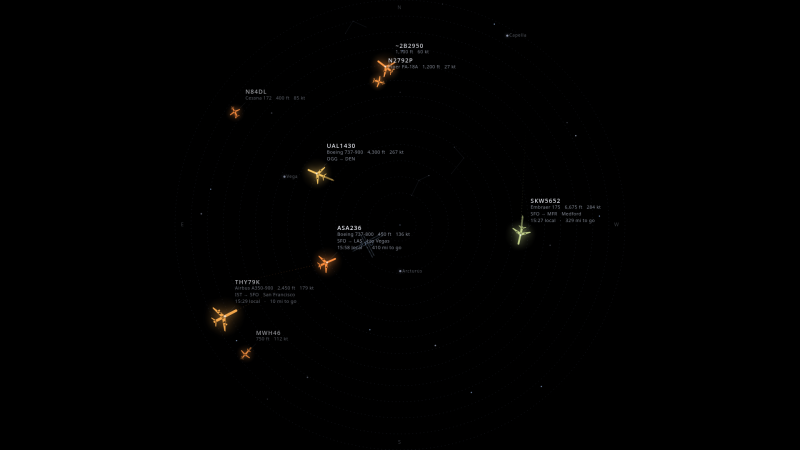
If you’re into airplanes, you’ve probably had the experience of hearing an unusual aircraft and rushing outside to try and catch a glimpse of it, all while fumbling with a smartphone to open a flight-tracking app. If your home was equipped with [cpaczek]’s Skylight project, which combines ADS-B data with a short throw projector, that little dance would have been totally unnecessary.
ADS-B or the “Automatic Dependent Surveillance-Broadcast”, is the standard by which aircraft broadcast their position and other flight information from onboard transponders. In most of the world, every commercial aircraft has an ADS-B transmitter, and they’re slowly creeping into general aviation as well. The signals aren’t hard to pick up with software-defined radio — like perhaps this RP2040 based unit we featured — or the RTL-SDR v4 this project calls for.
Using data from ADS-B, the Skylight software runs on Raspberry Pi 5 and renders icons of the aircraft exactly where they would appear above you, if that pesky ceiling wasn’t in the way. You get the flight’s code, destination and flightplan with a nice icon representing what type of airplane it is. Thanks to specifying a Pi 5, the projection is a smooth 60 FPS at 1080p. Airplanes aren’t the only things plotted, though — this is also a planetarium, giving you a full view of the stars and any satellites passing overhead. That’s obviously via an API, not SDR, and if you like you can configure it to track aircraft that way to — allowing you to set your Skylight for anywhere in the world, if you aren’t near an interesting airport.
ADS-B isn’t just for pilots and plane nerds — if you’re flying drones, you probably should keep an eye on it, too. In that case, though, you probably won’t be looking at your ceiling.
Thanks to [Thinkerer] for the tip!












Projecting a black sky seems to be a genuine trick…
not with new projectors and a black ceiling
You’d be surprised how many people don’t get that.
There used to be (there are https://www.amazon.com/Bluetooth-Wireless-Projection-Keyboard-Full-Size/dp/B01AXU2EJG ) a lot of keyboard projectors, that seemed to be doing that, based on marketing material. Sunlit room and white tabletop, perfect PC keyboard.
lol… the page states:
Frequently returned item
Check the product details and customer reviews to learn more about this item.
No need for black, in the demo video clip the plane is in a cloudy sky and he goes inside and shows it projected on the white (although it seems to be lit by changing colored light) of the ceiling.
And it looks nicer than black would I would say.
Oh and it has options:
Comet trails, altitude-graded color, and range rings + compass for orientation.
Live sky layer — sun, moon (with phase), bright stars + constellation lines, and satellites / ISS computed from TLEs. Scrub time forward/back from your phone, or jump straight to the next ISS pass.
Plotting Boards reinvented : – ]
I still remember the huge two/three-story-tall plotting boards – reverse-writing the markings with a grease pencil, etc. It looked awesome with multiple monkeys … pardon … “writers” jumping behind the plexiglass wall from spot to spot, coiled headphone cables regularly tangling in the air, etc etc. Mind what you are thinking, these were already obsolete in the 1970s, but were kept around as a backup up until late 1980s, so that’s what I got to witness first-hand, a backup operation when the main board elsewhere was offline.
Regardless, good hack, and thank you for sharing.
Sounds like a subject for a Retrotacular article.
you should also do this for starlink and satellites and sell this as a projector, (based on a cheap android projector with built in app)
Third paragraph.
But wouldn’t the directions be wonky? Think about it.
North is the top of the screen, South to the bottom, East to the right, West to the left.
When projected on the ceiling, things go bad. If the projector paints the top of the computer screen at the North edge of the ceiling, of course, South will be at the South edge of the ceiling. BUT East and West are at the wrong sides of the room. One could use a mirror to fix the orientation, but then the text would be backwards.
It uses custom software with lots of options, it’s not taking some image from somewhere else.
Problem with projectors, as always, is that the light sources still have a limited lifetime, and replacement tend to cost you.
This is an excellent project — one of those Hackaday things that made me immediately order the parts and spend the evening building it. Now I need to find a LARGER projector to cover my whole ceiling…
Very cool. What’s old is new again, modern rendition of this HaD post: https://hackaday.com/2019/08/02/ask-hackaday-how-would-you-build-this-flight-tracker-for-kids/
i don’t get it to run on my pi. lots of error messages when install script is starting.
maybe some sources no longer avaliable.