
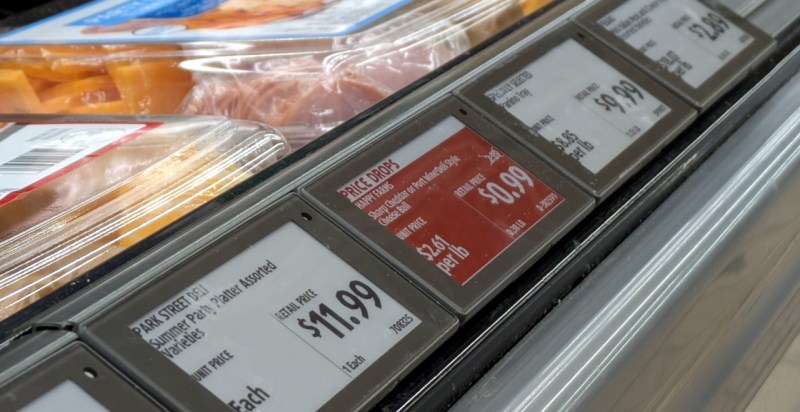
Unless you’ve spent the last few years locked indoors and had all of your goods delivered to you — a not entirely implausible situation, given our audience — you’ve likely noticed the growing popularity of electronic shelf labels (ESLs). They’ve been a common sight in grocery stores like Aldi for some time, and major retailers such as Walmart and Home Depot have been expanding their use of the technology.
On the surface, it makes perfect sense. With electronic ink displays, you can create a price tag that looks enough like a paper label that the customer’s experience isn’t really any different, but the retailer doesn’t have to send somebody out to update the prices. Sure, the upfront cost is higher than a roll of sticky paper, but theoretically, the ESLs should pay for themselves thanks to the reduced labor costs.
 It’s the sort of high-tech solution to a common problem that one of us would have come up with. If this were a decade ago, we wouldn’t have been surprised to see something like this get entered into the Hackaday Prize. It might have even won.
Now that the technology is becoming commonplace, there’s even more reason for hardware hackers to be interested in it. Since most of these tags will show whatever image you beam over to them via radio or infrared, we’ve seen a number of projects that repurpose second-hand tags as convenient data displays.
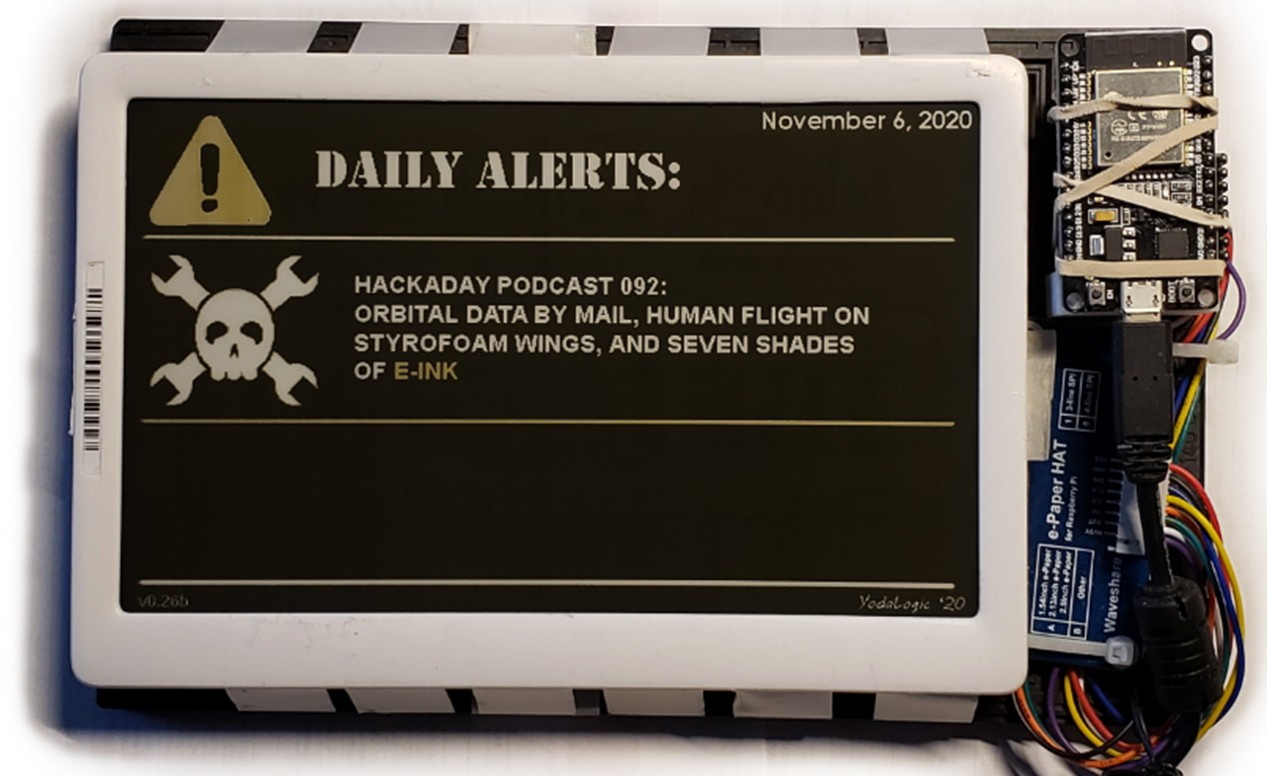
Rather than showing the price of milk, they can show the current price of Bitcoin. Or maybe you’d like to stick them up all over the house to display the weather forecast and your family calendar. They’ve been repurposed as badges at hacker cons, and at least one industrious hacker has used a discarded ESL to show an alert whenever a new episode of the Hackaday Podcast drops.
But not everyone is happy about ESLs. Recently, the United Food and Commercial Workers (UFCW) International Union released the results of a poll showing that most American consumers are opposed to ESLs, citing concerns that the technology would ultimately lead to higher prices.
With Great Power Comes…
The rejection of electronic shelf labels isn’t just about automation taking over a job that humans used to do, although that’s likely part of it. What’s got most consumers worried is what happens in the future once ESLs are the norm. There’s growing concern that the ability to rapidly and remotely update an item’s price will enable retailers to implement aggressive dynamic pricing schemes that were previously impractical. When you don’t have to send out a teenager with a price gun for each change, there’s nothing stopping stores from updating item prices every hour.
Things get really worrying when you consider the possibilities should the ESL system get tied into other data sources, and artificial intelligence be given free rein to virtually put its thumb on the scale. It’s not hard to imagine the price of umbrellas going up when it rains, or a premium being put on a particular team’s merchandise after they win a big game.
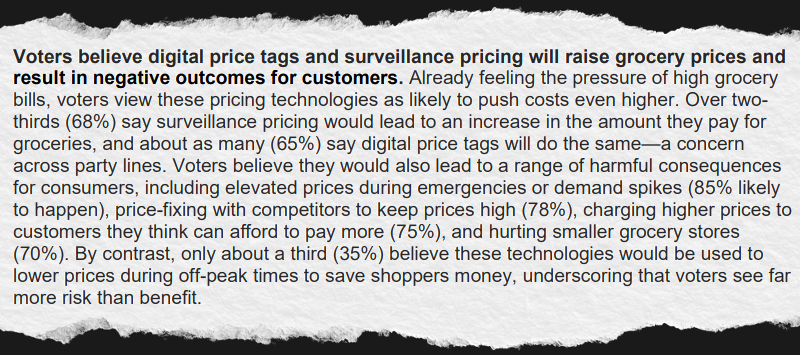
Such practices are referred to as “surveillance pricing”, and according to the UFCW poll, as many as 75% of respondents believe that one day stores might even attempt to tailor the price of an item to the individual. Like something out of Minority Report, the price tag could jump up when it detects a more affluent shopper passing by — or at least, one with a higher credit limit.
To those who may say this all sounds a bit far-fetched, the reality is that surveillance pricing is already here for many goods and services. Anyone who’s ever booked a hotel room can tell you that the price goes up and down based on demand, and rideshare services like Uber and Lyft have never hidden the fact that they adjust fare prices in real-time. Online retailers such as Amazon also routinely offer personalized “deals” based on your shopping habits or search activity, although whether or not you actually save any money in these scenarios is up for debate.
Electronic shelf labels don’t make surveillance pricing possible, since it’s already happening every day online. Rather, it enables retailers to use those same techniques in their brick-and-mortar stores in ways that weren’t possible before.
A Double-Edged Label
As hardware hackers, we love electronic shelf labels, if for no other reason than all those e-ink displays eventually trickling down to us. But the ability to change prices on a whim and without the need for human interaction is troubling, especially when considering the pricing schemes that are already so prevalent online. For better or for worse, we’ve become accustomed to dynamic pricing when we buy things on the Internet, but that doesn’t mean we have to accept as an eventuality that the same practices will eventually come to the grocery aisle.
So, Dear Reader, where do you fall on the subject? Are you excited about the technological implications of turning each price tag into a tiny remotely-controlled computing device, or does the potential for misuse outweigh the benefits? If so, do you think there’s a path forward that allows stores to take advantage of electronic shelf labels while protecting the consumer? Let us know in the comments.












I think that may depend on where you live. I’ve never seen one (UK).
Currys use them now. They’ve been in use in UAE for years.
I was thinking the same. Whenever I see an article about re-purposing shelf labels I always check eBay and find… nothing of interest.
I see lots of them on AliExpress for cheap – though the small narrow e-ink displays also exist as hats / capes for dev boards, without requiring any reverse-engineering (but maybe that’s the fun part).
Maybe more about where you shop. In the UK I’ve seen them in Aldi, the Co-op, and Go Outdoors just in this last week.
Yeah, was gonna say that I’ve seen them plenty in those shops.
Maybe it depends where in the UK you live. London sometimes seems like a different country compared to where I live! (Rural almost-Midlands)
I’m in rural Cornwall, I’ve seen them in at least Co-op, and Lidl.
I’m not in London. I live in rural actual-midlands (east mids specifically), so probably not that far from you. And Cumbria where I was last week is even further from London but plenty of electronic prices labels there too.
We have them in local Waitrose UK. I don’t trust them. Perhaps they go up and down based on sales, promotions, or when they spot me coming via my loyalty card. Certainly, the technology permits this. Who knows?
I’m in the US. The first time I saw one in store was last week, unless you count the one time I saw them in a shoe store 20 years ago.
Sooooo… The first time you saw them was 20 years ago.
Correct. But those ones were just 7 segment LCDs with the price. The actual label that said what the product was were still paper stickers. It must have been a failed experiment, because I never saw anything like that again until recently.
Agree… And I do visit Aldi and other stores and have never seen one….but what I have seen is stores not displaying the price of said object, which I find odd, idiotic and genius at the same time. I guess time will tell which one wins.
I never buy anything without a price.
I just take it home because obviously it’s free.
:D No, I really just refuse to buy anything without a price. That means anything that says, “call for a quote” immediately loses my business, and clearly I’m in the market. If you’re embarrassed by your price, I’m appalled by it.
Intriguing. UK also – my local CoOp, as well as Aldi use them, so they certainly are common around me
They’re quite common in Scotland.
UK law requires anyone using dynamic pricing to display the algo parameters and the full price range possible though.
This is a surprisingly sensible law.
But almost entirely unenforceable with e-ink price tags etc letting you update and do dynamic pricing even while claiming you don’t!
I just have to have few morals and code the dynamic pricing to milk you harder as you look like you can afford it while staying consistent enough to not get caught easily. Which might mean the prices can’t be changed quite as rapidly or at least dramatically as if there were no rules at all – too rapid and it would be easier to catch. However folks are unlikely to notice that 50p on the price per item for a small basket, especially if it doesn’t roll over to the next pound – only the first usually 1 or 2 digit on most items in most currency are the significant ones you might track in your head the rest is small pocket change. So rolling over to the next pound/dollar is vastly more likely to be noticed, but throwing 50p on those xx.25 or even xx.00 (as why use .99 to seem cheaper when you can price dynamically and go much higher!) not so much. Perhaps that changes to 5-10p of a huge shop as your running total most folks might keep in their head will get really really far out across a few hundred items.
Plus if dynamic pricing is openly published it will be even harder for the regular folks to keep track of what the price ranges on everything said and how the parameters are supposed to work for all the items in their basket as long as the published rules allow an update during opening hours so the prices will change on you. It will just end up too confusing!
Being forced to tell you they’re going to screw you over before they screw you over is a surprisingly weak deterrent.
but it allows you to decide if you want to get screwed over or not.
Really doesn’t, as you only have a real choice if alternative options that are not doing the exact same things exist. And 99% of the big business given a licence to screw with you for more profits just for telling you in the fine print are going to take it, the local little store if it still exists at all might not bother, but lacking the huge buying power and efficiencies that come with scale they will be vastly more expensive anyway most likely if they are a general store, or only stock the in season fresh locally farmed stuff etc…
They are in Lidl and Aldi across the UK.
I’ve not seen them here. But when I do, I’ll just photograph them and if the price changes at the till then I’ll complain.
They do exist in the UK. I’ve seen them in various stores in Bristol
Aldi, Lidi, Co-op have used them in West Midlands. I thought they were paper labels until I knocked it off the shelf then saw the buttons. I believe you can override the text with the right device, I’m waiting to see “Tesco is cheaper” written on them.
Literally the other day I spotted some in my local Morrisons, so it looks like they’re just starting to roll them out. Or it might be a test, they only had them on a couple of rows of shelves.
An update to say a few days later that they’re now on every shelf in this store, and that they seem to be very well attached to the shelf edge. (I guess they don’t want them accidentally falling off into people’s shopping ;)
Then you don’t go out
I live in the UK and both the Lidl and Coop stores near me use these electronic labels. The ones the Coop uses can display Black, WHite, Red and Yellow while those in Lidl seem to only do Black, White and Red. I don’t now how Coop update theirs but in Lidl they have a handheld device they use by scanning the product barcode then pointing it at the electronic label they want the product’s price to be displayed on.
They’re literally in every Aldi store
Lidl introduced deals that require the Lidl clubcard app, but these aren’t marked distinctly enough because the digital signs are small and limited to red highlights (Tesco uses bright yellow). There’s now a horrible pattern where customers pick up a deal, get told at checkout that the deal is fake, and either delay the queue while they install an app or, commonly, attempt to ditch their shop at the self-service checkout and leave, only to be stymied by the exit barrier which requires a scanned receipt to leave. Our local has replaced all of the conveyor belts with self-service checkouts too, except for the express checkout, so it’s no longer optimal for the big weekly shop.
It used to be that asda “forgot” to make sure the prices on the shelf met those that the barcode scanned.
Since lidl got esl’s they are playing the same game.
The issue isn’t the esl.
It’s the orientation on the shelf which makes them unreadable vs paper labels.
Because it seems we are being overly inclusive for less than 1% of the population that are not 5ft and over.
Same thing with digital (or QR code) menus.
It allows the restaurant to change prices based on time or season. Printing takes time/money.
Is it a good thing to have easily variable pricing?
At least the display tags aren’t siphoning your info through an app or website link like the QR codes can/do. I automatically assume if someone wants me to use a digital app of some sort they are gathering data.
Tags are probably less harmless than the app the stores often force you to use to get coupons nowadays…unless they are scanning MAC addresses through a distributed network or something.
But yes the cameras, apps and monitoring could very easily at this point create a tailored shopping experience based on income/status. Similar to the “l’idiot” scene from “LA story” [1]
[1] https://youtu.be/6jgJhAEcq6Q?si=a4GA6i0cKSOzzbdX
It’s already happening.
Customer data gathering via BLE positioning has been a thing for well over a decade, and it’s only gotten more precise. Right now it’s unlikely pricing is hyperspecific to the individual as that would be weird to see all the tags refresh as you turn the corner down an aisle. But it’s fairly easy to track where and when the regular big spenders hit the store on the way home and what they typically buy during those trips for Uber-style demand pricing.
Furthermore, the push for online ordering and curbside pickup even for brick and mortar stores skips the middle man and goes straight to traditional online dynamic pricing per customer, especially after COVID where we were almost dependent on them while they were highly subsidized.
It would require storing the “me price” for every product in the store, correctly displaying it when I am in front of the shelf, and then quickly switching to the default (or the specific pricing for the person walking down the aisle behind me). All of which would be very tricky to pull off smoothly – I would expect a lot of errors, which a business might tolerate if they never lose money on them, but even then, they might not want the reputational damage.
They won’t target you individually. They will look for trends. You leak information constantly and if they want to identify which fifteen minutes at a certain time on a particular day to catch a dozen people, then there is nothing stopping them from a technology point of view.
I’m kind of neutral on variable pricing (as any economist will tell you, the price mechanism is a vital signal that allows the market to allocate resources) but my concern with these things is that the pricing could easily be updated too often. What happens if you walk into the store with $10 in your hand, grab a sandwich at $6.99 and a drink at $2.99… and then get to the checkout to find that in the time it took you to walk from the chill cabinet to there, the retailer bumped up the price of either or both items? What price do you pay? A sale is a contract between willing buyer and willing seller; you’d agreed to buy the sandwich at the advertised $6.99 price, and it’s effectively a bait-and-switch if the retailer then demands (say) $9.99 at the checkout. I guess you’d have the option of just leaving the item(s) there and walking out without them, but that’s going to result in more than a few cheesed-off customers.
Right. As long as people watch out for it, there is a negative benefit with updating the prices during trading hours.
They have to deal with complaints, they lose customers. Eventually people will find it more convenient to make their own sandwiches
Electronic Shelf Labels are just a tool, if a business is going to be predatory against customers, the ESL is just reporting a price. Retailers can push the price to the registers whenever they want and most people would just assume they saw the wrong price and pay what is rung up to avoid conflict. The UFCW’s “poll” is from 1,000 people only, not really a good representation. They also leverage people’s feelings on the rising cost of groceries to say that the electronic shelf labels are to blame. What businesses charge, and currently often overcharge, has nothing to do with what type of label is being used. Grocery stores are fined constantly by weights and measures for having incorrect information on paper tags, why would letting them update more quickly and accurately be bad?
The whole surveillance angle is a bit ridiculous if you know how these devices work. If more than one person is in the aisle, is the ESL magically going to update (which takes a while depending on the manufacturer) to show each person a different price? No, it just isn’t a feasible thing to do
Where I live it’s a regular thing to have a checkout line delayed because the customer took pictures of every single price tag on every single item and is going through the pictures to make sure the checkout price matches the shelf price.
I stopped going to one small grocery because multiple people (ok two but they were different people) insisted that the checkout person hand-enter the UPC label because “don’t you know that lasers emit radiation and I’m not going to let you make my food radioactive”
Deeply suspicious people who are absolutely willing to argue pricing indefinitely.
The problem isn’t that the electronic label and the scanner’s price will be different. It’s that they can change the price throughout the day on BOTH depending on who shops when. Happen to go shopping after everyone with a job gets home from work? Get ready to pay 3x.
It’s not PER PERSON AT THE SAME TIME. It’s depending on the time of day and who typically shops then. With these labels they can update the price every 15 minutes, meaning they can make it more expensive THE INSTANT everyone with a job gets off work. BAM you’re not paying x because the clock struck 5:00.
This was not something shops could do with paper labels.
now paying 3x *
The issue here is that some people are still in work from home. Society will tear itself apart if only the people who work in an office pay the premium
The biggest point that consumer protection advocates have a hard time getting people to understand (at least with the communications that I have seen) is that many retail laws revolve around any pricing disputes being resolved by comparing the pricing on the shelf.
(ie, in a disagreement between the register and the shelf, the posted price is used)
These existing protections completely break when the price on the shelf can be changed automatically in both places, and will inevitably be to the disadvantage of the consumer and not the store.
And realistically, why does the price for a jar of pickles need to change multiple times a day or week like the stock market? I am not in here to buy pickle futures… Just damn groceries.
If you’re trying to get an avocado or mango that’s ripe when you want to eat it, you’re basically buying futures…
I’ll go a step further, why is the stock market even so volatile? It was meant to be an organized way for companies to get funding and investors to earn dividends, it should be about holding and getting consistent returns, not gambling for buy low sell high
Nah, these days it’s just speculative gambling. Nothing more. The IPO gives money to companies, and after that, the stock is basically worthless because no one really pays dividends anymore, but the shared delusion keeps things going.
I dunno, maybe if they ad a disposable vape i would be game.
They cost more money than regular labels. Therefore, they will only be deployed when they can extract more money from consumers. Thus, they are bad, and should be defaced or destroyed when encountered.
Or cost less than paying somebody to do it. Extract money from your customers and/or employees.
No, the extra cost can be recovered by reduced labor.
I would never steal the groceries, but these pricetags are tempting.
“Oh sorry, I assumed the price was for this e-ink display” as I show up at the checkout with a basket of them ;)
you’re reading my mind right now. Happy to pay for products, but those ESLs are soooooo tantalising.
They make great e-waste! See openepaperlink.org
Where do you get them that they are sufficiently cheaper than just buying an e-Ink display that was meant for hobbyists, is brand new and complete with API documentation and libraries with great community support?
I was once excited about all the cheap displays that would be available but haven’t really found them yet.
Once someone figures out how to interface with them the price skyrockets. Once, you could buy a Chroma74 for $5. Now it’s $50.
“The usual places”, i.e. ebay. Currently < $10 each for the smaller displays. 4.2″ and larger are currently more expensive. I’ve personally bought several 7.4″ for around $10, but you have to keep watching and be fast on your feet.
They’ve just started showing up in my local shop, weirdly they all seem to cost different amounts ;)
(j/k)
There is a new project for epaper Displays. Open protocol and everything:
https://opendisplay.org
It is backed by the Open Home Foundation, the same team is behind Home Assistant, ESPHome and more.
I have a couple ESL at home flashed with their firmware and it works great showing data from Home Assistant. You just need a couple of Bluetooth proxies in your home.
These have been used by supermarkets in The Netherlands for years now, at least before the pandemic. Mediamarkt has been using them for as long as I can remember. They’re pretty neat and have zero problem with stores using them.
Could this also lead to instantaneous price wars between stores lowering prices?
That’d be nice. The reality is that large supermarkets already collude on this stuff. They don’t need to do rapid dynamic pricing because they have had decades of experience learning to manipulate pricing in other ways that doesn’t require that capability.
It’s also easy to detect and prosecute that sort of fast pricing change. If you’ve got a half decent competition authority (sorry USA, we know that’s not you) then they’re all over that. Here in australia our ACCC just won a big court case against one of our major supermarkets for changing the price of products up just before dropping them back down and marking them as “specials” and claiming you were saving money when the register price was still higher than before. They got caught out violating their own policies which state that products need to be at a particular price for many weeks before a special can be done against that price. Weeks. We’re not seeing instant price changes here any time soon.
It still doesn’t do anything about the blatant anti-competitive behaviour our big two supermarkets have been doing for years, but it’s a start.
My local Walmart loves to do these ””roll backs” with there little smiley face guy. what happens is your paying 74 cents for something then one day it says rolled back price 74 cents! The sticker will say it used to cost 1 dollar. It was never a dollar but i bet you can guess how much the thing will cost in a week or so. I sometimes even catch myself saying “dang those ain’t in sell no more?” Instead one must realize the truth…………..there is no sale
Lowering?
You’re so funny.
You are so not retail :-)
Right, about that.
Electronic tags (and entire infrastructure behind these) sure make spontaneous/emergent cartels easier to form and dissolve. Once one store jacks up it prices for no good/sane/possible reason, it is just a matter of time until all stores in the area suddenly start selling same/similar things for about the same price, perhaps few cents lower to make it fly under the regulation agencies radar.
Store competition … aha, yeah, sure … price wars, aha, yeah sure … the only “wars” I see around me is “see who can charge the largest price” kind of competition. Had it not been for SOME regulations that are STILL in place we’d already see thing like average sponge bread sold for $20 (presently it hovers around $5 – SPONGE BREAD, the crappy kind that’s basically a sponge of unclear chemicals mixed in with the flour and some flavoring to make it tastes okay to eat).
Most Grocery store price wars are fought on the BUY side not the SELL side. Grocery stores operate on fairly thin NET Margins. Their price reductions are almost entirely the result of manufacturer/supplier discounts.
Price competition like that seems likely to be a fallacy. Think about how hard it would be to go to one store, check all the prices for things you want and then go somewhere else.
If the lowest prices are spread across stores or they fluctuate winners, then it very quickly becomes a near pointless endeavor.
The only way it ever worked was when stores where smaller, prices more stable and stores fought across the board on prices. As it stands now they can dick you around enough to make it not worth your time without really competing against each other.
Where I live there are 3 different grocery store options besides walmart. Two of the stores are across the street from one another a few blocks from my house, and the third is in the same shopping center as my work so they are all pretty convenient for me.
The quality of meat at one is better than the others, So I buy most of my meat there. Another has cheaper in store brands so I buy most of my generic staple items there. Two of them have really good weekly sales ads you can check online and compare to walmarts pricing, so from week to week Ill shop 2-3 stores in person depending on sale prices and check other items against the walmart app. Anything thats cheaper at walmart I get delivered on saturday.
There are some items that are the same price at any of the stores unless they are on sale, but there are plenty of items that have a 10-30% difference depending on which store you go to. mornings. Im shopping for a 7 person household so its worth it to me to put in the time and effort to get the best bang for our bucks.
Walmart, Aldi, Stop n Shop, and Shop-Rite all have apps which show the prices.
Surveillance pricing won’t work with shelf edge labels. With discrete sales (such as a hotel room), the interaction is atomic. You see the price and set in motion the purchase based upon that split-second.
In a supermarket, there is a disconnect between taking the item and paying for it, so you can’t link the price at the point of selection to that at the point of payment, and it is illegal (in the UK) for the two to differ.
I think the article muddles surveillance pricing with surge pricing. I’m not too worried about the former for grocery stores, but the latter is almost certainly coming. Increase the prices one hour before closing or before holidays when everyone is desperate to stock up, or just before an item runs out of stock.
I haven’t seen them for years, but there have been systems in stores that allow you to pre-scan items as you place them in your cart, using a store assigned device. Then checkout becomes a single, quick transaction. Something like that at your local Dystopian Grocers brick and mortar would enable capturing the dynamic price at the point the product is added to the physical cart, much more in line with how it could work with the virtual cart.
Nowadays, the scanner could be an app on a cell phone, which would probably not solve the fraud and loss that I think likely killed that mode of checkout. (The length of checkout time now doesn’t matter so much to the retailer since we so often provide the labor at no charge.)
Working in a mobile-scanning-heavy industry at the time, I also saw demos for RFID halos that would just scan everything in a cart, all at once. At the time, they never seemed to crack the elusive sub 5 cent RFID tag so that dream died.
Walmart Sam’s club and Costco all have this feature as part of their app and Walmart is finally starting to have more RFID tags on items so they have better inventory control
Good point. Yeah, that’d work, sadly!
Today this is true in most stores.
Amazons “just walk out” store demonstrates the potential for that dynamic to change, and such technology will only improve and proliferate in time.
Alternatively, Walmart already has offered the ability for you to “Scan and Go” where you use your phone to scan items as you shop. When you get to t he self checkout instead of scanning all items in your cart you scan a single barcode on your phone.
If you eliminate the cashier, if shelf stocking is automated, if janitorial services are robotic, and if your shelf tags update automatically, your store labor costs start to approach zero. With the growing success of raise the wage movements nationwide, Given that the average grocery store already spends approximately half of its gross profit on labor costs, The (nearly) unmanned store is almost an inevitability
RE: “… if shelf stocking is automated …” I suspect it wont’ be long before customers would be forced to in/voluntarily shelf stock. Average store near me is still 1950s “plain vanilla shelves holding the bare amount”, and the Amazon warehouse model is about as comparable with that as Ford T is comparable with Tesla, both have four wheels and drive around.
Eliminating the cashier completely will never work, at least not in the US, and in the particular area I live. The naive vision of people picking items and paying for them … let’s refine this a bit, every store has shadow slush fund to cover the expenses of items regularly disappearing with no trace. People liberally helping themselves is actually not the largest item, it is only visible to the sensational news agencies and all kinds of lawyers liberally helping themselves with trifle crimes. Try managers and their propensity to make things disappear on regular basis, and try perfectly working display items (like large TVs) suddenly going broken and discarded; also, the returned items … and I’ll stop at that. (as a side note, close to me there is a lively shadow market that exchanges so-called “refuse” for career favors, retail store, large franchise, like, REALLY large franchise, I’ll withhold the name, since I’ve got to learn their doings firsthand by accident, oh, we are talking LARGE market, fridges, washers, TVs, food, too, some of it disappears, poof, written off the balance sheets).
Reason being, if one never works “in the industry” he/she can guess, but there are ways of trickling things out in plain view of everyone. Like MANY ways. Price tags? While at it, why not, I have YET to see a store that would suddenly charge you SMALLER price compared to the one advertised. Literally. The mistake is always in the store’s favor. Always. They’d try to sneak up larger price on you when they can. Oh, I’ve also seen interesting sight, long check-out line, some kind of sale going on, people are impatient, and I am told two prices vs advertised one, so I said, no, this IS the price, and suddenly, very suddenly, the PC magically “breaks” and poof, my purchase disappears, to be entered anew, again, this time price and a half, slowly … entered slowly … when I said “NO!” poof, breaks again, and now a manager has to be called, because “computer is broken”. Magic in the making.
Now imagine the same scenario done by actor we don’t see, they just flip the prices unnoticeable, always in the store’s favor, ALWAYS.
Cheating with the prices is nothing new. If you’ve ever dealt with traditional industrial suppliers, you’d know that the prices are either not listed at all and simply made up on the spot, or the list price is something completely ridiculous just to list some price and every customer gets a discount. You get 80% discount on the list price, I get 95%, they get 87.5% discount… depending on who’s paying and who’s cashing it in.
Don’t forget that haggling for prices used to be business as usual.
The list price is also known as the government price, because the government can’t haggle and ask for discounts. They have to follow the public tendering process, and the publicly listed prices are real prices as far as they’re concerned.
Of course then, the suppliers that don’t directly list prices will not bid 20% of what the government officially believes they must pay, even though for all other business giving an 80% discount is the default. That’s just private information not officially available to the tendering process, even though everybody knows that the government is paying 5x too much.
ESL are just great. They contain a trove of nice hardware:
– some have Sharp low-power “memory LCD”, the other have e-ink displays. Some are quite large and some have three colors. All have a radio of some kind, be it bluetooth, sub-GHz radio. If not they have at least and IR link for updates.
Many can be re-flashed with OEPL firmware, severing their dependence to proprietary gateway HW/SW, and transforming them into useful appliances.
The cheapest ones accidentally fall in the shopping cart (oops), but there are sometimes whole boxes of them for dirt cheap on eBay too. Cheap because one mut change the batteries and it is often cheaper to buy new ones than tediously change the battery and sometimes pair them to the gateway again (most have only volatile settings)
Weather board, Server / rack status, calendar, fridge memo, picture frame, meeting room reservation board… there are tons of uses.
They don’t seen to stick on the shelves correctly huh? I find my self reaching under to pull out a handful of them and checking upc so I know what stuff costs. Sometimes there is no upc on the damn thing and I have to put three or four of the choices in the cart and have them check at the register. When they give me that look I show them the picture of the shelves with busted tags on the floor. Lol and the date of the picture too because it’s the same one on the floor every week.
Here in Austria we have those ePaper pricetags in almost all supermarkets since years and there are no negative issues coming up. it’s just a pricetag – they have been just printed on paper in tha past and now they are just replaced by a static electronic display. the staff still must go and reprogram every tag with a handheld device. They are not connected and can’t be reprogrammed over-the-air. They just save paper and I guess it’s less error prone (the programming device logs all tasks).
Demonizing such pricetags is just like being against electric lightbulbs in the past. It appears people are more retrogressive nowadays than 30 years ago – some just don’t keep the pace with technology.
Even if they’re updating wirelessly, it’s still illegal to switch prices up between the customer picking the item and the cashier asking for the money, so the price updates happen while the shop is closed. If you see a tag refreshing during the day, it’s probably to signal a new discount that you would get anyways.
The wireless tags have one additional advantage: if you ask the staff where something is, they can actually call the tag and make it flash and buzz. That has come handy once or twice.
A friend of ours does Spark while her kids at school shopping orders at walmart and delivering them to peoples homes. Her primary store rolled out etags late last year. She says it has made it so much easier because now she doesnt look for the items at all, she just hits the button on her spark app to make the next item flash. She says it cuts her shop times in half.
They are commonplace in Germany, pretty much every store has exclusively only electronic labels. Tbh I don’t know what the fuss is about regarding pricing. Sure, stores can change prices often but if they couldn’t they would err on the higher side to have more margin. If they can adapt pricing easily the average will likely be the same and I as a consumer can go at times where the price is lower. It would be good to require stores to actually publish realtime prices since they are all digital anyway in the same way that gas stations are required to publish their prices in Germany, then I would really have the choice. Nowadays more people are working from home and would be able to go shopping when prices are lower.
Our Walmart started switching a month or so ago. Dozens of them just sitting on shelves, easy to pickup. So tempting to pocket a few… But, they also have cameras everywhere. No way I’m putting my hands in my pockets.
Pricing, it’s what’s in the computer, and on the barcode. Likely better than sticker pricing labels. Mistakes made, or someone moving stickers to save a buck arguing advertised price. Most people pay the price scanned at checkout. Stores aren’t going to play a lot, and lose customers. Profit is from volume sales, not gouging on items. Too many other stores competing for sales on the same items. Shoppers will notice, and stop buying at scammy stores. Pissed off customers complain most. Social media gets the whining out quick, and far.
Really do want to play with some of these tags, just a little spendy surplus. Maybe wait and see. Thess complete units, and someone figuring the communication could be fun. Could change store tags to show anything, and it’s there until the store updates the price.
Lol I put my hands in my pockets all the time. Never take anything. the goal is to get a big crew to follow me around while I act suspicious. My little revenge for When they called police on me and I was charged with shoplifting after a self checkout mistake a few years ago (I was literally begging for a cashier that night because store was closing and I had two carts full, they told me too bad hurry up and of course I missed random items.. bastards wouldn’t let me pay for 56 effin dollars worth of groceries. Security said it was obviously a mistake but the cops were called ad per procedure. they asked me if I thought it was the stores responsibility to make sure I scanned everything. When I said yes they charged me. Walmart said I could shop their anytime sorry they called the police it was up to them what happened next. lawyers and court fees ruined me!)
Since then no more acting normal when I go grocery shopping. I got Hands in pockets shifty eyes bulging pockets. You know so they can have a little excitement in their job and not screw up someone else’s life. Damn I’m bitter ain’t i.
The problem is that for some reason the personal are not informed much about them in some shops, because if one fails it takes ages for it to be replaced, where you would think it was walking to the back and getting a new one and entering its ID n the computer interface.
Maybe all that AI agent stuff will actually be used in such environment in the future where they ask it what to do and it’ll tell them to replace it and it’ll update the db to know what it is labeling, all done verbally.
I don’t think I know a supermarket without them btw.
“if one fails it takes ages for it to be replaced, where you would think it was walking to the back and getting a new one and entering its ID n the computer interface.”
It would be nice if this were actually true of “paper tags” but in reality many stores did not have the printer that produced shelf tags, instead receiving a packet of them weekly from corporate. When a customer damaged a tag you would have to scan the product and submit it for replacement in the next weeks “tag pack”. So it would take up to a week from the time a stocker identified the damaged tag to get it replaced. Depending on the items restock frequency this could be as long as a month in some cases.
An etag needing replaced is easier as EVERY Etag can be assigned to ANY product. Labor incompetence is all thats slowing their upkeep in your stores.
For the time I’ve worked in retail, there was always a laser printer at the back office, and the tags are just paper. It would take some malicious compliance or willful incompetence to wait for corporate to send replacement tags for broken ones, instead of just whipping one up in MS Paint and printing a replacement.
No one who works in a grocery store cares enough to go through the trouble of whipping a tag up in MS paint and printing a replacement. Its neither malicious nor incompetance, its just corporate culture compliance.
That’s true. It’s more likely that you’d just write the price down with a ballpoint pen on a piece of paper, or leave the tag out entirely.
Though the reason I thought it would be easy to print the tag is because it gives you an excuse to loiter around the back office.
It’s actually surprising that shops would still get the labels printed elsewhere rather than just send a PDF to the shop and have them print it, because the cost of the logistics is pretty similar these days.
You know that employee loitering around the printer?
Thats far more expensive than the “logistics” of having your distribution warehouse printing labels for ALL of the stores they service and including the weekly tag packet in the trailer that is already being sent to the store.
Additionally you skip the expense of a printer, labels, ink, and tech support to keep that system running in a few dozen locations per region serviced by a single distribution warehouse.
The alternative is that they’re loitering between the shelves pretending to work, so they wouldn’t need to pick up another pointless task like re-arranging the bananas.
it’s more about looking busy than being busy.
I think it’s important to note that these tags are generally powered by two coin cells spot welded together in a plastic carrier which slots into the display housing. You’d need to change the batteries quite often to do surveillance pricing. On the other hand, RLCD price tags with a low-voltage four-wire bus running along the shelf would be perfect for that.
Exactly this, the article implied (and lots of comments assume) this allows for dynamic pricing and remote changes. It doesn’t, they aren’t remote at all. It’s just a very expensive (relatively) replacement for a bit of paper, which a shop worker has to come and edit with a PDA like device.
Nope. Many modern etags are capable of remote updates. They do not require a shop worker to come by. They can be updated wirelessly, instantly, in large numbers across a wide range.
“Walmart’s Digital Shelf Labels (DSLs) are wirelessly updated. They connect via wireless networks to the store’s central system and pricing database, allowing updates to prices instantly through remote, centralized management wireless system. “
Simple legislative solution: Only allow physical retailers to change prices when closed or between midnight and 2 AM. local time.
Simple in concept. But as always, the devil’s in the enforcement.
At Walmart in US this is 100% in full effect. Changing price for individuals and sort of surge pricing.
Tagged price using e-ink was one price. The price online on the App (the clerks in store will price match the online / app price which is usually lower) was $1-2 cheaper.
When we rung it up using our club member number or whatever it was even cheaper. Not complaining in that one per se but the implications that different people are getting charged different prices and that you do t really know whet the price of a thing is means you can’t shop around as much.
I vote no.
Landline phone companies use add spurious charges of a few cents. Profiting off customers who they knew wouldn’t challenge it. Today’s customers are armed with easy real-time data, apps, and community chat sites… I guess if it takes off depends on how busy, tired, or lazy any given area is? They wouldn’t roll out losing tech without anything to show for it.
If I had $10 on my pocket and was concerned about pricing. I’d snap a couple of photos of the tags. If the price changed while I was shopping I’d ask for the price or walk away
My local Safeway just converted over to these and I have to say I’m not happy about it since the chain has been taking more and more aspects of running the store out of the hands of local management in favor of centralized (opaque) decision making. The constant theme though has been that the customer experience has gotten worse and, though the store manager is aware of it, they neither know how the decision was actually made nor have any real influence going forward (so far this has covered things like having long periods of time when only self checkout is open as well as the management no longer having any say in what gets ordered and stocked) so it seems inevitable that predatory dynamic pricing is not far behind. Already they’ve moved the club diacount programs such that anyone not grandfathered in can only join via a spyware laden smartphone app =:-( so I don’t trust them at all…
if it helps drive down the price of commodity eInk displays and they start showing up in thrift stores, I’m all for them!
Aldi’s doesn’t have specials and such, just the lowest price all the time. No price wars. No psycol games.
No coupons. Poo pon coupons, that’s what pigeons do. My card at the big grocery is blank and accepted anyway, just a statistic of what sold but not me.
I like the tags in the store because an outdated price is much less likely to be displayed. The number of times I’ve picked up an item and been checking out only to find it is a completely different price is annoying. Most of the time the store will go check, pull the old price tag off the shelf, leaving nothing, and then perhaps give me the old price, but sometimes just point out the small print showing the price ended before the current date. Either way I have to decide if the time to fight is worth it or not, and whether I want the item at the new price.
I look forward to seeing these devices on the secondary market, but haven’t yet seen a glut.
Wait! A union is opposed to change? Say it ain’t so!
I see these on Aliexpress and they are always shown with a store logo or the same graphic framework. I have assumed they are screened on and only part of the area is writable or usable. Are y’all saying they are all actually completely writable? They are also rather expensive but if the full area is usable I will be getting some.
I worked at a grocery store that uses the electronic tags, and they had some really neat perks. My favorite feature was the find feature. If I was putting away a product where I didn’t know where it went, I could scan the label with the zebra gun and a light would blink on the tag showing me where the item went on the shelf. Saved a ton of time.
In terms of surveillance pricing, I am not worried about electronic tags being used for that. First of all, they are so slow to update, that it would be painfully obvious that prices were being dynamically altered for customers passing by. Even if they updated instantaneously, it would still be difficult to implement in a reliable way. And, if you quit using “the app” for everything, it will become much harder to reliably gather information on you.
Surge pricing is a different story, and I could easily see tags being used for surge pricing schemes. However the effects of that could be easily mitigated by working around the surge. My store sold TONS of bottled water in the summer, since everybody needed it for activities, etc. In this case, it would make sense to increase bottled water prices during the hot days and decrease them when it gets colder. However, there’s nothing stopping you from thinking ahead and buying a case or two of bottled water in April, when it’s rainy out and nobody’s doing anything. Same goes for the umbrella example. Buy one on a clear day when prices are low.
Surge pricing is maybe not great, but it’s definitely workable if you’re smart and can plan ahead.
US grocery store chain Publix has a policy to fully refund an item if the shelf tag does not match the price rung up. They happily apologize for the error and give up to 2 items for free and the rest changed to the shelf price. Last week bought 4 cheese rounds with ‘2 for 1’ shelf tag but rang up at full price, scored 2 free and the other two 1/2 off. I would assume the chain would have a similar policy if electronic tags are deployed.
Many stores have a policy that they will honor the shelf price if it’s lower than the price in the register.
I suspect one breakpoint for usage is how often new labels come with new plan-o-grams. If someone has to reposition, add, or remove labels about as often as the prices change then they might as well be sent in a paper label pack. That’s going to differ between store type and chain.
The strategy with dynamic pricing is the opposite of what you think.
Affluent shoppers get a discount, in hopes it will keep them coming back, and the poors get the higher price, as they are less likely to shop as frequently and you have to maximize what you can get out of them.
This is already happening in test markets in the U.S.
I have nothing against electronic labels, just as long as they aren’t used in this way.
The strategy with dynamic pricing is not what you think.
Affluent shoppers are shopping less and less and having their groceries delivered more and more.
Customized pricing on a customer by customer basis would be very resource insensive.
Dynamic pricing is far more likely to be implemented in a scheduled manner. Adjusting the prices so that people shopping right after work, during lunch hours, etc pay higher prices than those shopping during lower traffic hours. This allows the store to increase their gross sales to balance elevated labor costs incurred by the higher staff requirements during those periods.
Why would the store bother to adjust the prices down for people who come in at less busy hours?
They’re the minority of customers in the first place, so whether they pay more or less makes little difference. Keeping the prices high would not significantly lower the number of customers, and dropping the prices down would not significantly increase the traffic because most people are too busy to take advantage of the discount.
They might represent the minority of customers in number, but they often are the customers who rack up the highest order totals. Additionally these shoppers are the ones MOST likely to comparison shop multiple chains, so retaining their business is harder than those who convenience shop during high traffic periods in whatever store is directly in line with their commute.
I don’t buy it. The people who can come in at any time are people who are unemployed or pensioners, or kids skipping school, rarely the the type of person who would buy a lot of stuff at once.
From income distribution alone, it would be a rare person who has the time to shop around, the money to buy a lot of stuff, and the reason to go to local supermarkets to buy it rather than purchasing directly from suppliers.
the people who can come in anytime are the employed shopping for their daycare center. They are the employed domestic employee shopping for a wealthy household. They are the unemployed stay at home partner of the 6-7 figure partner. There are plenty of people with plenty of money shopping in the middle of the day and its not uncommon to see them with a FULL cart. Where your after work shopper only has a hand basket.
But you live in some european micronation with the population of a US state. So your world and mine are entirely different. Youre probably right within your perspective.
Looking at the income distribution for people who would have the money to hire people to do their groceries in the middle of the day, that’s looking at just 10-20% of the potential customers.
I’m still not buying the idea.
More so on the point of, if you were targeting rich people who have their servants shop during the day, you wouldn’t give them discounts – you’d keep the prices consistently high.
It would still be targeting a minority of a minority: people above upper middle class, who hire servants, and actually care what it costs to do their shopping on top of all that expense.
Youve really got tunnel vision. You seem to have latched on one part of what I wrote and cant let it go. You win. Enjoy your bliss!
This exact thing is what credit card
Companies do. Huge percs (free airline travel, lounges, low interest rates, and low/no annual fees ) for the heavy users on the backs of the average users who pay all the fees to subsidize the big rewards.
I posted above. This appears to be exactly what Walmart did for us. We use app, shop around and are pretty savvy I like to think. There are many other explanations but the case study of credit cards is well know and my personal experience is… anecdotal but still modest data.
Thermal paper’s pretty bad for the enviroment but so are these… but at least these can be reused so I just kinda feel torn.
The economics of the situation is probably that you could print 500-1000 thermal paper tags for the cost of every electronic tag, which won’t get a significantly longer life span in use, but if it saves labor on someone swapping out the tags which is less wages paid and more profit made.
seems kind of irrelevant to me. this is just a neat tool. the underlying economic situation is what has us tied up. monopolies, de-industrialization, centralized logistics, a workforce divided against itself. if i have a range of quality affordable vendors to chose from, it doesn’t matter how they chose to display their prices. and if i don’t, it still doesn’t matter.
yeah. this is a non-issue and, rightfully, nobody is talking about this at the dinner table. the tags are inexpensive, the materials involved are not substantial; the amount of labor being replaced is not drastic. prices have always changed (btw, I’ve noticed Amazon doing much more sinister experiments with “prime only” prices which only sometimes appear; I was looking at grow tents yday and could get up to $40 off some if I signed up for Prime. after I decided against grow tents as a category and ordered quantum lights instead, I went back to the grow tent pages to document this, but then the prime-only pricing box was nowhere to be seen). we have so many real crises right now. may’s well be asking how I feel about convex mirrors in warehouses.
Voters would probably be surprised to hear that it was their vote that has raised grocery prices and resulted in negative outcomes for customers, not digital price tags. :)
So if they detect I’m broke thay will display: Go away loser!?
If they could detect that you were broke you wouldn’t make it past the trapdoor.
No possible good can come from a broke person being in a business.
Not even as an employee, never hire messes.
I think there is a movie where the ads act like that , the second edition of this movie where the guy hunts robots and falls in love with a digital e girl or something, he was walking in the street and some adds tell him to walk away, but maybe I need more coffee. In the other hand ,companies go bankrupcy all the time but that doesn’t mean the CEO’s or owners are a mess.
“How Do You Feel About Electronic Shelf Labels?” Ask us when we can afford to go shopping again.
They’re a more recent addition at my Walmart (2 month’ish ago). They are pretty wrong at times, don’t line up with the products they’re suppose to represent.
It’s this age old dream for corporate HQs to control what is happening on the ground in mealtime. They’ll keep doing it, because they’re right there where these kinds of decisions can be made…. even if nothing works on the ground as expected.
Eventually I’ll have to buy all my things from Amazon instead, through a “family” account, that has the lowest price.
There’ll be a website for that amazonfamilyfinder.com “Find Amazon ‘Family’ members in your neighborhood. Lowest Prices Guaranteed.” … then there’ll be terms of service breach …. blah blah….
I don’t see surveillance pricing on these labels. Why? It’s impractical. Think of it – stores are busy. If you look at a tag, at the same time someone else does, what price will it show? It can’t display a price for you and a price for the other shopper. You both will have the same price and it will have so many decisions it’ll be impractical.
Second, people have phones. You want to change the price? Well people will compare against what they captured. Raise the price and they’ll reject the item. If you wonder why grocery lines are long, it’s because people will argue that the lemons were 10 cents cheaper. You do something like this and the lineups will be interminable. Either shoppers will abandon their carts, or argue with the cashier making lines go slower. Stores will have to hire more cashiers for the lines, and more restockers to put abandoned carts and products back on the shelf. The fact this happens is why price updates happen when the store is closed – you don’t want to change the price when it’s open as there will be people who want the old price even if you changed them hours ago (yes, some people do take hours to shop).
The impractical reality is people check prices especially at grocery stores. And they will argue over pennies. This sort of surveillance pricing will turn more people into those kind of shoppers who will check every price as it’s scanned. Which means instead of scanning dozens of items a minute, you scan one item, wait for the shopper to check the price, and then move on. At this point you’re scanning one item per minute.
Surveillance pricing only works easily online when you’re not with others and there’s no one around to argue with.
It’s not about some mythical “surveillance pricing”, it’s just generating necessary engagement on the site after a series of recent articles went rather quiet. Can’t make money when nobody watches your ads.
All them fools who commented simply got baited with a cheap ragebait.
I’m fine with the price of umbrellas going down when it’s not raining.
These articles always present the scary scenario to boost engagement. But the price of umbrellas SHOULD go up when it’s raining. You don’t want some people buying two when it’s raining and someone who has none arriving at an empty shelf. It’s fair and it makes sense.
This is not about what you think makes sense, it’s getting the most money, sense be damned if there is enough money. The Squeeze is on.
The trouble is, the sellers and the advertisers are in a position of power where they (metaphorically) control the weather. So they can cause it to “rain” whenever their spreadsheet demands it, by manipulating some factor which they control and you don’t.
Anecdote time. A guy I went to university with is a finance bro. Years ago he bragged to me that if he didn’t look like making his bonus that quarter, he controlled 80% of all the carparks in a major US city. He could ratchet up the parking charges until his stats hit his bonus threshold. These people make a living by making other people’s lives cost more.
Much ado about nothing. Gullible people worrying about things that won’t or extremely rarely happen. Get over it.
Mate, I’ve literally seen the price changing happen with my own eyes. Maybe consider who’s being the gullible one here.
I like Daiso stores in Japan and Korea. The prices a hard printed on the package during production and never change. Also the prices are round like 1000Y, 1500Y, 2000Y. It is like dollar stores, but the products are good.
I live in Newfoundland, a store opened in December with them, since then all the other national chain stores got them too. I think it’s great to save materials, and time.
The biggest problem I notice is they change the colors on them arbitrarily, matching the yellows and reds of sale and ‘affordable’ colorings on signs, even when the item is not on sale, or the cheapest of its type.
Canada’s grocery stores are also notorious for things like raise the price substantially, price lock it, then sell it at a temporary discount. (eg. store brand tomato paste was price locked at 2 for $1.00, then 3 months later became $2.00/can), it’s almost too easy for them to change prices.
These are all just problems with the people in charge of the grocery stores though, electronic tags are the ideal to me.
I live not very far from a large public university and find more than a few remnants of stolen tags – still waiting to hear of shenanigans that are possible with this sort of thing.
Corporations are pretty good at experimenting with cost saving, profit generating schemes, questionable ethics, legality. Sort of what an executive is hired to do. Their production standard/quota. They are expected to do something, even if it’s not practical. To sell the idea, they have to write it up, estimate benefits, risk management, positive, negative outcomes. Doubt we are going to see major scams in most stores.
There seem to be apps, that let people scan barcodes with their phones. Not sure what all they do, just annoying, as they tend to block aisle as they do it. Seem like a customer could simply scan barcodes as they fill the cart, and match at the register/checkout.
Dynamic pricing is meant to balance the workload. Encourage more to shop during slower hours. Peak hours less crowded. Stores still have the same number of people working, regardless of how busy. I’ll admit to just leaving a basket of groceries, and walking out, do to long, slow moving checkout lines. Mostly because they closed the line I was in, before I got very far. Out of 20+ checkout lanes, only 6-8 working? Including self checkout. Wasn’t going to spend 30-40 minutes waiting in line. I know I’m not the only one, see abandoned carts most everytime I shop.
They’ll only last until shoppers learn to hack them.
Hacking them to place funny or otherwise inappropriate messages happens now and then. Hacking them to get cheaper prices, not a concern really as the scanned price feeds from the stores database not the tags display.
It could even be possible to use the event change log to reference store security feeds and determine that you were altering prices. Which they would let you do. They would let you keep changing prices and they would keep honoring your self imposed discount for as long as it takes for you to rack up a felonious amount, just like they do with frequent shoplifters today.
Absolutely hate the stupid things, pointless waste of technology
I’ve noticed prices changing on certain things between days at my local supermarket since they started using these, so I’m not a fan of how they’re used. Meats changed price a lot, specifically- but probably tons of other things too.
Sure, but is that not easily explained by tariffs and whatnot? Meat changes price nearly weekly
The store I work at in Ontario exclusively uses these. All the fears of surveillance pricing are, as of right now, baseless. It would be nearly impossible to pull off a personalized price for affluent individuals. What if they look up at item online first, only to find the shelf price to be twice as much? What happens when, at the cashier, they protest the price and ask us to re-check the shelf? There is simply too much in motion to account for every possible discrepancy. Unless there is a massive change in system, this is an unexecutable idea.
“surveillance pricing is already here for many goods and services. Anyone who’s ever booked a hotel room can tell you that the price goes up and down based on demand”
That’s not surveillance pricing, but pricing based on scarcity.
With hotels it prevents all rooms to be booked full too quickly in a high demand region and spreads out people more. Price gauging in an emergency prevents hoarding and stimulates new more supply to a region with high demand.
It’s only surveillance pricing if it discriminates individuals.