
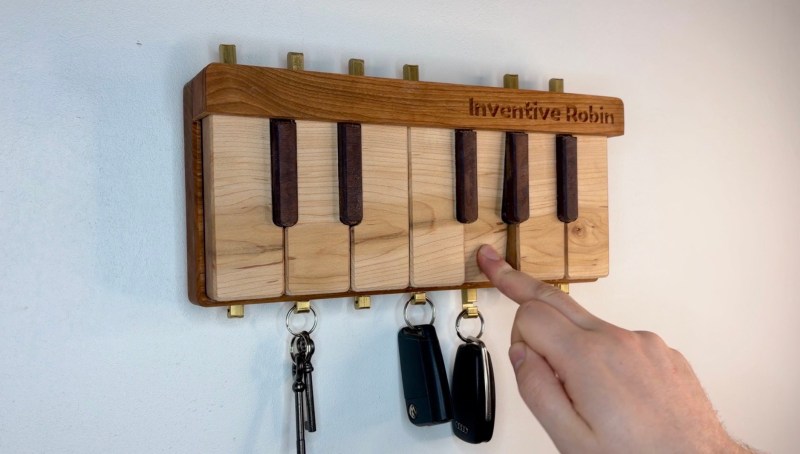
There are many ways to deal with keys: a bowl next to the entryway, a junk drawer, or you can just leave them in your pockets and hope you remember to check on Laundry Day. [Inventive Robin] has come up with his own, unique take on the key holder concept: he’s got piano keys to hold his car keys, CNC’d out of some nice hardwoods.
Of course, it’s not just a fake one-octave piano with hooks glued to it; that wouldn’t be quite enough to catch our fancy. There’s a mechanism hidden under the “white” keys– made of maple– that lowers the brass hooks when you press the, er, wooden actuator, so you can retrieve your, uh, lock-openers. Keys, that is. They’re both keys, of different sorts, because English is a wonderful language. In any case, pressing the maple key a second time lifts the brass hook, trapping the likely metal key hanging on it.
The mechanism was carved from acetyl sheet on the same Shapoko CNC machine that handled the wood, and was assembled with purchased metal rods, springs, and some plastic standoffs. It’s very satisfying to watch it work unenclosed, so check out the build video embedded below to see that in action– jump to 4:46 if you don’t want to get the whole design brief.
It’s not the most complex of hacks, but it’s beautifully done inside and out, and [Robin] is clearly happy with the result. It’s nice enough that visitors might want to photograph the key holder, but perhaps have them do it sans keys– those photos could potentially be a security risk.












Overkill, very cool. Next version adds Glockenspiel.
I second that.
Or fleamarket-sourced grandfather clock gong rods. Definitely worthy : – ]
Don’t think there’s much risk showing photos of closed car keys?!
Very neat mechanism. I’d also point out that that set of keys are in the key of C.
But I do think the grain runs the wrong way on the keys. That would bug me.
The grain runs the wrong way and isn’t lined up from key to key. Either is bad enough. Both together just really gets me, though.
“The wrong way”?! It’s artistic genius, I tell you. The lateral orientation is clearly intentional visual poetry symbolizing how a piano player’s hands traverse a piano keyboard as their fingers flow deftly between notes. As for the broken grain pattern, I completely relate to that as a representation of my (attempted) playing.
:-D
I haven’t watched the video and I’m totally projecting here, but I figured that the grain orientation originated as a property of the wood source: as in, “Hey, I have this box of random offcuts laying around that an ordinary (normal) person would have thrown away years ago. I can use these to make something.”
That’s my project! And yes, you’re right – I’d pay more attention to the grain direction if I made it again, but tbh I was just happy to make the damn thing work in the first place!
its a easy fix: just buy a sheet of veneer and resurface them the right way. (grain going top down in the right order)
One does not ask why a person would build this. (The answer is, of course “because I can”).
The question is why would you want a mechanism like this to hold your keys? A simple hook is simpler and easier to use, requires less time and action, and doesn’t require inspecting it to determine the state of the mechanism before attempting to remove or reinsert the keyring on the hook — because the same action is used to latch and unlatch the key.
I know it wouldn’t last a single day without damage on my wall, or would simply remain a set of hooks, forever unlatched. But also forever bereft of keys, because we never hang keys on hooks.
Because kids and pets : – ]
I agree with all your points, including that the overall answer is still “because I can”!
Oh yah, after 3 months they’ll all be in the open position, for convenience. But that’s 3 months of clicking goodness.
How will it hang the key shown in the thumbnail ? It wil probabbly not fit the too tiny hook.
Awesome project!
Thanks for featuring my project on the Hackaday blog! It was a great challenge to make but very enjoyable all the same.
I like the BNC Connector Keyholder. I had it at my last job. Not designer made, but was cool.
Nice idea, if you used that with BNC terminators, you could sense which key was there and which not.
I half expected to see a simple lever pushing on a latching push switch or even a magnetic solution.
Admittedly it’s a pleasant surprise to see an interestingly designed purely mechanical mechanism like this.
RE: There are many ways to deal with keys – ours is “small hooks screwed into the entrance door”. Logistic are simple, keys stay on the hook until you need them, returned once done.
Years and years back i bought this neat “whistler key token”. If you left your keys in a pocket, buried beneath the inbox papers, etc, you whistle certain frequency and it whistles back. Right, once the battery run out, you are left one-on-one with the reality that’s not powered by any batteries.