
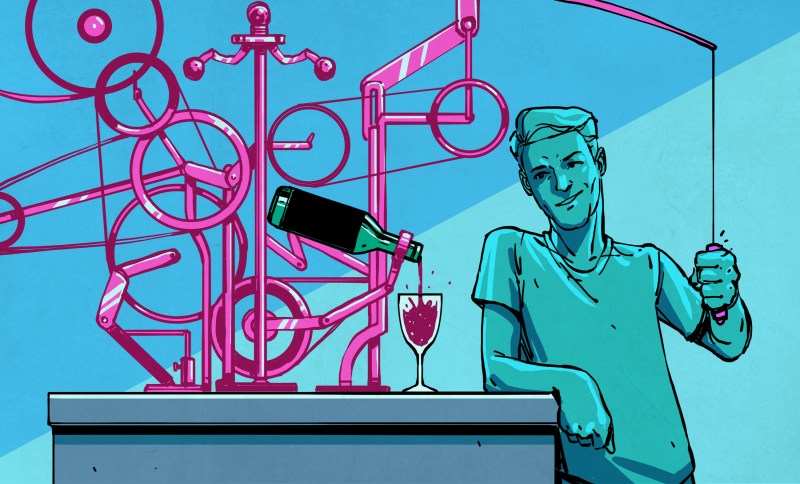
I studied physics in college, and I’m always surprised how fundamental some of the concepts are. Take waves for example. You really wouldn’t expect the same underlying concept to be at work on surface of a pond, the string of a guitar, light passing through two slits, and then in the probabilistic behavior of electrons orbiting inside nuclei. But here we are, in a world filled with wave-like phenomena.
What little control theory I know, I’ve learned in the school of hard knocks. But it’s equally amazing that the same basic concepts govern the tuning of car shock absorbers, PID controllers, active audio filters, and other more complex systems where feedback matters. Crucial in all of these systems is the judicious balance of amplification and damping.
And last week on vacation, learning to drive a covered wagon pulled by a heavy draft horse, I saw the same patterns again. The horse likes to pull, and when the wagon comes over the crest of the top of a hill, it starts to roll forward into his harness, pushing him from behind. This makes the horse uneasy, and he slows down, the wagon pushes him harder, and positive feedback gets out of control.
The man who was teaching me to drive the wagon said, “it’s not like a car” in that you don’t tap the brakes to slow down and then let go. Rather, you hold on the brakes for a lot longer than you think is necessary – until the horse tells you that he feels like pulling again – and then you let up only a tiny bit at a time. Otherwise, you end up in the under-damped case, where you let the wagon go too much, it slows the horse, you slam the brakes, the horse pulls hard, and you let up on the brakes, and the cycle continues anew.
What he meant by “not like a car” was that the brakes aren’t just slowing down the wagon, they’re adding damping to keep the horse-wagon system from oscillating. Once that clicked in my mind, everything was smooth sailing. After a couple of days, I even started adding some feed-forward to my mental PID controller, letting the brakes go a little bit more when the horse was approaching the bottom of a hill, and he obviously wanted to pick up a little more speed before the grade ahead.
The horse seemed happy that I was finally getting it, but I don’t think he had any understanding of tuning PID loops. He did have me pondering, on a long stretch of rolling hills on a summer morning, if there were a good minimal set of patterns that explained a maximal breadth of phenomena. I’m starting with the physics of waves and the control of feedback systems, but what’s next?












Have a look at “Dynamical Analogies” by Harry F. Olson.
1st ed. 1943: https://archive.org/details/DynamicalAnalogies
2nd ed. 1958: https://archive.org/details/in.ernet.dli.2015.133700
i see yet more such. specially my whole life is like such wave of having bad and a bit better times (and height of this wave changes quickly actually, even few times daily). not saying that “golden proportion” also oftenly appears in nature (eg. in plants oftenly)…
Also if you spend enough time on a small enough boat (40-50ft) in heavy enough seas (4-6ft) you come to learn, without reading any research papers, that every sea state has repeating patterns.
I’d love to read specifically about that 7-11 pattern in ocean waves but web search being what it is in 2026 all I’m finding is disposable products from Amazon/Temu/etc. and royalty-free stock photo sites and if I try to narrow it down I just get No matches found so, fantastic. We’re doing just great.
Remember the promise of “The World-Wide Web”? 😢
Unlimited access to information would give us a new renaissance, they said.
Unfortunately it meant readopting ideas and attitudes from the 16th century.
yes, but maybe thats just an overshoot before settling into something more stable.
Everything has an expiration date.
Ideas re-emerge when the conditions are suitable.
For example, the left-green preaching the idea that the society and the entire world is a zero sum game, for the past century, has laid good groundwork for the emergence of modern mercantilism.
Yes.
As a student I had the privilege of designing both analog (PI) and digital (PID) controllers for projects and I still see those patterns everywhere, so I can relate. One pattern that you will also see from now 😆 is the roll when big aircraft are on autopilot. I am convinced it is controlled with a PID filter because there is this very gentle and slow but predictable left and right roll. Just like an I factor tweaked so it can cross zero in a predictable way. If the I factor was too low, the plane will get stuck flying lopsided.
I wonder if this is intentional- a commercial pilot once told me that they had, on occasion, intentionally caused this gentle roll left and right to help calm down a crowd of passengers who were upset at having their alcohol service cut off.
I don’t know if it was just a joke to them at the time or more widely used trick, but aircraft manufacturers do tune some other parameters (eg light levels), for maximum passenger docility, so it wouldn’t exactly surprise me.
Never herd of that patter. Is it something like this:
https://thenaturenetwork.co.uk/why-do-ocean-waves-always-come-in-sets-of-seven/
You might be interested in checking out all the techniques that people in in Pacific used to navigate across vast distances. A blend of knowledge of the local fauna and flora, smells, feel and sound of the water. They could also detect different types of waves that emerged from the reflections off landmasses long before seeing it.
The equipment used for this type of wave detection consisted of two items suspended forming an incredibly sensitive pendulum. The most experienced navigator would suspend his (had to be a man) navigation equipment and from what I have read, the others would show keen interest and keep an eye on the readings.
Nowadays, marine navigators don’t use that specific equipment for navigation anymore and the occupation is also no longer limited to men.
Very appopriate illustration
You can brighten someone’s day with a wave 👋🏼. We also enter contracts by signing waivers with our waver 👋🏼.
Thinking in Systems!
https://www.chelseagreen.com/product/thinking-in-systems/
Came here to say this! Donella Meadows lays out a nice compact catalogue of recurring patterns that you’ll start seeing everywhere.
Another good book on patterns also comes from Chelsea Green: Seeing Nature, by Paul Krafel. It’s been out of print for a while, but it’s been republished by a friend of mine as Shifting. You can find it on Amazon https://www.amazon.ca/Shifting-Natures-change-Paul-Krafel/dp/9198917218 (no affiliate marketing, don’t worry).
This book is a memoir of Krafel’s time with the US National Park Service, and at first it feels like only that — just a collection of disjointed stories. But after a while he pulls it all together tidily. The patterns he identifies echo Meadows, David Holmgren/Bill Mollison (co-creators of permaculture design) — I mean, that’s inevitable with patterns; it’s what makes them patterns ;)
And I’d be remiss if I didn’t mention the late Christopher Alexander, the creator of the pattern language concept. His book A Pattern Language is extremely hard to find, and it’s focused exclusively on human habitation systems (rooms, houses, neighbourhoods, all the way up to nations) but a lot of the patterns are surprisingly relevant outside that context.
And of course Ward Cunningham and others cribbed the pattern language concept for their own domains, so much so that pattern languages have become their own pattern now :)
Shortlist of generalizable patterns (no order and across levels, just top of mind, please critique/add to)
Waves
Cybetics/Control theory/feedback/feedfoward
Evolution
Tensors/matrix/networks/high dimensionality
Linear algebra
Thermodynamics
Ecological systems
Frequentist statistics
Bayesian statistics
Mass flow/unit analysis
Calculus
Turing machines
Postmodern critique
Benford’s Law
Pareto’s law
Humans are fundamentally analogue pattern matching machines at both micro and macroscopic levels.
We see faces in wood, animals in clouds, process light waves, sound waves, feel emotion from music, conflate correlation with causation often…
Herd and social mentality favours doing less and copying patterns set by others, our whole society is founded on a hierarchy, where orders are (often, not always) passed down like waves from the top and this is seen as correct.
Pushback and you’re a rebel, a nuisance, until enough people copy you, and your “wave” becomes the stronger one.
It’s almost like we were designed as our sole (soul?) purpose for recognising and interacting with waves.
Perhaps Hitchhikers Guide to the Galaxy wasn’t just a story, maybe we are a giant computer.
Yes, a great lesson in interacting with this giant computer (or what ever we are “part” of):
Tune in and stimulate softly; get rewarded with similar subtle stimulation.
Ooh, look: they’re re-inventing the hippies.
Dude. Just lol.
As an amateur psychologist, I look for patterns in how people behave. (Also my own behavior).