
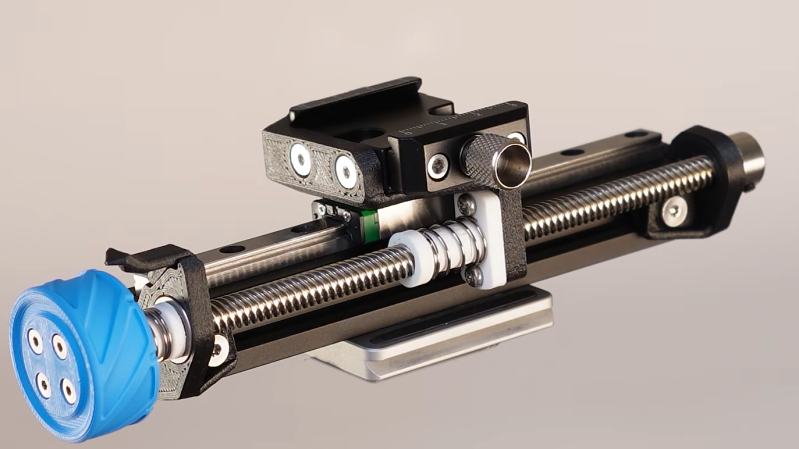
When taking macro photographs, you often need just a tiny bit of controlled motion — so little that it’s tough to pull off by hand. To address this, [Salveo] designed a small open-source macro photography slider featuring an anti-backlash handle.
Macro photography gives you an extremely shallow field of view, sometimes under 1 mm of depth, in which subjects stay in focus. To combat this, it’s common to capture multiple images while sliding the camera forward or backward, then combine them for a much larger depth of field than a single shot provides. [Salveo]’s slider gives fine control over this focus-stacking process, with the knob even marked to show every 1 mm of linear travel.
The slider is built around a 150 mm linear rail, though it could easily be lengthened or shortened to suit your needs. A T8 leadscrew, paired with anti-backlash nuts, translates the knob’s rotation into smooth linear motion. The knob itself uses a custom-designed anti-backlash mechanism to ensure the slider works cleanly in either direction.
You can grab all the 3D-printable files as well as the full bill of materials from the project page. Be sure to check out [Salveo]’s build video below. Thanks [Tim L.] for sending in this awesome open-source slider. Be sure to check out some of the other macro photography projects we’ve covered, too.












Great job on printing the anti backlash mechanisms. I will never get tired of seeing linear positioning mechanisms and all of their applications.
I like it! Antibacklash nuts for the knob and the camera slider nut are very good.
I might build it with a second, finer position adjuster using a differential screw. That would allow precise positioning down to 10 um or so and allow for higher magnification macro photography using focus stacking.
This makes me wonder, if you can somehow use a 3D printer to aid in stacking. Obviously it can’t carry a full sized camera, but it could carry a mirror, or two.
In many cases, it could carry the thing you’re photographing.
Good point, but if you move the subject the lighting would change though, and that’s a problem when stacking.
Lol it’s easier just to adjust focus in increments, unless you’re working at the edge of your focal length… Which you probably are