Camera Slider: Build Instead Of Buy Goes Awry

[TheHyperFix] had a problem. He’d spied a brilliant camera slider, but didn’t want to lay out big money to acquire it. The natural solution? Build one! Only, life is seldom so straightforward.

The plan was straightforward – take an old broken 3D printer, and repurpose its parts to make a camera slider instead. The build started with a aluminium extrusion, some V-slot wheels, and a 3D printed platform to hold the camera. Moving the platform was done via a belt drive, using the stepper motors and some software to tell the original printer controller what to do.

Unfortunately, the early experiments failed when the controller blew up under load. An Arduino was subbed in with a CNC shield, which got things back on track, and [TheHyperFix] had a somewhat functional slider with relatively jerky movement. A tough iterative design process ensued to work out problems with bearings and the Arduino’s pulse limit, among others.

As it stands, the slider is semi-functional, but it’s not quite well behaved enough to use for professional shooting. Still, for a first attempt at electronics prototyping, we think [TheHyperFix] did a pretty solid job. It might not be all there yet, but it’s well on the way, and a great deal was learned in the process.

If you’re trying to build a camera slider in a hurry, you might like to try recreating one of the builds we’ve featured before. Video after the break.

Continue reading “Camera Slider: Build Instead Of Buy Goes Awry”
macro photo slider

Tiny Moves, Big Depth: An Open-Source Macro Focus Slider

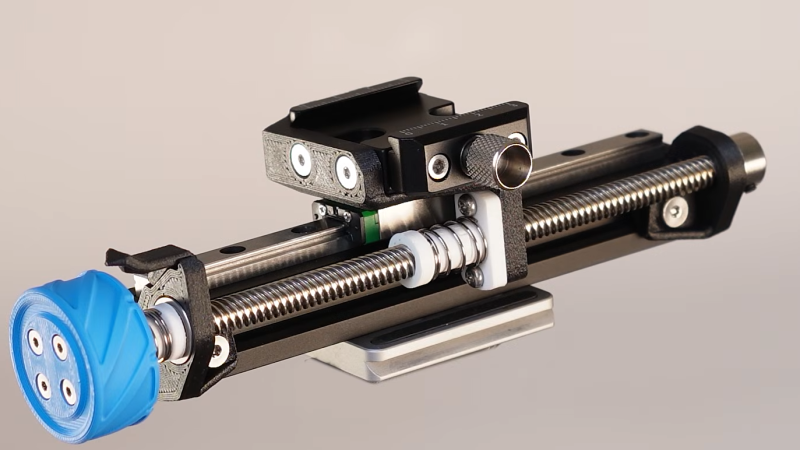
When taking macro photographs, you often need just a tiny bit of controlled motion — so little that it’s tough to pull off by hand. To address this, [Salveo] designed a small open-source macro photography slider featuring an anti-backlash handle.

Macro photography gives you an extremely shallow field of view, sometimes under 1 mm of depth, in which subjects stay in focus. To combat this, it’s common to capture multiple images while sliding the camera forward or backward, then combine them for a much larger depth of field than a single shot provides. [Salveo]’s slider gives fine control over this focus-stacking process, with the knob even marked to show every 1 mm of linear travel.

The slider is built around a 150 mm linear rail, though it could easily be lengthened or shortened to suit your needs. A T8 leadscrew, paired with anti-backlash nuts, translates the knob’s rotation into smooth linear motion. The knob itself uses a custom-designed anti-backlash mechanism to ensure the slider works cleanly in either direction.

You can grab all the 3D-printable files as well as the full bill of materials from the project page. Be sure to check out [Salveo]’s build video below. Thanks [Tim L.] for sending in this awesome open-source slider. Be sure to check out some of the other macro photography projects we’ve covered, too.

Continue reading “Tiny Moves, Big Depth: An Open-Source Macro Focus Slider”

Camera Slider Uses Repositionable Rail To Do Rotational Moves

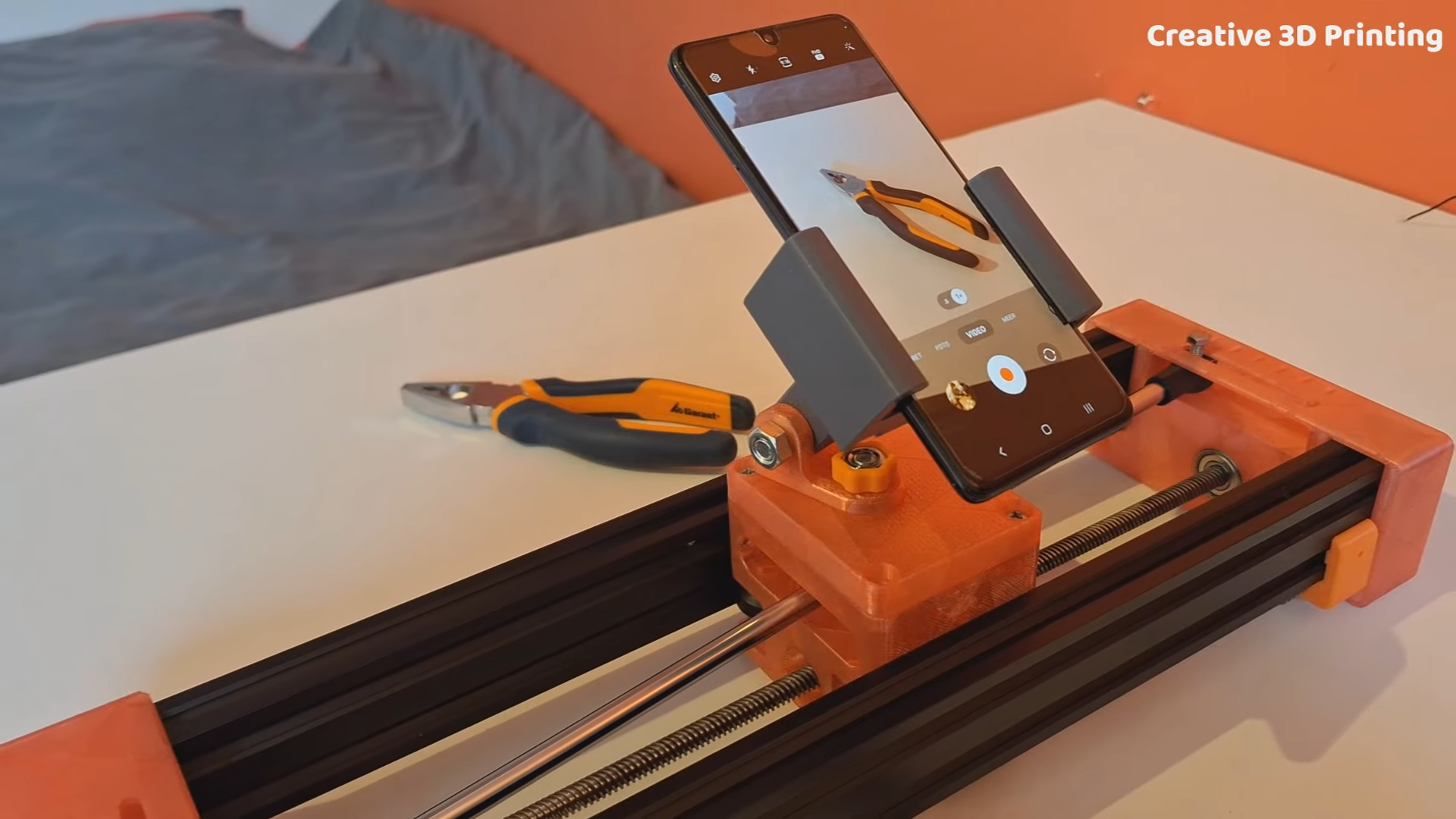
You can buy motorized camera sliders off-the-shelf, but they’re pretty costly. Alternatively, you can make one yourself, and it’s not even that hard if you’re kitted out with a 3D printer. [Creative 3D Printing] did just that with a nifty design that adds rotation into the mix. Check it out in the video below.

Why should a camera get all the fun? Try your phone.

The basic slider is built out of 3D-printed components and some good old aluminum extrusion. A small 12-volt motor trucks the camera cart back and forth using a leadscrew. It’s torquey enough and slow enough that there isn’t much need for more advanced control—the motor just does the job. There’s also a limit switch set up to trigger a neat auto-reverse function.

The neat part, though, is the rotational mechanism. A smooth steel rod is attached to the slider’s housing, which can be set up in a straight line or aligned diagonally if desired. In the latter case, it rotates the mounting on the camera cart via a crank, panning the camera as it moves along the slider’s trajectory.

It’s a mechanically sophisticated design and quite unlike most of the camera sliders we feature around these parts.

Continue reading “Camera Slider Uses Repositionable Rail To Do Rotational Moves”

DIY Camera Slider Moves And Rotates For Slick Shots

Camera sliders are a popular project for makers—especially those who document their projects on video. They’re fun and accessible to build, and they can really create some beautiful shots. [Lechnology] set about to follow in this fine tradition and built a rather capable example of his own. Check it out in the video below.

The slider relies on V-slot rails, perhaps most familiar for their heavy use in modern 3D printers. The rails are paired with a 3D-printed camera carriage, which runs on smooth rubber rollers. A chunky stepper motor provides drive via a toothed belt. Trinamic motor controllers were chosen for their step interpolation feature, making the motion much smoother.

The slider doesn’t just move linearly, either. It can rotate the camera, too, since it has an additional motor in the carriage itself. In a nice retro touch, the wires for this motor are run with an old coiled telephone cable. It’s perfect for the job since it easily extends and retracts with the slider’s motion. Controlling everything is an Arduino, with speed and rotational modes set via a tiny screen and a rotary encoder control.

It’s a very complete build, and it performs well too. The video it produces is deliciously smooth. We’ve featured some other great camera sliders over the years, too. If you want to dig into Trinamic drivers, we can get you started.

Continue reading “DIY Camera Slider Moves And Rotates For Slick Shots”

Old 3D Printer Parts Repurposed Into DIY Camera Slider

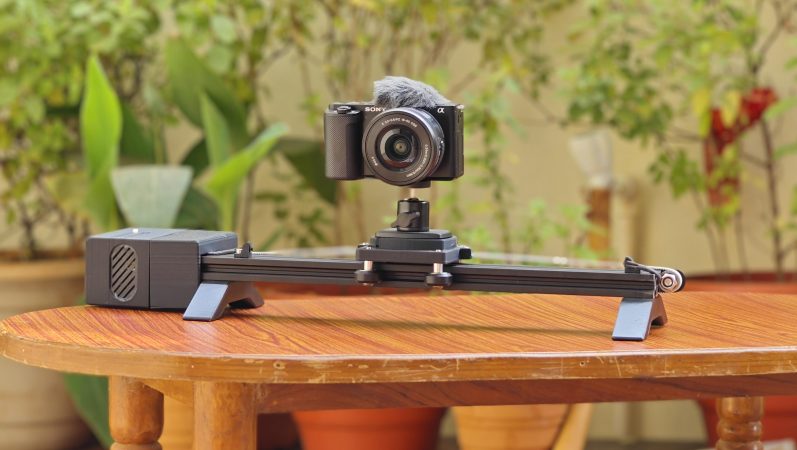
What do you do with an old 3D printer? They’re full of interesting components, after all, from switches and motors to lovely smooth rails. [Mukesh Sankhla] had a great idea—why not repurpose the components into a motorized camera slider?

The heart of the slider is the 4020 V-slot aluminum profile. It’s upon this that the camera carriage rides, running on rubber rollers to keep things smooth. A stepper motor and belt are then used to move the slider at a constant speed up or down the rail while the camera gets the necessary shot. The build relies almost entirely on salvaged components, save for an ESP32, OLED screen, and a few buttons to act as the control interface. There are also the TMC2208 stepper motor drivers, of course, but they came from the salvaged Ender 3 unit as well.

This is a classic project. Many old 3D printers have pretty much the perfect set of parts to build a camera slider, making this build a no-brainer. Indeed, others have tread the same path. There are plenty of other potential uses around the lab or for soldering.

Meanwhile, the proof is in the pudding. Scope the slider’s performance in the video below.

Continue reading “Old 3D Printer Parts Repurposed Into DIY Camera Slider”

A Very Fast Camera Slider For The Glam Shot

High-speed photography with the camera on a fast-moving robot arm has become all the rage at red-carpet events, but this GlamBOT setup comes with a hefty price tag. To get similar visual effects on a much lower budget [Henry Kidman] built a large, very fast camera slider. As is usually the case with such projects, it’s harder than it seems.

The original GlamBOT has a full 6 degrees of freedom, but many of the shots it’s famous for are just a slightly curved path between two points. That curve adds a few zeros to the required budget, so a straight slider was deemed good enough for [Henry]’s purposes. The first remaining challenge is speed. V1 one used linear rails made from shower curtain rails, with 3D printed sliders driven by a large stepper motor via a belt. The stepper motor wasn’t powerful enough to achieve the desired acceleration, so [Henry] upgraded to a more powerful 6 hp servo motor.

Unfortunately, the MDF and 3D-printed frame components were not rigid enough for the upgraded torque. It caused several crashes into the ends of the frame as the belt slipped and failed to stop the camera platform. The frame was rebuilt from steel, with square tubing for the rails and steel plates for the brackets. It provided the required rigidity, but the welding had warped the rails which led to a bumpy ride for the camera so he had to use active stabilization on the gimbal and camera. This project was filled with setback and challenges, but in the end the results look very promising with great slow motion shots on a mock red carpet.

We’ve seen DIY camera sliders of all shapes and sizes, including ones made from skateboard trucks and wood, and even a measuring tape.

Continue reading “A Very Fast Camera Slider For The Glam Shot”

Designing A Quality Camera Slider Can Be Remarkably Satisfying

Camera sliders are great creative tools, letting you get smooth controlled shots that can class up any production. [Anthony Kouttron] decided to build one for an engineering class, and he ended up mighty satisfied with what he and his team accomplished.

As an engineering class project, this wasn’t a build done on a whim. Instead, [Anthony] and his fellow students spent plenty of time hashing out what they needed this thing to do, and how it should be built. An Arduino was selected as the brains of the operation, as a capable and accessible microcontroller platform. Stepper motors and a toothed belt drive were used to move the slider in a controllable fashion. The slider’s control interface was an HD44780-based character LCD, along with a thumbstick and two pushbuttons. The slider relied on steel tubes for a frame, which was heavy, but cost-effective and easy to fabricate. Much of the parts were salvaged from legendary e-waste bins on the university grounds.

The final product was stout and practical. It may not have been light, but the steel frame and strong stepper motor meant the slider could easily handle even heavy DSLR cameras. That’s something that lighter builds can struggle with.

Ultimately, it was an excellent learning experience for [Anthony] and his team. As a bonus, he got some great timelapses out of it, too. Video after the break.

Continue reading “Designing A Quality Camera Slider Can Be Remarkably Satisfying”