
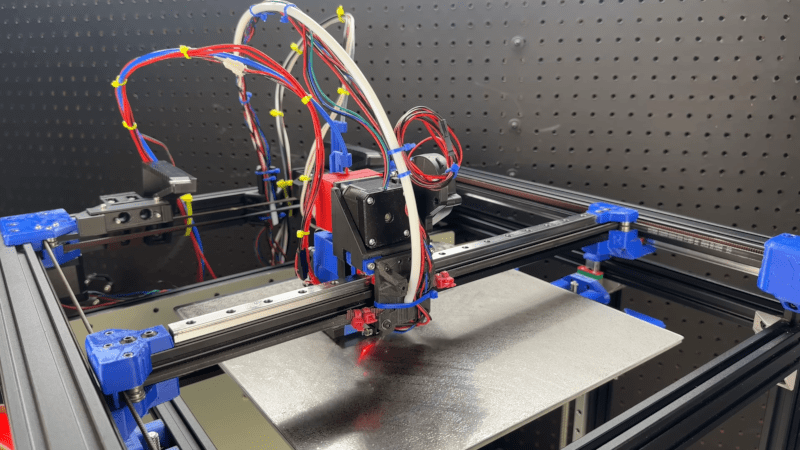
All the cool new 3D printers have tool-changing heads. Instead of multiplexing filament through one hot end, you simply park one hot end and pick up another. Or pick up a different tool, depending on what you need. There are many advantages to a system like that, but one disadvantage: cost. [Ultimate Tool Changer] has been working on a design for what he calls a simple, cheap changer, and it appears to be working well, as you can see in the video below.
This is one of those things that seems easy until you try to do it. He talks about a lot of the failures and dead ends along the way.
We worry that the tolerances are tight enough that wear over time might affect some of the key components, but how long that might take or if it will happen at all, we can’t say. Regardless, the system does appear to work, and we have no doubt you could keep it aligned or periodically replace parts to work around any wear issues.
One of the problems we have nowadays is that our main printers are plug-and-play boxes that are difficult to modify significantly. But if you have a homebrew printer or something made to expand like a Voron or old-school commercial printer, it seems like this would be something you could adapt.
We’ve seen homebrew tool changers, of course. Many times, actually.











These days, “works” is too low a bar. I like to see makers keep working on something beyond the “it works” point and get to the “it works very well” point. Or even the “it works very well; it doesn’t cost a fortune; it’s very convenient to build, to service, and to upgrade; and not only that…” point.
And I’d like pony and a cup of hot chocolate each morning delivered personally by the current CH president.
Because anything else is too low of a bar for my taste.
I see comments similar to this about software features on my projects….my answer is applicable to this as well.
“We do these things as a hobby as time, interest, and desire are available. Projects don’t pay the bills so they aren’t the priority. If you want more rapid development and a better result you can either contribute or pay for the project to become the priority”
Getting something to work is only 20% of the work. Getting it to work well is less rewarding and not the forte of many ADHD maker types who’d rather move on to the next new thing.
So pay the makers to do that? They don’t own you anything.
That’s what I intend to do. The maker might be Snapmaker or Prusa/Bondtech, however. I’m waiting for all the first-gen bugs to be shaken out.
So do the work to carry it from working to ‘suitable’ for your needs yourself or offer to pay them to take it far enough then!
The creatives might well get it to the point they are happy with its function as they know how it works so it is easy for them to keep it working well enough. Or they learned enough for the future project it was only ever meant to be a stepping stone for…
For years I’ve had lots of projects that went just far enough for me to get what I need. As the question always becomes “is making it “better” worth my time?”. And most of the time that answer is no/ not yet.
I watched all 90 minutes of this video and my only take away was that tool changing printers look like a reliability nightmare.
sometimes you just need to pay for things. our free time and disposable income is limited. I’m a ham and I usually build my own antennas but I recently bought a VHF UHF commercial antenna and put it up. it just worked.
could I have made one myself? certainly. and probably a better one with fewer compromises. but I don’t have neither the time, nor the materials, to build one that will not only work , but most importantly: keep working. I know this commercial antenna will work there for years unless lightning hits it. one I make myself? it will probably need servicing after a few rains. (I’ve built very reliable quarter weaves, j poles, and sleeve dipoles, but this one is a bit more “serious”, and I need it to work when I need it.
it’s the same with toolchangers. you can do awesome things with them. but you need them to be reliable. it needs to work 100% of the time. 99.99% is not good enough when you have 1000 layers and 3 tool changes in each layer. it means it will fail 100% every time you print something.
sometimes you just need to throw money at the problem
I’m sure there are specific cases where tool changing is useful and worth the complexity. I just haven’t encountered any in almost 15 years of 3d printing.
My first printer was actually a dual-extruder (wooden) Makerbot Replicator. I eventually scrapped the 2nd extruder for parts because having multiple colors wasn’t worth the maintenance effort. And a dual-extruder is MUCH simpler than tool changing.
I don’t think I’d agree – dual-extruder is a big PITA as you generally need to get both nozzles rather too perfectly coplanar to the build platform and/or keep them both very hot so the inevitable touches between the second potentially not even in use nozzle and the part isn’t a hard head crash that is likely to knock your part off the bed etc. Tool changers have different issues, but I’d suggest are really much simpler as you just need a decently repeatable mount so the tool offset won’t change enough to matter, and that mount is pretty easy to manage in the almost zero forces on the tool head world of 3d printing.
I envy you, I’ve had so many occasions I’ve wished I could use my currently magic smoke free dual extruder machine for mixed material printing, either as a really decent support material combination or to have that flexible/solvent weldable/stiffer (etc) section to make the compact design I’d like more possible or just need less manual effort. You can get past it, often anyway, but it is such a cool feature to have when you can have it.
Copper prints
https://techxplore.com/news/2026-04-scientists-3d-copper-alloy-components.html