
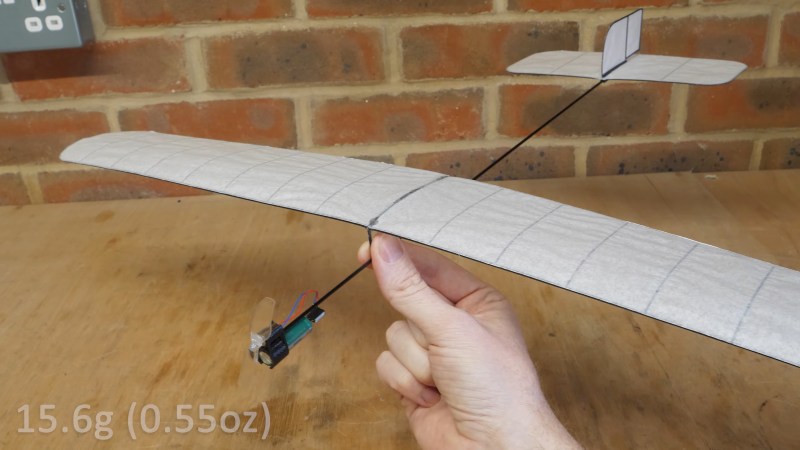
There’s something to be said for a simple wind-up, free flight model airplane. With no controls, it must be built very well to fly well, and with only the limited power of a rubber band, it needs a good, high-lift design without much superfluous drag to maximize flight time. There’s also something to be said for modernity though, and prolific hacker [Tom Stanton] puts them together with this supercapacitor plane.
If that sounds familiar, it’s because [Tom] did this before back in 2023. But for that first attempt he converted a commercial R/C toy rather than a plane optimized for low-power free flight. Just like with the best rubber-band machines, his goal for the new production is more flight time than winding time. Plus lots of views on YouTube, but that goes without saying.
Thus this machine is smaller and lighter than the previous iteration. Rather than balsa and tissue like the free-flight aircraft of our youths, [Tom] is using 3D printed plastic for the structure. But he’s got a neat hack built in: he’s printing the wings and control surfaces directly onto tissue paper, eliminating the bonding step. Of course that means his wings are printed flat, but a bit of heat and some bending and he has a single-surface airfoil. Single-surface airfoils are normal in this application, anyway: closed wings add too much weight for too little gain. If you want to try the technique, he’s got files on Printables.
Another interesting factoid [Tom] discovered is that the energy density of supercapacitors decreases sharply below 10 F. As you might imagine by the square-cubed law, bigger is better, but the sharp drop-off dictated he use a single 10 F cap for this build, along with a micro motor. Using the wind-up generator from his previous build, he’s able to get 45 seconds of flight out of just 4 seconds of cranking, a good ratio indeed.
[Tom] seems to like playing with different ways to power his toys; aside from supercapacitors, we’ve also seen him finessing aircraft air motors — including an attempt at a turbine for a model helicopter.












Super cool. If a small tissue paper wing plane can fly so well i wonder how well slightly larger cardboard planes do?
I wouldn’t be surprised if we start to see semi disposable cardboard or similarly inexpensive material planes (fiberglass??) in future for deliveries or even military use
Foam board planes are really common. It’s lightweight and easy to work with.
A friend made a RC cardboard plane back in the day. Structurally sound and plenty of power. Didn’t fly because of center of gravity being fucked.
Thank you for sharing your heart so openly with us
spam spam spam
i don’t like spam
I’ve seen other projects that create a form to mold your warmed up parts over, you could print your exact airfoil shape then heat\mold the wing over the form to get an exact profle.
You could alternatively add a few joints that are articulated with stops so they bend to a specific degree to approximate the curve. Then you print it flat, bend at the joints, and put a dot of glue to lock it there.
what distance?
He was going in circles, so hard to say.
Not something you can do without a lab but…
* use a super thin titanium sheet (for base structure)
* deposition of aluminum on the titanium (for conductivity pathways)
* deposition of silicon on the aluminum (to make an amorphous solar cell)
This would be an wing that would be super light AND produce energy for flight. This seems like something that a university could manage.
The real trick though would be to extend this design and build a closed wing in such a way that the enclosed area acts as a capacitor that is directly charged using the amorphous solar cell on the outside of the wing. This seems more like a research project that a capacitor manufacturer might do for PR.
Sounds great from a technical perspective, but probably impractical unless it can be mass-produced cheaply.
3.5 grams gets you PBLC-3R8/50MA2 , a 50F 3.8V lithium ion capacitor. If gravimetric energy density is the goal, I’m left wondering why a 10F 2.7V supercap was chosen instead.
my guess is ESR / power density may be a big consideration here. Per its spec sheet, that lithium ion capacitor is limited to .25 amps continuous. This may be adequate for normal flight (unclear, since I don’t know the motor he ultimately used), but if so, you still need to worry about higher current use if the motor stalls. A bigger issue is charging, which could take a lot longer for the same capacity, since you have to make sure you’re not going above that safe current limit.
another consideration – the lithium ion capacitor has a minimum working voltage and cannot be discharged to zero without harm. so if you solve those problems, you still need a protective cutoff circuit, which adds additional weight.
you also have to worry a little bit about the capacitor self-discharging below that voltage while in storage.
all of these things can undoubtedly be worked around, but probably not without compromising simplicity and ease of use.
Strangely, the specs I found list the part as DC ESR ~ 455 mOhm, 0.3A (2.8A pk), whereas on Digikey I’m finding 750 mOhm, 0.25A (1.8A pk). There’s ongoing materials development, so perhaps something got changed there. but it’s not indicative of a fundamental flaw. Another search on Mouser brought up VMF706M3R8 (3.8 g, 100mOhm, 0.35A cont at 15K rise, 18A short circuit).
0615 style motors (I forget which ones are used in the video) seem to have 580 mA current draw under load, which feels like a good match for intermittent use.
LICs are worse at low temperatures, but should be fine in weather where the paper sogginess issue is also resolved.
Battery protection: same as for Li-ion cells, <2A boards (8025A+DW01 classic) should be sub-1g.
Now you’re perfectly in the right to call out the armchair-isms here. I should have the motors and protection PCBs here somewhere to go with the LICs I bought a couple of a while ago. If they’re still in usable condition…
That’s a radical way to build a wing! Very impressive!
There’s definitely something elegant about a motor charging a supercap, but energy density is king for this application…really should use a tiny lipo cell :)
Li-Ion is more energy dence than LiPo
Nothing radical. Nothing new. Even using first layer infill as foil itself is nothing new.
I made one Friday and regular printer paper is sturdier although a gram heavier
I has a similar Paper Plane Motor kit like this https://m.youtube.com/watch?v=TYWp4mH12XA
The next part you need to do is to do a second bottom layer and then dope the two tissue sides to stretch it and pull a lateral stress over the frame. Once you cover to exposed framework, you will get far better laminar flows over the surface. Even adding the dope and the second layer is secondary to adding the pre-stressed part of the stretched tissue.
Another part to doping the tissue, it seals out the moisture loading.
If you are careful with the thinning of the dope, you can add the flight warps to the wings just using the stress on the tissues to add the required twist.
Fairings around the cap and motor can be made with tissue over forms and Doped to make that part more smooth.
I heard that you can even print up tissue fills using a halt print command, the over print bleeds through the tissue and locks the two in place.
What you need to think like is…. 3Dprinted frames…. Not flat surfaces… once a 3D frame is produced, say a full 3D body and faring for all your stuff, printed as a simple polygon framework… then carefully place tissue polygons onto the hole… and final print the last few passes to seal down the tissue, Trim the edges and do the next polygon, it would be hard doing all the halts to place the tissue, But you could do very intricate and lightweight structures if you carefully add the outer cover on the last lines of G-code for that polygon.
Getting good at holding the tissue on the model as it prints it in place will take some technique, but i think you can see whole realistic body and win structures can be made fairly quick compared to balsa. Being able to print the silk or tissue part you may need whilst making the frame is a real game changer if you really think polygon and super light weight framing… the the tissue can even be used internally to offer GUY WIRE like cross braces if you were real slick with the staging the parts placement as you print the model.
Tissue, Silk and other things that molten plastic might be useful to work with…. A good place for expansion.
I wonder how well it might work with carbon fibre sheet, You know….. how well does a 3D printer INJECT into the offered target….
Good Job on the think start.