Electric Truck Sets Racing Record

The 24 Hours of Le Mans races is an extremely prestigious endurance motorsport event which attracts the best cars and drivers from around the world. It’s one of the longest-running races too, taking place once a year since 1923 (with a few obvious understandable gaps). But, like most motorsports, it’s financially out of reach for most people. One of the more popular attempts to bring racing to the masses has been the 24 Hours of Lemons races, which have price limits on vehicles to keep the barrier to entry low, and an EV truck recently entered one of these races with some interesting results.

The group behind this vehicle is called Team Arcblast, who retrofitted an old Datsun pickup truck to the extreme to enter this race. The modestly sized electric motor is installed in between the cab and the bed for easy access to the driveshaft, with the engine bay repurposed for all of the cooling and radiators needed for endurance racing like this. They’ve also equipped the truck with plenty of efficiency-increasing spoilers and other aerodynamic parts, and rebuilt the cab with not only the required roll cage and other safety equipment, but a modified driving position with steering and other components from various Miatas.

The most impressive part of this build, however, is the battery. The team invented a method of swapping out batteries quickly to avoid having to fast charge the car in the pit area. The system lets a battery slide in to the middle of the truck above the motor and quickly connect to the electrical system allowing for very quick pit stops and the ability to charge other batteries while the race goes on. All of these modifications together allowed the team to break the EV record for a Lemons race.

For a Lemons race, though, even this truck stretches the original spirit that these races were started, however impressive the build. We published a primer to these types of races a while back which includes much more affordable internal combustion options.

Thanks to [JohnU] for the tip!

Continue reading “Electric Truck Sets Racing Record”

They Weren’t Joking: Gentoo WAS Ported To GNU Hurd

Long ago, in the aftermath of the UNIX wars, three kernels emerged from the rubble: BSD, Linux, and Hurd. BSD, being UNIX, was held back by legal wrangling in the aftermath of the wars, and that allowed Linux to pull ahead to a pole position it still enjoys to this day. BSD has its following, of course, but Hurd? GNU Hurd seemed destined to languish… until April 1st, 2026, when the Gentoo Linux distribution was ported to the Free Software Foundation’s kernel.

It turns out, they weren’t actually joking. The joke part was that they were moving fully to the Hurd kernel, away from Linux– you can absolutely still run Gentoo with the Linux kernel, and make no mistake, that’s still the default and best-supported option. Options are good, though, and the Gentoo team has decided that it’s time to add some options to the kernel space, and give the Hurd some time in the sun.

Unlike the Linux kernel, which follows closely the monolithic UNIX framework– and the BSD-Unix kernel, which is Unix–GNU Hurd is a microkernel architecture, based originally on the Mach kernel. In that, it’s rather like MacOS. Unlike MacOS, given its roots in the Free Software Foundation, GNU Hurd is 100% free and open source. There are advantages to a microkernel architecture– it keeps drivers out of kernel space so a dodgy WiFi adapter can’t crash your system, for example– but the big disadvantage is, of course, drivers. Both Linux and BSD drivers can be ported, but that takes work and many of them have not been.

Still, now that Microsoft has become a major contributor to the Linux kernel, we could see a lot of the old-school Linux users who talk about “win-doze” and still spell Microsoft with a dollar sign being tempted to join the Hurd. If that appeals to you and you’re not into Gentoo, Debian has quietly let you install with the Hurd kernel for years now. It’s either that or embrace BSD and escape the chaos vortex.

The big three aren’t the only POSIX kernels out there, of course– there’s even one written entirely in Rust, for the die hard rustaceans amongst you.

Your Own Tool Changer

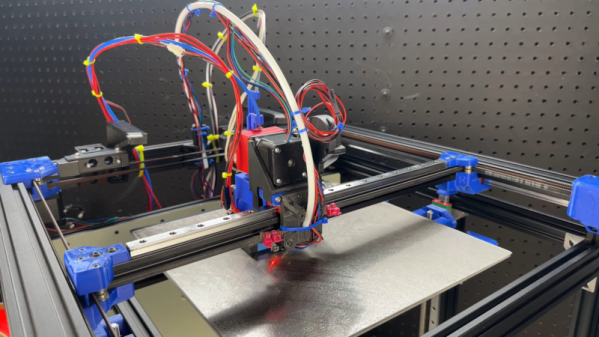
All the cool new 3D printers have tool-changing heads. Instead of multiplexing filament through one hot end, you simply park one hot end and pick up another. Or pick up a different tool, depending on what you need. There are many advantages to a system like that, but one disadvantage: cost. [Ultimate Tool Changer] has been working on a design for what he calls a simple, cheap changer, and it appears to be working well, as you can see in the video below.

This is one of those things that seems easy until you try to do it. He talks about a lot of the failures and dead ends along the way.

Continue reading “Your Own Tool Changer”

ESP32 Weather Display Runs Macintosh System 3

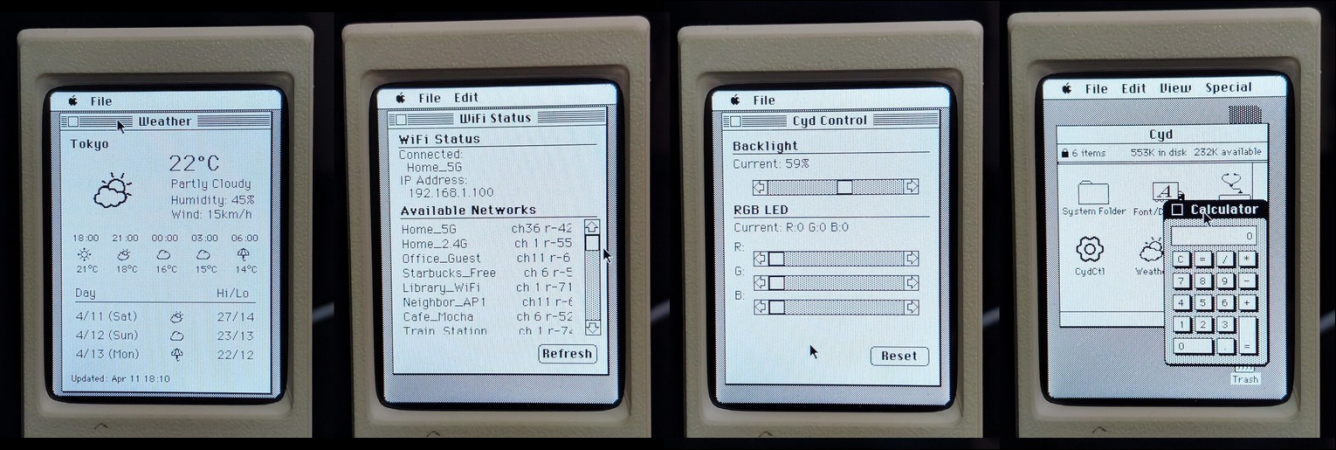
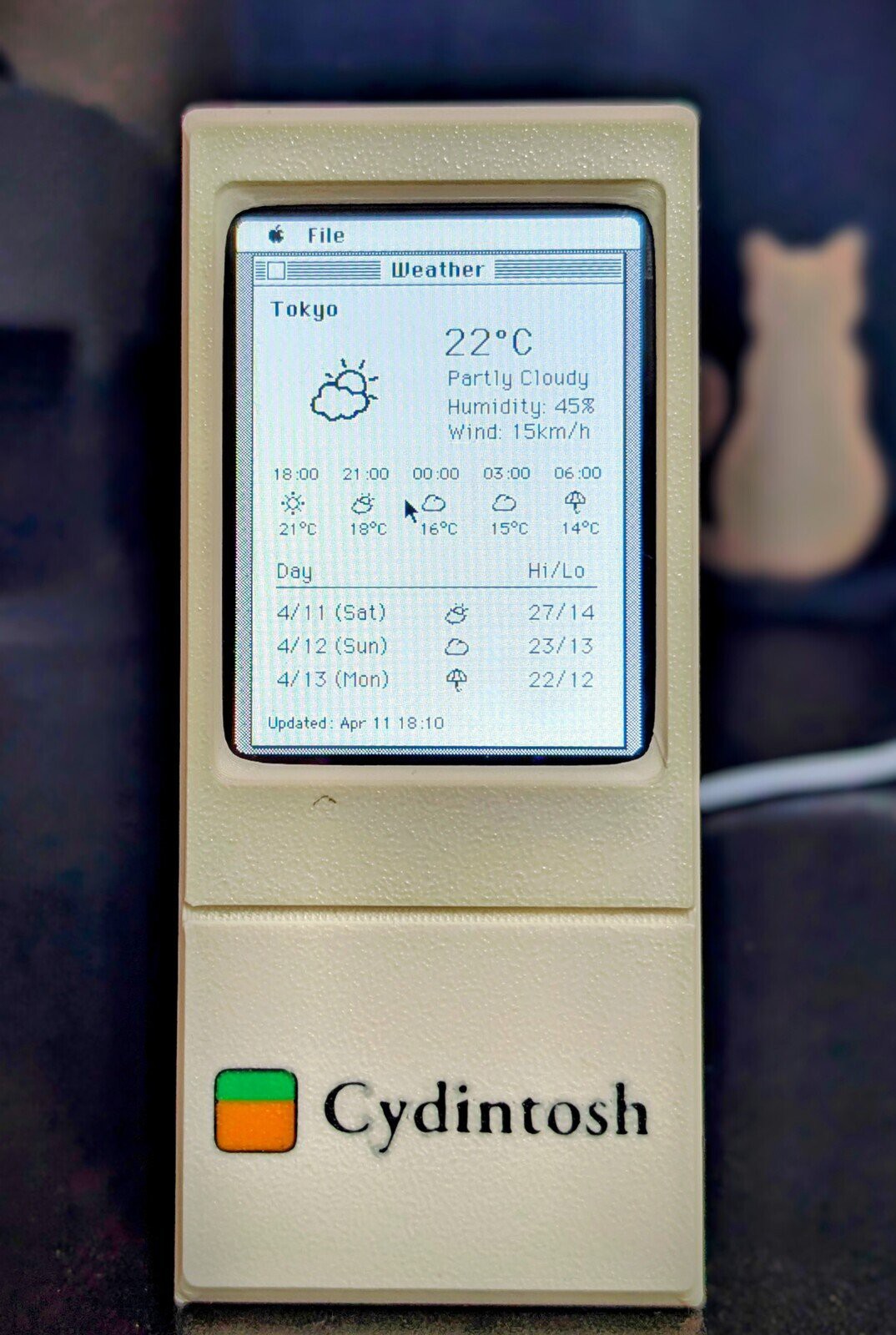
It seems like everybody takes their turn doing an ESP32-based weather display, and why not? They’re cheap, they’re easy, and you need to start somewhere. With the Cheap Yellow Display (CYD) and modules like it, you don’t even need to touch hardware! [likeablob] had the CYD, and he’s showing weather on it, but the Cydintosh is a full Macintosh Plus Emulator running on the ESP32.

Honey, I stretched the Macintosh!

The weather app is his own creation, written with the Retro68k cross-compiler, but it looks like something out of the 80s even if it’s getting its data over WiFi. The WiFi connection is, of course, thanks to the whole thing running on an ESP32-S3. Mac Plus emulation comes from [evansm7]’s Micro Mac emulator, the same one that lives inside the RP2040-based PicoMac that we covered some time ago. Obviously [likeablob] has added his own code to get the Macintosh emulator talking to the ESP32’s wireless hardware, with a native application to control the wifi connection in System 3.3. As far as the Macintosh is concerned, commands are passed to the ESP32 via memory address 0xF00000, and data can be read back from it as well. It’s a straightforward approach to allow intercommunication between the emulator and the real world.

The touchpad on the CYD serves as a mouse for the Macintosh, which might not be the most ergonomic given the Macintosh System interface was never meant for touchscreens, but evidently it’s good enough for [likeablob]. He’s built it into a lovely 3D printed case, whose STLs are available on the GitHub repository along with all the code, including the Home Assistant integration.

Reverse-Engineering Human Cognition And Decision Making In A Modern Age

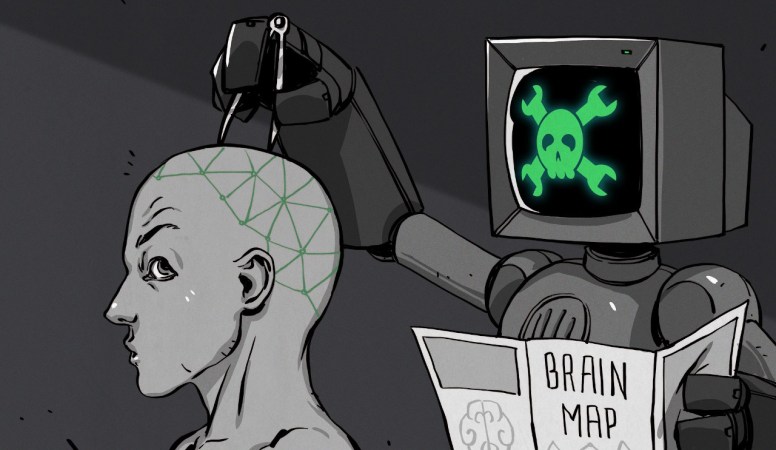
Cognitive processes are not something that we generally pay much attention to until something goes wrong, but they cover the entire scope of us ingesting sensory information, the processing and recalling thereof, as well as any resulting decisions made based on such internal deliberation.

Within that context there has also long been a struggle between those who feel that it’s fine for humans to rely on available technologies to make tasks like information recall and calculations easier, and those who insist that a human should be perfectly capable of doing such tasks without any assistance. Plato argued that reading and writing hurt our ability to memorize, and for the longest time it was deemed inappropriate for students to even consider taking one of those newfangled digital calculators into an exam, while now we have many arguing that using an ‘AI’ is the equivalent of using a calculator.

At the root of this conundrum lies the distinction between that which enhances and that which hampers human cognition. When does one merely offload tasks to a device or object, and when does one harm one’s own cognition?

Continue reading “Reverse-Engineering Human Cognition And Decision Making In A Modern Age”

From Lunar Dust To Breathable Air

Moon missions are hot again for the first bit since the space race. While the previous period had us land on the big lunar rock, the missions of tomorrow have us living on it. The initial problem of landing in one piece has been solved, but there are many more puzzles to solve. One major issue of living in the vacuum of space is the lack of breathable air, because, ya know, it’s space.

This brings us to today, where [Blue Origin] has announced a prototype method of turning Moon dust into the valuable gas we call oxygen. [Blue Origin] hasn’t posted much about the actual process behind this feat, terming the system “Air Pioneer”. What we do know is that it requires melting the regolith and then passing current through to release the O2 molecules from their rocky prison.

While some publications on this matter have been calling this a first in its entirety, this isn’t entirely true. NASA has worked on this technology for the past couple of years, called “Gaseous Lunar Oxygen from Regolith Electrolysis”, or (GaLORE). What [Blue Origin] has done, however, is complete the task under a for-profit motive. Perhaps this can introduce the drive needed to accelerate the development of the tech? (If anyone knows any more detail about the Blue Origins system, please let us know.)

Private space is certainly an exciting and quickly moving space in nearly all regards. It’s important to see how far we have come from the initial moon missions. If you want to check out some of the wackier lessons from that era, be sure to read up on the fight for moon cockroaches!

Skylab Under The Ocean

A crew lives on a station in a hostile environment. Leaving that environment requires oxygen tanks and specialized gear to deal with pressure differentials. A space station? Nah. A base built on the ocean floor. The US Navy was interested in such a base in the 1960s, and bases like this are a staple of science fiction. But today, we see more space stations than underwater bases. Have you ever wondered why?

Diving deep underwater is a tricky business. At a certain depth, the pressure forces gas like nitrogen to dissolve into your body. By itself, this isn’t a problem, but when you ascend, it is a big problem. If the gas all comes out at the same time, you get bubbles, which can cause decompression sickness, commonly called the bends. The exact problems vary, but the bends often cause extreme joint pain, fatigue, or a rash. Sometimes people die.

While you think of the bends as a deep-sea diver’s problem, it can also happen in airplanes and outer space. Any time you go from high pressure to low pressure quickly, you are subject to decompression sickness. Depending on what you are doing, there are different ways to mitigate the problem. For diving, traditionally, you simply don’t surface too quickly.

You dive, do your work, and then head towards the surface, stopping at preset stops to let the pressure equalize gradually. Physics is a bear, though. The longer you stay at a given depth, the longer you have to decompress.

That means you rapidly reach a point of diminishing returns. Suppose you dive to the ocean floor. You spend an hour working. Then you have to spend, say, eight hours gradually rising to the surface. That makes extended operations at significant depth impractical.

George Bond was thinking about all this and had an interesting idea. It is true that, in general, the longer you stay down, the more gas your body absorbs. But it is also true that, eventually, your tissues saturate, and then you don’t absorb any more.

Continue reading “Skylab Under The Ocean”