
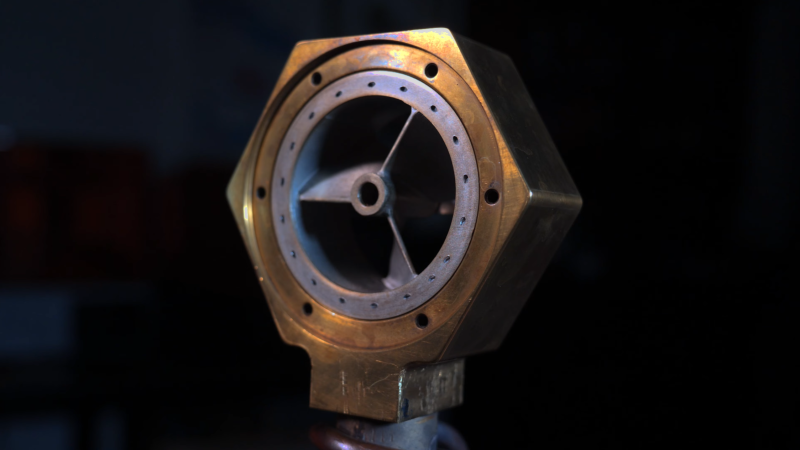
Rim-driven thrusters turn the normal propeller-motor arrangement inside out; rather than mounting the motor at the center of the propeller, they use a large hollow motor, with the blades attached to the inside of the rotor. They’re mostly used in ship propellers, though there have been some suggestions to use them in electric aircraft. [Integza], always looking for new and unusual ways to create propulsion, took this idea and made it into a jet engine.
Rather than using an electric motor, the fan in this design is propelled by miniature rocket nozzles along the edge. The fan levitates on a layer of high-pressure gas between the fan rim and the housing. To prevent too much pressurized gas from escaping, the fan and housing needed to fit together closely, but with minimal friction. A prototype made out of acrylic and resin and powered by compressed air proved that the idea worked, but [Integza] wanted to make to this a combustion-powered engine.
The full engine would be similar to a rocket engine, with the fan being the nozzle. The combustion chamber was built out of a brass fitting, and it burned propane in compressed air. The fan and housing were CNC-milled out of aluminium and brass, respectively. They worked well when powered with compressed air, but seized up when connected to the combustion chamber — the fan was thermally expanding and jamming in the housing. Progressively rounding down the edges of the fan failed to solve this, and a hole melted in the fan during one test. [Integza] machined a new fan, which he anodized to increase its heat resistance.
To keep it from overheating, he sprayed water into the combustion chamber, creating steam and cooling the exhaust stream to a manageable temperature. The engine did work, though we do wonder whether the fan actually increases its thrust over that of the base rocket engine.
This isn’t the first unconventional jet engine [Integza]’s built, nor the first which tries to amplify the thrust produced by a rocket engine.
Thanks to [Keith Olson] for the tip!












I’m sure it’s just me, but… “Sign in to confirm you’re not a bot”…
Cool
Jesus.
steam probably even increase the pressure and thrust, no?
Reminds me of “Tip Jet” aircraft.
Although I’m not sure why a rim driven fan would have a central hub.
It is a manufacturing detail, used to center and align the part when machining both top and bottom
Would like to see a 3-D exploded schematic!
1:45 in the video above. It’s a schematic for the plastic prototype, but it should answer your questions about the full sized one too.
You could have the blades top before reaching the center, but I assume they’d have to be very strong. Having them attach to each other at the center probably reduces their vibration a lot.
And the tolerance for the outside rim is very very tight. It’s possible you’ll need to turn it on a lathe in which case a central hub will be important.
It does make sense that they would have a central hub while turning it on a lathe, but it would be easy to remove it as the last step.
I’m not sure that strength is the reason for having a center hub either. For marine/water applications they don’t have a center hub, and marine props blades tend to be under more stress than air fan blades.
Rimjob.
The hubless fan he’s referencing looks a lot like the Raptor NG concept – which has a load of pretty big gotchas tied to it.
Biggest issue (as far as I understand it) with moving the mass in fans to the rim is the forces you have to deal with at the sort of speeds you’re going to need to reach. Problem gets much harder as you scale the whole concept up in size and rim speed. Cool idea re the little vectored nozzles though.
… and all because tomatoes patented the concept of conical tapers to adjust clearance after machining.