
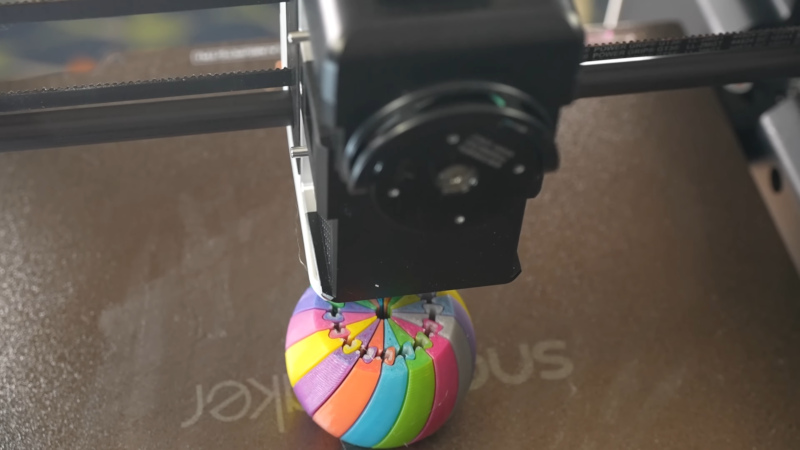
Many modern desktop 3D printers include the ability to print in multiple colors. However, this typically only works with a few colors at a time, and the more colors you can use, the higher the machine’s cost and complexity. However, a recent technique allows printers to mix new colors by overlaying thin sheets of different filaments. [YGK3D] looks at how it works in a recent video.
In the early days of 3D printing, there were several competing approaches. You could have separate extruders, each with a different color. Some designs used a single extruder and switched between different filaments on demand. Others melted different filaments together in the hot end.
 One advantage of the hotends that melted different materials is that you could make different colors by adjusting the feed rates of the plastics. However, that has its own problems with maintaining flow rate, and you can’t really use multiple material types. But using single or multiple hotends that take one filament at a time means you can only handle as many colors as you have filaments. You can’t mix, say, white and black to get gray.
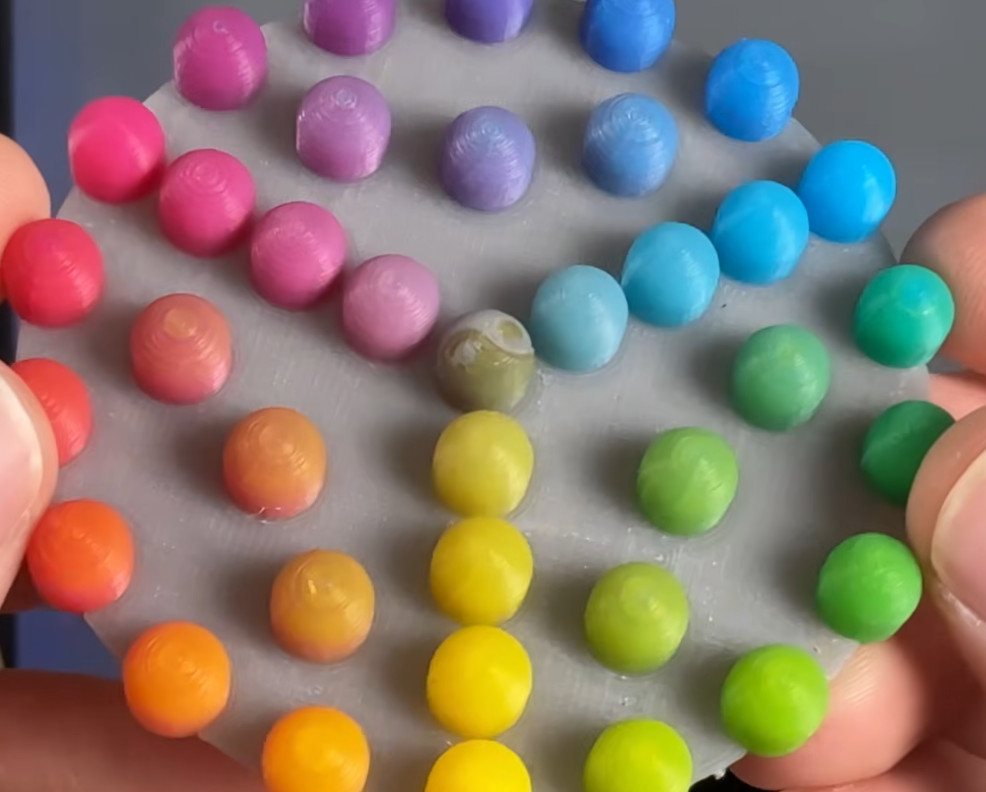
Using Full Spectrum, you can define virtual filaments, and the software figures out how to approximate the color you want by using thin layers of different colors. The results are amazing. While this technically could work on any printer, in reality, a filament-switching printer will create a ton of waste to mix colors, and a single-filament machine will drive you batty manually swapping filament.
So you probably really need a tool changer and translucent plastic. You can see the difference in the test article when using opaque filament vs translucent ones. At low layer heights, four filament colors can give you 39 different colors. At more common layer heights, you may have to settle for 24 different colors.
One issue is that the top and bottom surfaces don’t color well. However, a new plugin that adds texture to the surfaces may help overcome that problem.
We looked at Full Spectrum earlier, but development continues. If you are still trying to get a handle on your filament-switching printer, we can help.












Variable harness by blending TPUs?
I would just get an aero/air tpu and vary its temperature for hardness and then regular tpu for other colours
i dunno how well it would work on any official multi-colour printing solutions; bambu can’t do tpu except for “tpu for ams” which is a bit more like that “flex pla” you see out and about. My BMCU can handle tpu… ish. Requires it to be above the printer so the ptfe tubes don’t have any sharp pens and sometimes clogs but it works.
tl;dr probably not.
Bambu can do any TPU if you feed it into the extruder without the AMS, feeding it in the same way that someone without an AMS would normally do any other filament. The TPU for AMS is harder than some other TPU so that it can be fed into the extruder with the motor.
I like it. Would have to see it up close to see how well it really works. Seems to look better than the inkjet print head method.
But it highlights that there is a problem with the way filament switching works. The current solutions of nozzle switching and purging are not very good. These tiny heat chamber buckets seem to be the problem.
Wild stuff, and would make some great unicorn poop 😆
The Mosiac pallette and the bambu with AMS are color SWAPPING systems. This is a method for creating optical blends of different filaments.
Can you provide a clear source for this that can be used as prior art against the patent mentioned in the video? It would be worth fighting this before it becomes valid.
Double the world plastic pollution. A lot easier just paint it by hand.
Correct me if I am wrong, but I believe painted plastic is more difficult if not impossible to recycle, whereas self coloured plastic may only head in one colour-direction, but is still recyclable?
Not true,
especially on smaller models. The printer is far more precise than I could be.
CMYK systems pop up with regularity (who remembers the water-cooled spin-mixing printhead from a few years back?) but the biggest obstacle has been software. The slicers, file formats, and serial links stuffed with gcode just aren’t set up to handle color. On that front klipper has been a massive innovation simply for daring to rework a lot of the stack.
I proposed a system once and some company is even working on It: use white filament and inject color inks during extrusion. Or even some additives to vary properties.