
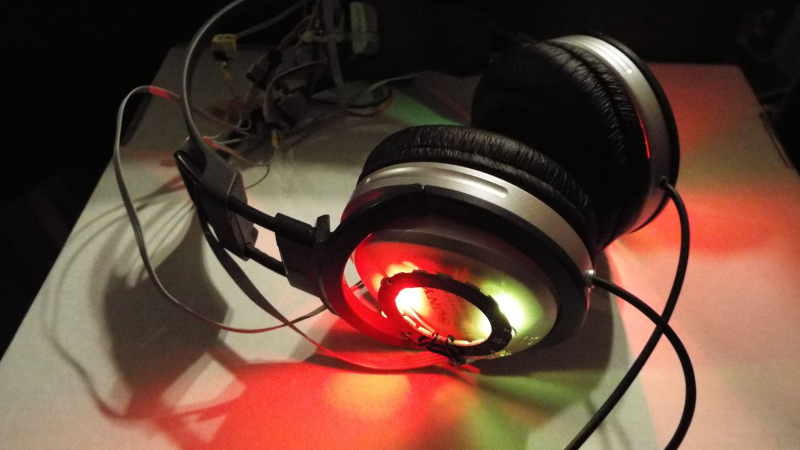
Noise cancelling headphones are a great way to insulate yourself from the bustle of the city, but due to their power requirements, continuous use means frequent recharging. [Alessandro Sgarzi] has an elegant and unique solution — powering the noise cancelling electronics by harvesting energy from the ambient noise of the city via a sheet of piezoelectric film.
This impressive feat is achieved using a LTC3588-1 power harvesting IC and a pair of supercapacitors, while an STM32L011K4T6 microcontroller processes the input from a MEMS microphone and feeds a low-power class D amplifier. This circuit consumes an astounding 1.7 nW, a power that a noisy city is amply able to supply. Audio meanwhile comes via a traditional 3.5 mm connector, which we are told is the cool kids’ choice nowadays anyway.
We like this project, and since it’s part of our 2026 Green Powered Challenge, it’s very much in the spirit of the thing. You’ve just got time to get your own entry in, so get a move on!












Typo above. Should be 17nW not 1.7nW .. still tiny though!
17nW for a MEMS a µC and a Class-D Amplifier still sounds unlikely to me:
You need a good headphone to even hear a 17nW audio-signal at a comfortable level.
Peter/DL3PB
“Completed project” with no files, and the maths are very dubious. And the thing has no noise cancelling feature are stated in the article. Smells like slop of slop.
I got some Jabra bluetooth headphones for Teams at work, and they were not cheap. They feature a noise cancelling feature. After using it for about a week, I noticed that I was getting chronical headaches. Disabled noise cancelling, and no headaches since.
Not sure if it’s the Jabra implementation, but noise cancelling is not for me.
i remember also having issues with jabra’s version of ANC on the headphone i got from my company (their top of the line office headphones at the time), it never got to the point i started having headaches but they were really unconfortable. it’s clearly anedoctal but considering i’m now using Bose’s QC35 for hours at time without issues it’s probably something to do with jabra’s implementation of ANC.
Thanks, good to know it’s not just me and that it’s still worth for me trying another brand!
So I read the project and have to assume mono sound able to be drowned out by the sounds that power it?
This film seems fake. $cm, what kinda unit? What voltage? Could be speaker materiel itself possibly, more likely noise maker.
The partial power of audio signal from 3.5 jack is not enough to run this noise cancelling circuit? Actually I am tired to make some math:) What about solar powered buds challenge?
Maybe you could make a DIY RTG from beads used in old smoke alarms, or find a used iridium-192 source (easy available as their comunally used for checking welds).
According to the creators comments on their project page, noise cancelling is not yet implemented. These appear to be just an amplifier stage for the headphones. Looking forward to seeing a schematic, code and or some other details from the creator.
Oh, so this is running the amplifier? I was wondering what its doing if the noise canceling isn’t implemented yet. Cause I have headphones with no microcontroller nor any other power consuming parts besides the drivers that get powered by the ghost input power from the 3.5″ plug. I’d recommend some of the soft foam earphone caps. They cancel noise and don’t require engineering nor powering.
It’s not “ghost input power”, it’s a headphone amplifier. As in a small amplifier (in the source device) that is able to drive headphone speakers.
“soft foam earphone caps. They cancel noise”
That’s not noise cancelling that’s hearing protection, noise cancelling is actually its own thing.
I get the motivation to do this, and it’s very cool that it can be made to work.
But if you don’t want the exercise of engineering such a thing it’s worth remembering that the “traditional 3.5 mm connector” has 3.3 volts present on ring 2.
In really traditional there isn’t any power, just pure audio, but according to my experience, if the player has a remote play-pause function on the 3.5 mm jack, or it is a 4 connector with mic input that might have play-pause/forward/reverse (different ohm to ground gives different function), then it does have some power, but at a very low current, often a 5k or 10kOhm resistor.
“ring 2″ refers to the additional ring on 4-wire connectors. It’s the second ‘R” in “TRRS”. Not present on the venerable (as distinct from traditional) 3-wire TRS stereo output-only jacks.
Yes, it’s current limited, capable of providing limited power: Only 15 thousand times more than the amount required by this project.
I still have my passive in ear monitors. Basically earplugs with reference earphone built in. Etymotic. 25 years and still better than everything else.
For some reason this article brought to me the image of a set of headphones, powered by crank , so you put the crank ,give some turns, detach the crank, done for some hours. :)
This sounds implausible. Sure, maybe you can power up the chips on 17 nW (though the PAM8302A listed consumes 3000 nW already in shutdown mode).
But getting any useful amount of audio power from the speaker elements? Nope, not happening.
The purpose of this project is not entirely clear and raises several questions. In the absence of a noise-cancelling function, and with audio provided via a 3.5 mm jack, it is unclear what role the STM32L011K4T6 microcontroller and the MEMS microphone are intended to fulfil. Additionally, the source of power for the LEDs (definitely beyond nW-scale) is not specified. As it stands, the technical explanation appears incomplete.
If this actually works out, one could skip the energy harvesting stuff and power it from a coin cell, a CR2032 might even outlive the headphones. For a “green” touch, zinc-air cells could be an alternative.
Page not found. The thesis is written like a fairy tale. But challenge accepted!