
Once the microcomputer era got going in earnest, the floppy disk quickly supplanted the tape as the portable storage method of choice. They were never particularly large, but they were fine for the average user to get by.
At the same time, it wasn’t long before heavier-duty removable storage solutions hit the market for power users who needed to move many megabytes at a time. In the 1980s, these were primarily the preserve of big print shops, corporate users, and governments. By the 1990s, even the mildly savvy computerist was starting to chafe against the tyrannical 1.44 MB limit of the regular 3.5″ diskette. Against this backdrop launched the SuperDisk—the product which hoped to take the floppy format to the next level, yet faltered all the same.
More Is Better
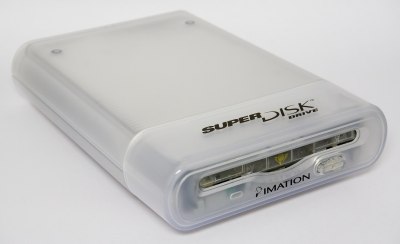
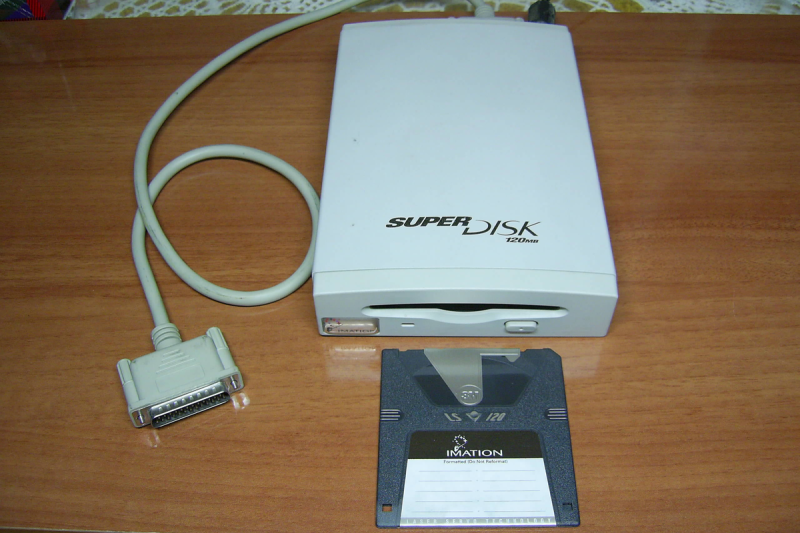
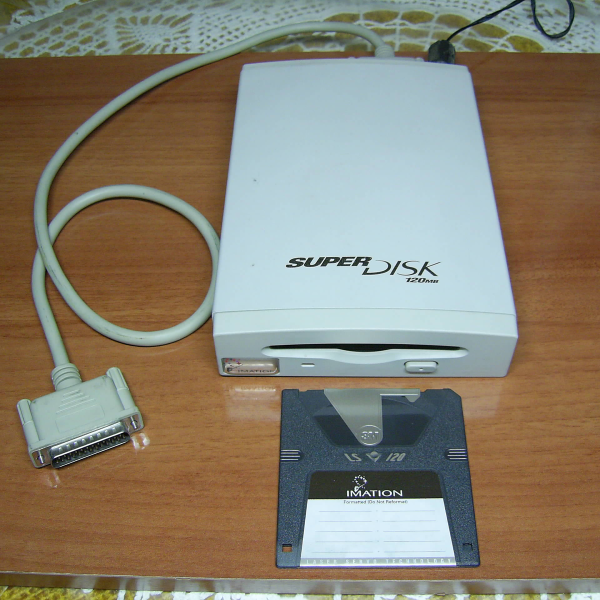
The SuperDisk was yet another innovation spawned by 3M, or more specifically, by the company’s storage group, Imation. Landing on the market in 1996, it was intended to be a higher-capacity successor to the regular floppy disk. In this era, the default removable storage was was the 3.5″ floppy, capable of storing 1.44 MB on a high-density double-sided disk in the dominant IBM format. The SuperDisk would easily eclipse that with its 120 MB capacity, almost 100 times what users were used to getting from a compact floppy disk. Back in the mid-1990s, when hard drives were just starting to flirt with gigabyte capacities in the single digits, this was a huge chunk of storage to be carrying around in your pocket.
The format relied on so-called “floptical” technology. The idea was to use optical guidance to more precisely position the magnetic heads that read and write the floppy magnetic platter. This would allow a disk to pack more tracks in per given area of disk, massively increasing the storage density. Where a regular 3.5″ floppy disk had 135 tracks per inch, an LS-120 disk would expand that to 2,490 tracks per inch. The LS-120 disks were physically unique, due to the need to have optical alignment tracks on the magnetic surface that could be read via a laser and sensor. Hence the LS designation, for “laser servo.”
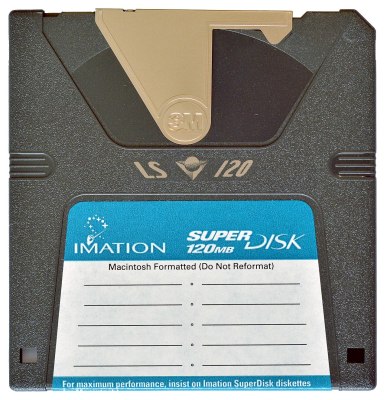
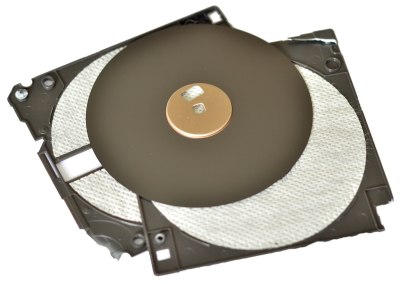

A variety of drives were made available in the marketplace, both in internal and external versions. The latter typically used parallel, USB, or SCSI interfaces, while internal drives were accessed via SCSI or ATAPI. Despite the special technology inside SuperDisks, they were otherwise very close in size to regular floppies, albeit with a rather unique shutter design. This allowed the SuperDisk drive to also read regular 1.44 MB and 720 KB diskettes. Notably, though, this was really only a thing in the PC world—the drives could not read 800 KB or 400 KB Macintosh format disks.
Unfortunately for Imation, the SuperDisk had a major hurdle to overcome from the outset. Iomega had already launched the Zip drive in 1995 to rapturous applause, racking up huge orders from the drop. The drives were not compatible with regular floppies in any way, and initial versions stored just 100 MB per disk. However, the first mover advantage had launched Iomega’s market share and stock into the stratosphere. There was little market interest in the upstart competitor when purple drives were already sitting on desks in business and universities around the world. Nevertheless, the SuperDisk drive still found some traction with big OEMs, showing up as an option in Dell, Compaq, and Gateway computers way back when. Panasonic even launched a line of digital cameras that used the supersized disks, not unlike Sony’s floppy disk cameras but with far more storage that made them more practical. Sadly, though, uptake was never high enough to make the SuperDisk a normalized replacement for a regular floppy drive, nor even a viable or well-known competitor to the all-domineering Zip.
Nevertheless, Matsushita persevered with the SuperDisk concept for some time. In 2001, the company launched LS-240 drives, which doubled capacity to 240 MB per disk. They also came with a fun party trick that allowed regular 3.5″ floppies to be formatted to hold 32MB. This feat was achieved in part due to the use of shingled magnetic recording (SMR), a technique wherein magnetic tracks on the platter are allowed to overlap to increase storage density. “FD32MB” formatted disks could only be read in LS-240 drives.
By this point, however, the CD burner had already taken over the world. With a CD-R or CD-RW retailing for less than a dollar in quantity, and capable of storing 700MB-plus, the value proposition of the SuperDisk faltered, along with most other magnetic storage solutions of the era. The drives would eventually go out of production in 2003, by which point the venerable USB drive was rising to prominence as the go-to standard for removable media.
Other than being a little late to market, there wasn’t a lot the SuperDisk got wrong. There were no major scandals with the reliability of the drives or media, and they had the nice feature that they were backwards compatible with existing floppy disks to boot. Sometimes, though, it’s impossible to overcome showing up late to the party. Between Iomega’s dominance in the 90s, and the widespread abandonment of magnetic removable media in the early 2000s, there was never really a good time for the SuperDisk to shine. Like so many other technologies out there, it was perfectly capable at what it was supposed to do, it just didn’t find the right audience. A solution without a problem, perhaps, given that others had already solved the issue before the SuperDisk saw the light of day.
Featured image: “SuperDisk” by [Miguel Durán]











1.44->120 is >>10x.
Got stuck on that one myself.
” In this era, the default removable storage was was the 3.5″ floppy, capable of storing 1.44 MB on a high-density double-sided disk in the dominant IBM format. The SuperDisk would easily eclipse that with its 120 MB capacity, nearly ten times what users were used to getting from a compact floppy disk.”
120MB / 1.44MB = 83.33x
Never forget the tape room!
Just reminds me how downright insufficient everything was in the 1990s. Every moment was chafing against limitations and every upgrade was overdue. Feels like i replaced most of the components in my main PC every other year for a decade. Crazy how satisfactory, by comparison, a ten year old piece of hardware is today.
Restrictions craft innovation. While nowadays, your typical electron App uses easily 1 GB of RAM and 500 MB of storage for what could do the same in 1/100.
And those innovations became obsolete the next year, when the technology marched by the need to have them.
Point in case: Amiga’s graphic chips pushing an obsolete and resource-limited planar architecture to produce high color graphics using a hack that made it temporarily superior at the cost of being difficult to program. Then VGA and SuperVGA came along, and wiped the floor with it.
Reminds me of using 13 floppy disks to install Windows 95!
The worst part was when one of the disks wouldn’t read for some unfathomable reason (even though it worked in every other machine). I, for one, was thrilled when CD-ROM drives became cheap enough that I could finally convince my boss to let me start adding them to our computers.
I had a 3.5″ IDE drive with all the installation files for WIN95 that I would temporarily plug in during installations. It was some much faster.
How about the 50 floppies for some of the Borland languages?
I used 50 floppies for the MMC and later SLS distributions of Linux. I’d go to work on the weekend and use several machines at once. Format format format FTP FTP FTP. Then replace disks and start again.
I think it really depends what one is doing. I was doing desktop publishing at the time and I went from a Quadra 700 in 1992, to a 100 MHz PPC upgrade in in it 1995, then a Powermac 9600 604 250 MHz in 1997 to a G4 500 MHz upgrade card in it 2000. Other than Ram upgrades and replacing a bad video card, I don’t think what I did was too far out of line as what I have done in the past 10 years with my other computers.
The flip side is this, I shelled out for each computer what could have purchased a decent used car at the time, but I could write it all of in my taxes. A so a budget home user didn’t have that option.
Back in the day with the 400-500 MHz machines you could really feel it in everyday use just on how fast the system would respond on the desktop running simple applications like word processing or web browsing, especially when multitasking. You didn’t have 50 tabs open in a browser, you had one (there were no tabs), and you could see the screen stutter and lag while scrolling.
Falling back to the older 100 MHz machine would not have be possible because it simply could not run the new applications and the rapidly increasing amounts of data you wanted to process. Even when you weren’t running out of RAM and swapping to disk, simple things like decoding an MP3 could consume all the CPU resources and make it practically infeasible to do anything else at the same time. You needed that upgrade to make it tolerable.
Today the new machine might be technically 5 times more powerful than the 10 year old machine, but both will play Youtube and edit a Word document without any lag, and even slower systems will do it without much pain.
Hackady from April 2050: “Here’s an SSD from the late 2020’s, holding mere gigabytes of storage. Can we run Doom XIV on it?”
Heh. I spent 12 hours on a 1200 baud modem downloading the ~5 MB source tarball of GCC to my ATT 3b1 computer (because the compiler that came with it choked on Nethack). Now there are freaking web pages bigger than that.
We used to think in terms of an annual hardware refresh, or maybe every 2 years if you were on a budget. Now if you buy high end hardware you can basically use it until it dies. I consider myself a power user but I have no plan to upgrade my cpu (4 years old), GPU (6 years old), or mobo (8 years old). (Ryzen 5800x3d / Geforce 3090 / x570 mobo).
But it did take me a few years to disconnect from PC-upgrade media coverage. I’m so happy that I don’t need to “stay on top” of benchmark news stories and have hardware fomo anymore.
Times have sure changed. Those upgrades (system/graphics card/etc.) felt really ‘good’ in the 80s, 90s, 2000s. Each one was a ‘leap’ forward and you could see/feel the progress every time. It was a magical time… I recall when I put foot in mouth, when I told my wife the 100Mhz 486DX would last us a looooong time it was so fast…. A year or two later, was upgrading!
As you say, today, you really can’t see any change for everyday work. My AM4 platforms all just ‘scream’. Do a compile (except when using Rust), and done before you remove your finger off the the return key. Everything runs smooth from browser to videos, editors, 3D cad, etc… . Network 1Gb and 2.5Gb speeds, SSDs for fast storage… Therefore, other than ‘WANT’ (or system(s) lets out the magic smoke), I have no reason to jump to AM5 platform for home use. For business, only reason for PC turn-over is now due to lend/lease expiring contracts…. Of course now with memory prices even the ‘want’ has gone by the wayside.
I don’t recall the super disk at all, but I must have run into it….
i was doing upgrades yearly seemed like. more ram, more storage, cd burners, voodoo cards, seemed i was always at the electronics store looking for my next upgrade. now i usually just do a mini itx build because im gonna spec it for the next 5 years, by which time there will be a new socket a new pcie standard, a new usb standard, and a new ram standard anyway. only thing i still upgrade is the gpu, and those are starting to last 5+ years as well.
thank you for giving the wonderful LS120 drive and disk its own post; i had mentioned it in comments on the one for the zip drive(within the last couple weeks). :)
Sad fact…. Using a cleaning disk in one of these usually destroys it.
I still have some operational ones and every LS120 disk I have still works. Kinda wild
i had one of these. the only problem is nobody else did. so it got little use. i seem to recall the disks constantly having errors though. the best thing is you could stick a normal floppy in the drive and it would work fine. most computers around the time had separate floppy and zip drives. then cd burners killed the need for both.