
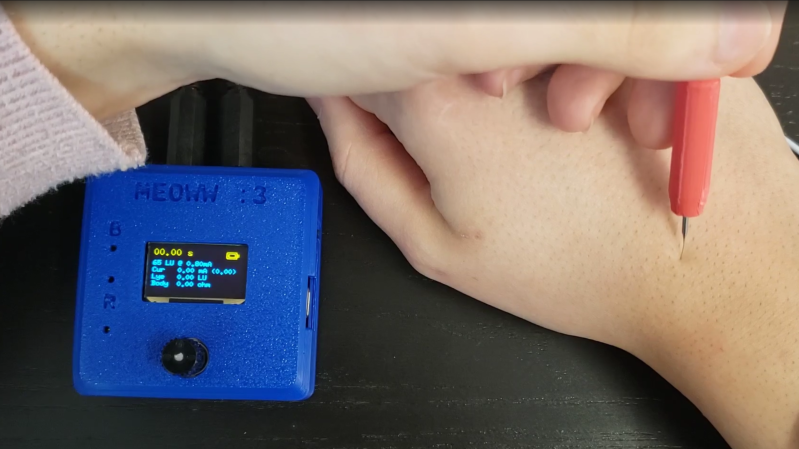
If you talk to the FDA, there’s only one permanent method of hair removal—electrolysis. This involves sticking a needle into a hair follicle, getting it very hot or running a current through it, and then letting heat and/or the lye generated kill the root of the hair dead. Normally, you’d pay someone with a commercial machine to do this for you at great expense. Or, you could do it yourself with a home-built machine, as [n3tcat] did.
Based on the available information out in the wild, [n3tcat] decided to build a galvanic electrolysis machine. This specifically passes current through a needle in the hair follicle to generate lye at the hair bulb, which kills it. The amount of lye generated depends on the amount of current and the time over which it is applied. More lye is more likely to kill a follicle permanently, though there are limits with regards to avoiding scarring, other skin damage, and excessive pain.
 [n3tcat]’s guide explains the basic theory behind galvanic electrolysis, as well as how the rig was built. An early attempt simply involved hooking up a 12-volt car battery to a standard electrolysis needle, sticking it in a hair, with the other electrode being an aluminium can held by the person being treated. The fun thing was that this allowed varying the current depending on how much contact and how stiffly the person grabbed the can.
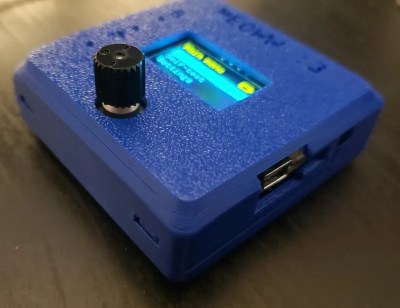
After a few successful hair removals this way, [n3tcat] decided to build a better rig. An RP2040 microcontroller was enlisted to run the show, powered by a 3.7-volt lithium rechargeable battery. An OLED screen and a rotary encoder were selected to serve as the interface, while a foot pedal was added for firing off current. A boost converter was used to push the battery voltage up to the vicinity of 15 volts for delivery to the needle, set up to avoid excessive current delivery for safety. A DAC was paired with an LM358 op-amp feeding into a MOSFET to control the current passed to the needle for accurate, controlled treatment, with the RP2040 monitoring the current level via a dedicated ADC. The needle itself got a D-printed pen-like handle for better ergonomics, easing the process of slotting the needle into a hair follicle. Everything was then assembled on a cute PCB, and wrapped up in a nice 3D printed housing. The files are available for the curious.
Electrolysis is a process that can cost many thousands of dollars depending on how much hair you hope to remove. Thus, it’s easy to see the appeal in having a rig that lets you do it at home. It’s just one of those things where you have to take the proper precautions to ensure you’re not unduly hurting yourself. Stay safe out there, hackers!












If you get the settings wrong, you can always give https://en.wikipedia.org/wiki/Scarification a try…
Modern electric arc scarification art is typically performed with a sinusoidal waveform of 250-500khz with voltages between 200-400V at an amperage between 0.4-1A.
you would have to seriously miss the settings to get decent scarification results. This is outputting 15V DC. Unless you add a bit of nichrome youd be unlikely to get more than a few light surface pocks.
Not the just settings – the source has to be grossly over-specced for that to happen.
I get it, armchair critics will criticize, but let’s check the facts first, shall we?
Sorry, this was meant to be funny. First thought that came to mind. No research was done on my part.
“meant to be funny”
Yeah, that seemed pretty clear to me.
No worries. I took it for HaD’s long held tradition of taking potshots.
Back on topic, it’s good to make your design incapable of doing meaningful harm, e.g. by making it not much more powerful than necessary. The car battery doesn’t seem to be in line with that thought.
do u ohms law, bro?
Car batteries nominal voltages vs resistance of the human body, you would have to try quite hard to scar yourself, you would get much fasster results by using the heat of a short circuit to create thermal scarring.
I would say a car battery or this pleasingly aesthetic little gadget is perfectly within the controllable range to get the intended outcome
Dvorak:
Most of the resistance in a human body is the skin.
This thing involves needles poked into the skin.
The car battery is a terrible power source for such a thing.
Worst case, power lead shorts to needle and you’ve got a torture device.
Right down to being applied to crotch.
Which is better than if it went wrong when being used for your mom’s moustache.
Then she’d get electroshock.
Don’t worry, Christian. I thought it was funny.
At least 2 of us knew it was obviously a joke!
Maybe this is silly or I’m missing something, but why to use many outputs (5 actually) to control the current source? we are talking about pwm right?
My DIY flamethrower also removes hair permanently. Still working on the scarring side effect.
If it’s for facial hair, then you can use a guillotine to remove the scarring.
What could go wrong?
Like needle poke too deep, burn too much, dirty needle, broken needle.
Soon we do surgery ourself.
Poke too deep and youve got a pin prick.
Burn too much youve got a small burn.
Dirty needle? as long as you arent sharing with others there isnt going to be anything more on your needle than you would be exposed to cutting yourself shaving.
Broken needle? Seriously? If you drop it and the needle breaks replace it.
You do understand that high school dropouts get certified to do electrolysis in an 8 week course thats about 1 week theory and instruction and 7 weeks of supervised practice. Its not rocket science.
no it is rocket surgery
No, it isn’t. Rocket surgery is a high skill profession involving the cutting anf welding of exotic materials to a very high standard. I have an old friend that is a (retired) rocket surgeon from the shuttle era.
Rocket surgery could also mean surgery done with rockets. I’m sure it would be effective at hair removal, too.
Many US states have no licensing requirements to be an electrologist, and even in places that do the training is a course that takes a few days. Galvanic electrolysis is the safest kind of electrolysis, and when doing DIY you can directly feel how much you are using. Most of the risk of infection comes from sharing needles between patients because of the risk of blood transmissible diseases which is why disposable sterlised needles are used(even then the act of electrlolysis creates lye and/or heat which kills bacteria in the same way it kills the follicle cells).
The biggest risk is using a dangerous power supply such as the car battery or an ac adaptor.
“[…] batterie de la voiture […] ”
It’s simpler and more straightforward to use battery acid (just kidding)
I’m not a body mod guy (no tattoos even), but come on, if anything is ethical to hack on, your own body certainly is.
I’ll be staying hairy, but it’s great to see someone build useful gear and save a pile of money. Even better to publish details and empower others
There’s a few annoying hairs I’d love to get rid of permanently.
I’d gladly remove the ones from my ears for instance.
yeah, but how to get the right combination of mirrors, or idk cellphone holders? I keep thinking of the China where professionals do ear cleaning with tweezers -it’s not that weird, and I’m sad I’ve never found any of these places in Chinatown, it’s probably not lawful in North America. But in the Chinese Ear Cleaning stores, people do it every day, over and over, with no patients deafened. It’s one of those things that makes me think “we’re the weirdos here”.
“yeah, but how to get the right combination of mirrors, or idk cellphone holders?”
Sad internet person,
Some people, likely most people in fact, have friends, and family members they can ask for help.
A lot of Chinese people have the gene mutation that gives them dry ear wax and therefore need the poking and prodding tools of the Chinese ear cleaning stores. That mutation is less common in other places so the stores would be less profitable.
However China will supply you with a teeny tiny ear camera tweezer thing that you can view on your phone. I guess you could adapt one of them for an electrolysis needle.
The car battery is hilariously sketchy. The final build is great and well researched.
I’m curious – is it possible to repurpose TENS/EMS device?
If you reverse the polarity can you grow the hair back? Now you got something
Without eyebrows you might defeat facial recognition.
Or make it very easy.
“D-printed pen-like handle” – Should that say 3D-printed? …
And ants just thought they had to worry about magnifying glasses….
A Bug’s Life meets HOSTEL
I spent probably $1800 and over a year of appointments (you have to keep shocking the hair until it stops coming back) getting my eyebrows done. They still look great 20 years later and I haven’t plucked one since. Hurts quite a bit but totally worth it.
20 years ago, women would shave their eyebrows and redraw them with a sharpie.
Men would pretend it looked good (then laugh about it with their friends).
Beware making fashion permanent.
Considering that I’m looking at having to get electrolysis on my face due to the amount of white hairs on it AND the one place that I trust to do the job charges something like $60/hour (and that’s their bulk rate!), this might be something useful to play around with. (laser hair removal only removes hair with pigment in it; white hairs stubbornly remain).
A car battery?? Yeesh.
When I was young and dumb I watched my bio teacher connect a battery to a frog’s legs. Twitch. Made me wonder if our muscles would do the same thing, so I devised an experiment. Poked two seeing needles a tiny bit into my thigh, and then touched the needles to a 9v battery. It hit me like a car. Oops. I got results, but definitely hadn’t thought the experiment through very well. I learned that was a very necessary step to science.
For the love of god, why use a car battery for an early test?!
anything to make the femboys softer and more cuddly.