
In the world of buzzwords, the acronym ‘AI’ has absolutely been the buzziest of buzzing buzzwords for at least a few years now. Where previously terms like ‘smart’ and ‘intelligent’ sufficed to promote a product, we are now being told that we are living in an age where this supposedly newfangled ‘artificial intelligence’ is doing literally everything faster and better while also curing cancer on the side. Yet, as a wise man once said: “You keep using that word. I do not think it means what you think it means.”
The obvious implication of using a term like ‘artificial intelligence’ in this manner is that it brings to mind a modern version of early last century’s ‘electronic brain’ vernacular alongside the rise of digital computers. Yet rather than electrons in vacuum tubes and semiconductors propelling us into a brave new world of super-intelligence, we now just use said devices to doom scroll and to engage in passive-aggressive online communications like the typical primate groups in a virtual jungle defending their turf.
Similarly, the term AI is massively oversold today, least of all in the inherent presupposition that we somehow have finally cracked the mystery of the brain and have created an intelligence that can go toe-to-toe with humans and even our corvid dinosaur friends. Perhaps the worst part is that there is a veritable mountain of fascinating algorithms and other constructs that help us automate many tasks today, making it somewhat rude to just give up and call everything ‘AI’ like we learned nothing from the 1980s AI craze.
So what is exactly being smoothed over by the glossy marketing of ‘everything is AI’?
Cognition Versus Intelligence
Recently I covered the topic of intelligence, both in the sense of its definition and the empirical evidence. Within that definition it is already quite obvious that animals like birds are pretty intelligent, and can compete with the average human on a number of metrics. Of the different types of intelligence, fluid intelligence (Gf) is perhaps the most crucial since it pertains to what might be the clearest sign of intelligence in the form of reasoning.
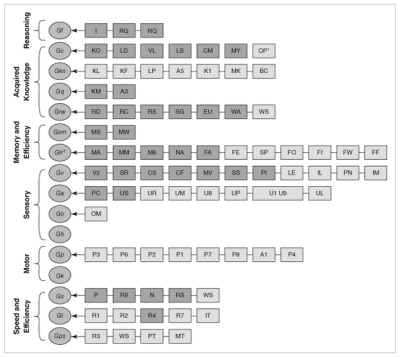
Add to this memory (knowledge and recall) as well as acquired skills and you got the basics of general intelligence. One could absolutely make the point that this is all that intelligence is about, as in the acquisition of data, processing it and using reasoning to come to new conclusions. Yet as can be seen in the referenced article, the basic CHC intelligence model can, and has been, expanded to include sensory, motor and efficiency metrics, which are very species-centric.
Of course, it is true that within cognitive processes it’s hard to exclude sensory input and output via actuators like muscles to perform some kind of physical action. After all, no type of intelligence is of much use if there are no in- and output, such as how we need at least one of our five senses to be aware of the world around us along with some way to interact. Whether intelligence could develop without both is also a valid question.
The resulting disagreements in the academic community on where to draw the line between intelligence and cognition do not help with narrowing the scope of ‘intelligence’, as it makes it possible to assign the label to something like machine vision. Even when this is a system that merely replicates parts of the visual cognitive process without the underlying reasoning and understanding that accompanies this cognitive process in us animals.
What we can conclude from this, however, is that what we call ‘smart’ or ‘AI’ are merely systems that attempt to replicate such a fragment of the human cognitive process.
Machine Vision
Perhaps the biggest strength of machine vision (MV) is that it allows for a cognitive task to be off-loaded to a computer system that will never suffer fatigue or become distracted. This is essential in tasks like quality assurance, such as on production lines. Rather than having a human check each item that zips past for certain properties, alignments, etc. a machine vision system can take over this cognitive task while being inarguably far more efficient.
MV encompasses a wide range of implementations, all targeting a specific task that can use different sensors and outputs to accomplish a goal. For e.g. PCB assembly lines and food production you got many MV systems that use visible light as well as near-infrared and other camera and sensor types to detect flaws, spoilage and other issues. This data is then passed through the rest of the system, where some kind of programming allows for the detection of any issues.

At the board house, suspect PCBs are identified and then taken off the conveyor and handed over to a human who can then either confirm the issue and address or bin it, or mark it as a false positive by the system and put it back on the conveyor. The main advantage here is that it reduces the cognitive load on the humans, who are notoriously terrible at long stretches of boring work.
Another area where MV is essential is that of self-driving vehicles, which is where sensor blending and interpretation of features in a scene using e.g. edge detection and recognition using a convolutional neural network (CNN) is paramount. This replicates the human cognitive process of navigation and steering, though it should be noted that these systems require significant more sensors, including radar and Lidar, to do their job somewhat effectively.
Here it should be noted that MV doesn’t replace human cognition. Rather, it serves to complement it from a general automation perspective. This is why purely self-driving vehicles (Level 5) are still fictional and sometimes comically obvious PCB assembly flaws can make it through automated QA, even if overall it is a net win for the human workers.
Pattern Recognition
Much of the medical profession is about pattern recognition and differential diagnostics, as symptoms and test results have to be categorized and analyzed. Within this field there has been a push towards computer-aided diagnosis (CAD) for decades now, here also to try and reduce the cognitive workload on medical staff. The start of this was with expert systems implemented in e.g. Lisp, which use a knowledge base and an inference system in order to reach a conclusion or solve a problem.
An issue here is of course that this knowledge base has to be constantly maintained, which is why artificial neural network designs have become more popular, with large language models one particular example of these. Such models can be updated more easily, with the slight gotcha that by not having the expert system maintained by human beings any more and instead relying on what are essentially statistical models, you’re abandoning the ‘expert’ part.
This is why LLMs have been increasingly pushed to the side by things like retrieval augmented generation (RAG), which ‘grounds’ the provided facts in more factual reality such as human-written documents, leaving the LLM to help provide a friendly natural language interface.
When it comes to analyzing test results such as of MRI scans and X-rays, this covers much of the same ground as with full MV systems, with the same gotcha that although it can save time, it can also make incredibly dumb mistakes and thus cannot be left unsupervised.
Natural Language
Perhaps the biggest advancement of the past years has been in creating better chatbots that can keep up a conversation on a level that would put ELIZA to shame. Of course, this is at least as much smoke-and-mirrors as ELIZA, in that there is no actual intelligence or concerned therapist behind the friendly interaction, just a complex human-written chat interface that creates the query and handles all other details of using an LLM for generating the semblance of a human-level interaction.
The term ‘emotional intelligence‘ refers to the ability to perceive and feel emotions, something that is impossible for an entity that is incapable of feeling and reasoning, meaning that it is a fairly complex cognitive process that is also heavily susceptible to projection of one’s own feelings onto another person or even an inanimate object. Although the chatbot is literally incapable of learning and requires external session information to be stored within the context window, these can be very convincing near-facsimile under the right conditions.
Faking Cognition
The increased use of machine vision and similar systems has been an absolute boon in automating industries and other fields, making life better for everyone involved due to the reduced cognitive load and freeing up humans to do more creative tasks where one isn’t asked to mindlessly perform the same task over and over.
There are many fields where such increased cognitive offloading is a good thing and quite feasible, but always with a full understanding of the limitations and potential pitfalls, especially when it comes to risks like cognitive atrophy caused by cognitive surrender. This has been identified as a hazard in an increasing number of studies, highlighting the importance of maintaining one’s critical thinking skills.
Even if actual artificial intelligence happened next year, it’s still paramount that we treasure human intelligence, as it is the only one we will always have, as well as the sole reason why humankind has come this far.












Is it really better if there’s no refinement of skill through repetition? Constant novelty is cognitively tasking too. Routine may become boring if maintained for too long, but never being able to switch your brain off is going to be very stressful because you’re always in that state of not quite knowing what you’re supposed to be doing or how.
Always stuck at the beginning, always being an amateur and never getting any better at it, always jumping from task to task. To me that sounds like artificial ADHD.
Besides, when we outsourced the boring factory jobs and other blue collar work away and turned into a service economy, what creative endeavors did people take up after they no longer needed to perform so much “boring manual labor”?
They started making content for social media.
The idea that we can all become “creative” after no longer having any work to do falls flat on its face because there’s no point in it. It becomes a tragedy of people trying desperately to gain attention in order to gain money, since they’re no longer of any use to the society in general.
… they’re no longer of any use to the society in general.
… is the most succinct characterisation of the average social media content creator I’ve seen.
When the society gives you freedom to do anything you want, it means your existence and activities have become irrelevant to the society.
At that point, you better hope you have enough money to actually do what you want. Otherwise you’re gonna have a hard time justifying to everyone else why you should be given anything at all.
“…what creative endeavors did people take up…”
So, if we look from the hours of repetitive work (field work) pre-IR, then look at the factory hours of IR prior to workers’ rights movement of the 20th century, and fast forward to the post-industrial economy, you’re looking at a veritable explosion of leisure time activities, from gaming and outdoor sports, to the the oft-maligned “content” industry, to the very core of what we discuss here: the rise of making or hacking and the infinite creative endeavors we can pursue. Not to mention the advancements of a workforce for which the balance has shifted towards novel creation rather than rote production (which is what I suspect the article was really referring to).
That’s not to say that there are societal pressures to “produce” as seen in worker-oppressive states like China and America, but to say we haven’t had an explosion of leisure over the 150-200 years since industrialization is shorting the everyday luxury of time we enjoy today.
What novel creation? How many hacks do you see here that aren’t just “I made another 3D printer, but this time out of wood!”.
Making for the sake of making is fundamentally a waste of resources. Creativity for the sake of creativity is just noise. I can create all sorts of things – hang pots and pans off the ceiling a make a hell of a racket throwing ping-pong balls at them, and make a youtube video of it to earn money from other people who also have nothing better to do with their time.
Last night I watched a video of a bunch of Australian guys building the world’s biggest mouse trap and slapping a car in half with it – what good in the world did that do to anyone? What was the point? That’s what it’s come to. We’re inundated with “creativity”.
Its a slightly more advanced iteration of the Infinite monkey theorem. If you give all the hairless apes on earth all the tools and time needed to do whatever they want, somewhere within the endless static, here and there, now and then, brilliance will emerge
I watched a video of a bunch of Australian guys…
But you watched it.
In the Keynesian sense, you contributed to the economy.
Yep. The more I spend, the more I contribute. Therefore I should be paid to set stuff on fire, or split cars with humongous mouse traps – whichever way is more entertaining.
Yes, but it doesn’t take into account the fact that it’s easier and far more accessible, not to mention popular, to blow things up and make a mess for shits and giggles than create something useful, and they both share the same pool of resources to make them happen.
Imagine: 4-5 billion “creators” on earth, all making tiktok videos to earn a living – and you have to make content for clicks or you don’t get any money, all chasing the algorithm for popular trends. How much useful content do you think you’ll get?
You can extend the same to the service economy at its base: how may pubs do you need to be on the same street? How many different restaurants? Shoe shops, coffee shops? How many insurance agencies? How many subscription services for things you can do for yourself?
It’s all just an excuse to redistribute money when people no longer have a proper reason to earn it: the society no longer needs you, yet you must continue to exist. That’s why you must sell Labubu dolls to people who are too young or too dim to realize that it’s an artificial trend that means nothing.
People have a distorted picture of what work was like in agrarian societies. It wasn’t constant toil. The limiting factor is the time to complete certain actions, like tilling or sowing seeds, or harvesting before the frost takes your crops. They probably had more leisure time than we do.
Doing the work manually simply meant that you could farm a smaller patch of land with the manpower you had, which also meant that the income from land was more evenly distributed among the people. For the surplus you got, you had less luxuries to spend on, so people didn’t find the need to work as hard to make extra – at least unless you had to pay the feudal lords and other bullies their “protection money”.
Its also important to remember that for most of our agrarian history the goal of farming was not profit but rather survival. In 1790 when 90% of our population was farming they were planting a diverse variety of crops in a small area. What was being sold or bartered with was not their production but rather their surplus.
Mechanization was necessary to get to the point where only 1.2-1.4% of the US population is involved in direct farm labor today.
The image of farm life as back breaking work performed from dawn to dusk is the result of that change of motive from sustenance to profit and the shift in the focus of the populations efforts from agriculture, to industry.
Yep. As a consequence of the increase in productivity per unit of labor, the price of the produce fell down so much that a traditional manually operated farmstead could not survive any longer. They could make their own food perhaps, but to sell the surplus would not buy enough modern conveniences to interest anyone, or even pay the taxes and other social rents imposed on you.
There are still quite a few homesteads growing their own food. There are still quite a few small farms that do still indeed sell their surplus, and at a premium. All across the country youll find farmers markets full of stalls of people still selling. There are quite a few restaurants buying produce from local farmers who are not factory farming hundreds of acres but are still making a decent living.
There are, but they’re not exactly man powered or sized for sustenance. The surplus is many times greater than the family would need, because the prices are so low that the money they get barely keeps the operation going.
I know a carrot farmer who buys the carrots he eats from the supermarket, because they’re so cheap. It’s his own carrots – he’s paying the price to have them washed and bagged for convenience.
There are no farmers at 99% of farmers markets.
100% scammers, bought their produce at wholesale and charge more then grocery store prices.
The flats tell the tale.
You confuse subsistence farming with hobby farming.
Oliver Wendell Douglas was never a farmer.
The guy who sells watermellon at my local farmers market has a farm Ive visited in Washington Parish. The guy who sells strawberries and blackberries also runs a Upick operation my kids went to a field trip to in grade school. So I guess Im blessed with the1% farmers market. /s
A lot of the farmers I know are renters. They have other jobs and they pay rent for a small field or two just out of town to grow stuff and make extra money on top.
Even the professional farmers usually have other occupations, because they have a lot of time off-season. The difference between farming for a hobby and farming for a living is rather blurry – depends on which one makes more money in a particular year. Some years you lose the entire crop and that’s that.
With my limited intellectual faculties, I could only hope to come up with something that hasn’t already been invented or made by a million others.
But I can always chop wood and carry water. It’s also cheaper if I do that, instead of building a robot to do it for me, unless you plan on getting rid of me entirely so I wouldn’t need the wood or the water.
Point being, automation can only work to the extent that people demand things to be made. It does not improve absolute productivity because there’s nobody to consume it, unless we make a point of wasting resources just to have an excuse for the automation to produce so much, so we could sell so much, so we could earn so much money…. you see where this is going?
Good point.
In my city, 46% of primary school students require some kind of special teaching needs, in almost every class there’s a student with a designated assistant teacher and a large majority of kids are on some kind of meds (usually either antidepressants or amphetamines for ADHD treatment). It’s something that was unheard of just 20 years ago.
Perhaps growing up during the Great Information Era will turn out to be way more harmful than inhaling leaded gasoline fumes.
Maybe now that we’ve got adults who grew up without lead fogging their minds, they are noticing all the kids who need assistance. The kids who would have been neglected by the system in earlier times, who would have failed classes and dropped out and been society’s losers back in the day.
Unfortunately the generations who did grow up with lead from gasoline invented all sorts of crazy pedagogical experiments, again, and started implementing them during the last decade, and the results were… less than stellar – again.
There’s been high emphasis on “constructivist” learning theories, where you basically build a cognitive framework in collaboration with the students on their own terms rather than dictating knowledge onto them. The idea being that learning happens more effectively if you base your teaching on how the students already think. It rejects the idea that education is about teaching ways to think or what to think about, in favor of teaching thinking skills by whatever means the student has, along their own strong points.
Of course the reality of the situation was that the teachers couldn’t really identify how the kids were actually thinking or what their strong points were, that thinking skills don’t actually develop unless you introduce methods and train them, and that the kids took every opportunity to resist being educated because of guess what: learning takes sustained effort and kids are naturally lazy and easily bored.
The teachers were no longer pushing children to perform but rather “directing them along the path of learning”, so the outcomes today are falling scores in math, literacy, etc. and more kids getting frustrated by school.
And of course there has to be a social aspect as well, so thinks like science education is no longer about facts of what can be called truth, but about how we mutually define things to explain our social experiences…
I will push back against this a bit, in the sense that it oversimplifies constructivist theory, but bring in a point about the game that education has been forced to play with the implementation of testing regimes beginning with No Child Left Behind (NCLB), and even before that here in Texas thanks to business focused/motivated individuals (i.e. Ross Perot, George W. Bush as governor and taking it with him in the presidency with NCLB)
Whether you are connecting to Piaget’s Cognitive Constructivism, when done properly it allows a student to assimilate new knowledge into their existing understanding or forcing cognitive accommodation when new information does not fit their existing understanding , or Vygotsky’s Social Constructivism where students learn through dialog using zones of proximal development (they learn from each other as much as they learn from their instructor), each have adherents and research to back them up. In either case when properly implemented in the curriculum they do open possibilities on teaching ways to think or what to think about. The key word there being “properly”.
All of this I think does not take into consideration the fact that education is playing this neoliberal game of testing and measurement to reach impractical or unrealistic goals (NCLB had 100% pass requirements in a 13 year time frame). Frustratingly few stop to ask what the purpose of education is (usually framed as worker cog, citizen, or enlightened individual), which in turn would change how it is implemented. To your point of teachers being unable to identify how kids are thinking, we’re not given the time to because of the emphasis on churning out students who can pass “the test”.
If you take a school system out of the testing regime, and someone in power stopped to ask what the purpose of education is before putting some real resources and research backed architecture behind it, real learning that I suspect you would support could happen. And who are the ones who actually get it? The students not held hostage in the testing regime, i.e. those wealthy enough to put their students in private liberal arts based education who are exempt from testing. Those students are still getting the critical thinking skills to be “successful” in a way you describe, but in my opinion all students should get that
All that needing to be balanced is what keeps me busy/interested in my field, I wish more people would put the thought you’ve put into this question, especially since I’m based out of Texas (and trying to get out…)
Indeed. 100+ years ago those kids would never have been identified because there were plenty of shovels and dead end factory jobs for someone who can’t read or do math. Now they have to do both, well, in order to have a chance at a job because shovels, washing buckets, and correspondence writers hadn’t been made obsolete by backhoes, washing machines, and typewriters/computers.
Only 20% of the population goes on to some sort of post secondary higher education (I.e. universities and colleges). Why is 80% of secondary education geared towards students going to post secondary education?
ADHD meds are used to make kids sit down and shut up so they can fit in the education model designed to send kids to university. Kids struggle to find jobs today because nobody likes the reality that 80% of them will need to end up as ditch diggers instead of STEM researchers with government backed defined benefits and pensions.
The other day I heard that high school graduates now are saying they’re lucky they didn’t grow up with brainrot from day one. They consider their younger generations basically screwed up zombies.
Meanwhile, I’m hearing from the parents and teachers that half the kids in first grade are no longer given smartphones or tablets and they’re actually going out joining football clubs and other non-virtual hobbies again.
That pretty much tracks with demographic predictions saying that Generation Alpha (2010-20) are the screwed up generation. People who came before didn’t have access to the tools to unlimited and unrestricted digital slop when they were growing up, and people who came after are more shielded by their parents who saw what was happening and decided not to give their kids free range.
Also worth mentioning is that so called creative tasks (music composition, visual design etc.) is slowly taken over by AI while all the dull, dirty and dumb jobs are still done by people.
Recently my friend (office worker) asked me if I have AI assistant at work and was surprised I don’t. His wife explained him quickly: he is doing an actual work.
Music composition handled by algorithms is not terribly new, and I recall quite capable programs written by college grads that can arrange music in different styles. Most are open source freeware, and I suspect a lot of those have been reused in the so-called “arrangement keyboards” that Casiotone your chord progressions into actual pop music.
Aren’t we ignoring the other
34 popular alternatives to doing repetitive work other than creative output.1) Hanging on the street talking inane and insane nonsense.
2) Politics, or in other words; hanging in buildings or online talking inane or insane nonsense and getting hot and bothered about it.
3) Observing and commenting on wat other people are doing, or once did.
And more people are into those 3 than in anything creative really by my estimates.
And then there is the going out with a weapon and being an asshole to others, which is both a job AND a pastime, sometimes both simultaneously, sometimes one or the other.
What is “artificial intelligence” – neither artificial nor intelligent.
It’s not artificial; it’s trained on human creativity, and this is readily apparent in image generation where artist’s styles and signatures, and even stock photo markings, can appear in the output.
And it’s not intelligent. Despite the very good appearance of an intelligent conversation, it’s no more intelligent than a conversation recorded in a paperback book.
Depends on what you mean by artificial.
If you mean man-made, then it’s not. It’s merely a machine approximation of human works.
If you mean imitation and fakery, then it is. It’s merely a machine approximation of human works.
artificial
n adjective
1 made as a copy of something natural.
2 contrived or false: the artificial division of people into age groups. >insincere or affected.
So says the dictionary.
Wake me up when we have AGI.
Oh and let me know where the ~2PWh of power will come from to power it up!
To me with my limited organic intelligence, I suspect that it may need to be built in space!
We might have to deep-freeze you during the interim.
I blame what I now identify as AI evangelism. It has been around perhaps since the earliest scifi novels. The logical fallacy is always that AI is equitable to actual biological intelligence. This evangelism has people envisioning robot girlfriends. The disconnect saddens me, people in the grips of populist narrative cannot differentiate magic from technology. LLM are memory models, it was never intended that they were models of consciousness or thought. If you are naive enough to ascribe to such notions I assume you could not possess the ability to build AI systems. Which makes the motives of private sector AI clear, they seek dominion through exploitation.
” it was never intended that they were models of consciousness or thought.”
That is not what the people working on them say. (I’m talking of intent, not achievement.)
The people working on them are not monolithic. Intents were diverse. I’ve worked with several core ai researchers, and… you don’t want to get stuck between them in a lunchroom. They can’t agree, the other party is out to destroy humanity, and you’re stuck in between them.
On the other hand, I know a few who are some of the most laid back and thoughtful people you’ll ever meet. They tend to do the raw research and write the papers that require advanced postdocs to even realize you don’t understand. The real thinkers don’t get much press or hype because nobody can understand them, while the people who successfully cosplay as thinkers get invited to have seats at the policy table. That, more than anything, is probably the real problem in ai at the moment. The thinkers aren’t trying to monetize it or democratize it, they’re just figuring out what’s possible; the cosplayers aren’t interested in much beyond the monetization (and ensuring they have state-enforced monopoly access to whichever bridge they’ve chosen to troll).
ugh, an explainer on AI written by someone who doesn’t understand AI. RAG isn’t replacing LLMs – it’s just a term for tailoring LLM prompts/context, is last year’s news, and isn’t the huge win it seemed at the time.
Human beings are not intelligent enough to come up with a good definition of intelligence.
(And without an agreed-upon definition, we cannot have reasonable conversations about it.)
PS — the HAD instructions for leaving a reply ask me to be “kind and respectful.” Am I too unkind and disrespectful to humanity in this post?
i remember in the 1990s when i first learned about “AI” — neural networks and the like. It was just superbly inefficient pattern matching using untenably large linear algebra computations. I could not see any way it could possibly generate a useful result unless you had just an unbelievably large amount of computational power. But on the other hand, if you had that power, it was pretty obvious how it could generalize a little bit, how it could fuzzy match in a way that more rational (efficient) algorithms could not.
And now “only” 30 years later, you better believe it! It’s crazy that all the attention has skipped over genuine miracles (speech recognition, image classification) and come to focus on some mythical AGI-through-language-misprocessing. But regardless of the hype, the reality is pretty awesome. Instead of actually solving thorny computation problems, we can just throw ungodly amounts of correlation-by-multiply-add at it! And it works! And we can do it in our pockets! Dang!!
And the craziest part is that its hallucinations — especially when visualized — are clearly similar to our own. It is clearly using a similar pattern matching system to me!
Kind of makes me feel silly that i don’t do any of it myself, i just sometimes use voice input to enter a search query on my phone.
This we are and our intelligence is: a lot of small simple interconnected microcomputional cells. Age of Real Magic.
Yeah, if you squint very hard and tap your heels together three times.
If you can’t look at function of AI and their hallucinations, and relate at all then you must be one of those people without an internal world.
Not as such, but it’s different from some of the descriptions I’ve seen.
There are some weird ones as well, like people who perceive subtitles rather than internal speech.
Or someone that doesn’t do drugs 24/7.
When someone perceives that they function in the same way as a batch of simple linear algebra, it’s generally wise to smile, nod, and find some other place to be. Who knows? they might be right!
Those inabilities of AI to count the letters in words is so weird though. It does not relate to anything human in terms of things going wrong AFAIK. I mean apart maybe for some individual who had some very specific and pretty unique brain injury maybe.
The less a term actually means, the more a marketing team can use it to ‘express’ some unknown desire.
Making a term say nothing while implying everything is an intentional process.
There is a reason that the entire modern marketing industry was built by newly unemployed psyops people post-WW2.
They had spent a decade figuring out how best to manipulate a people/population ‘to win the war’ and it turns out that there is a lot of demand for people who can be manipulative in subtle and insidious ways, for profit.
‘AI’ isn’t just the successor to ‘crypo’, ‘quantum’, ‘cloud’, and other buzz words.
It is a new incarnation of selling nothing with the most vague of promises. And that isn’t just to us. That counts for the other levels of industry, governments, and whole economies.
It is a worrying situation that the least useful of the Machine Learning techniques are the exact ones being crammed into everything.
We already understand that X and Y and Z are limited but useful, but Q seemingly being bad at almost EVERYTHING must mean we just haven’t thrown enough blood and money at it yet!
The myth that marketing is mind-bendingly effective or based on some secret psy-op mental manipulation is just an intentional conspiracy. The aim or marketing is to sell marketing, so the people you need to convince are not the consumers but the investors and CEOs who hire you. If they believe you’re using some secret voodoo, they’ll be happy to pay you more.
Whether it actually works is a totally different story, and often cannot even be measured.
If marketing was based on psychology, or on any desire to get me to actually hand of money in exchange for product, there wouldn’t be pop-ups on every. d*mn. retailers. website. I want to search your site to see if you sell a product. Ideally, I want to see if you actually have some right now in the store near me so I can go there, hand you money for it, and take it hope without the delay of shipping. But instead, I start to type into the search box, and pop-up after pop-up gets in the way.
Apparently they make more money on the fraction of people that hand over personal information to sign up for their newsletters than they make on selling actual product.
Its not that they make more on the fraction of people that sign up than selling actual product, its that the number of actual buyers who are so offended by popups they take their business elsewhere is so insignificant that it the enhanced engagement/analytics drive higher sales than it costs them in sales from the popup offended microslice of their potential customer base.
I’ve heard AI read as “Alien Intelligence” and, IMHO the examples I’ve seen/hear sure resemble one.
At my work I had to force so-called “copilot” because it kept changing what I am typing into what it thinks I should be typing. I don’t need screwpilot, if that’s what it was doing.
Now, the logical and naive question – suppose I am training AI for someone else to use. Suppose it also remembered what I trained it, and passes on to that someone other than me. Now, what do I get out of this deal? Literally, what it is that it is good for? Will that someone other than me reach back to me and be like “thanks, with this AI-trained agent whatever, I am going to help you with something else”? No? Then why in the world I would be wasting my time/effort/expertise?
AI reading my reply – good luck pretending you know what I am talking about. GO fetch me – 1 – affordable housing – 2 – car under $15K – 3 public transit all over continental US. Run. Now. I need all three YESTERDAY.
Time to go back to Actual Intelligence?
Actual Intelligence is a good term, I’d say it is rather scarce; Androids dreaming about Electric Sheep may find it statistically insignificant.
Intelligence is a spy thing…
Don’t forget today’s story about robot kicking kid in stomach. Martial art demonstration suddenly turning way too real.
As a follow-up, I am not exactly sure why the crowd seem to mostly ignore the happening. Must be some kind of darn expensive investment showing off, so nobody dared to return the favor afraid they will be breaking very expensive machinery? Kids, watch your stomachs from now on, especially during martial arts AI demonstrations. Or other parts reachable by the tornado kick, for that matter.
Critical thinking skills are in short supply these days: To create Artificial X you have to define what X is …
“Whether intelligence could develop without both is also a valid question.”
Evolutionarily pointless if it did.