
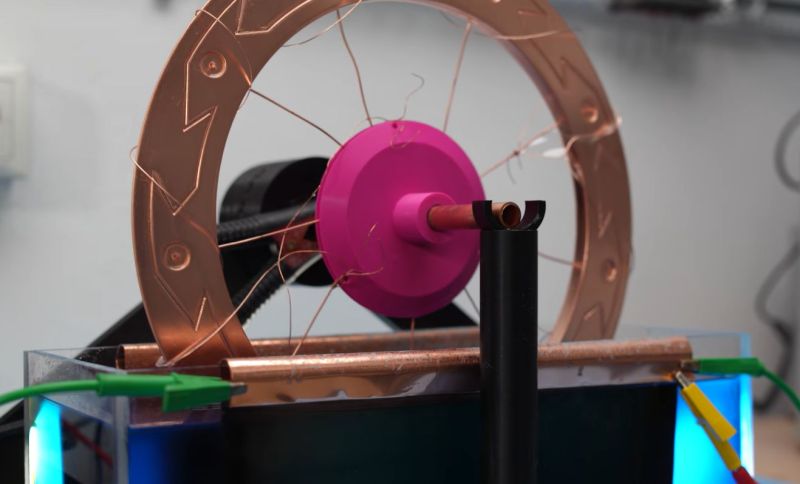
Electroplating 3D prints is a good way to get a pretty nice coating on even a basic PLA part, but generally you’re expected to dunk the entire part into a big vat with electrolyte after coating it with the requisite conductive paint layer. This is great for small parts, like a ring you’d put on a finger, but gets rather silly when it’s a much larger part, such as the one in [Hendrik]’s recent video. Out of curiosity he tried to see whether rotating the part through a much smaller vat would still get you an even coating, or not.
Perhaps ironically this process required building a custom vat out of acrylic, as well as an entire rig to hold up the part and gently rotate it. This highlights the main disadvantage of this approach, in that unless you’re doing a small production run or otherwise get to re-use the rig a lot it’s a lot of extra effort.
That said, the rotation is controlled by an ESP32 and a stepper motor along with a requisite stepper driver, with the most exotic part being the whole custom PCB and enclosure, all of which can be used repeatedly. With all of that tested and confirmed working, the part to be plated was sanded, sprayed with conductive paint and hooked up to the rotating rig for an overnight run.
Following that the part’s new copper coating was polished before more layers of electroplating were applied to get the desired two different colors from different metals. Along the way no issues were found with this method of rotating electroplating, so if you regularly struggle with oversized parts to electroplate, this would seem to be a viable method.












This is an old process, to only submerge part and rotate it. They use it to electroform large industrial scale components. I think theres a recent paper from 2015 on using this idea to electroform copper canisters for radioactive waste. Been around for a long time but still cool to see it on the small scale.
So they are reinventing the wheel?
Jokes aside, quite a bit on every level.
The point of the video was to keep things cost effective. They made that clear at the beginning. The ESP32 running a stepper motor, couldnt a $3 gearmotor do the same thing? Or fabricating a new custom sized tank, what about a sterilite bin? Etc.
The concept of the video is cool. The execution had me scratching my head.
Right. Stepper motor + controller? Here’s a old Lego Technic/Fischertechnik gear set, lol.
It’s a non-Ferrous Wheel!
.
.
I’ll leave by the back door, shall I?
Don’t forget your coat.
That was wheely bad.
I found the whole thing electrifying…
Veritably galvanizing.
It’s a nice shortcut when you have a lot of things on your… Plate
How about dumb plating ?
So to save fluid, instead of lying it in a tray, he makes a custom tank that holds way more fluid than a tray would. Then he makes a custom PCB to drive a stepper to do the job of a DC gear motor.
This isn’t a hack, this is just plain idiocy.
Actually, idiocy is not understanding that this is just an experiment, not an industrial process.
Plain idiocy?
You seem to have a limited understanding of the application and implication of this project. While this disc could have been plated in a shallow tray, this apparatus would be capable of plating a significantly larger and more complex object than a tray could, WHILE using much less electrolyte. Another factor you have not considered, Electroplating power supplies must be scaled to the surface area being plated. A shallow tray plating this entire part would require much higher current than this would.
It is a bit… let’s say shortsighted rather than idiotic. As an experiment, it doesn’t prove much beyond its own special case.
Consider that it works only for objects with a hollow center – otherwise you need to submerge the rotating axle in the liquid to cover all surfaces, and then you would get uneven coating between the center and the rim when one part spends more time in the liquid than the other.
For the generic object, the tank needs to hold at least half the swept volume of the object, plus little bit more to account for the variable displacement of the object as it rotates, so you basically need a tank that contains nearly enough liquid to submerge the object anyways – especially if you allow for differently shaped tanks for different objects.
Not entirely. It just speeds things up.
“Not entirely. It just speeds things up.”
Insufficient current to surface area results in uneven coating which can result in poor retention of surface features.
Yes. Keyword being insufficient.
If your limiting factor is a power supply too small for the object you’re trying to electroplate, it may be solved by a rotating setup, but as I said, it only really works for special shaped objects like a wheel rim that can be evenly rotated in the liquid.
It’s not a generic solution to “how to electroplate large objects”.
Also, if the object wasn’t rotating you could save on the electrolyte simply by blocking off unneeded volume in the tank. Hot glue hollow plastic blocks, water bottles, etc. to the bottom of the tank.
Then there’s also brush plating, where you basically apply the electrolyte with a soaked sponge connected to the electrode. In this video, a pump is constantly circulating the electrolyte, but at home you can get away simply dipping the sponge frequently or dripping the solution on it from a squirt bottle.
https://www.youtube.com/watch?v=wCeZWbsl3ko
To agree with you, the whole point of the video was to save costs. It was their opening statement, though it was phrased “save me liters of chemicals” – electroplating chemicals are indefinetly reusible with maintenance, and any degredation that does occur is from total amp-hours. So it would occur the same no matter what given the same part.
Then they go on to make custom PCBs, automate a motor in home assistant, and fabricate a custom tank that will only fit this particular project. All for a proof of concept? What?!
I realize this is a similar argument to “they could have just used a 555” and sometimes the project itself is the fun of it, but when the premise is to save money…
Ah, but it saves cost by generating youtube clickbait, so the monetization on the video counts against the cost of the electrolyte. Their premise was entirely valid.