
As straightforward as the concept of taking battery packs out of an old electric or hybrid car and reusing them for home power storage sounds, this thought process skips a few essential steps. As argued by [Ed] in a recent video based on his own experiences with high-voltage Nissan Leaf batteries in a home PV system, the main problem is that you’re taking a battery out of a larger system including a lot of the management hardware and software.
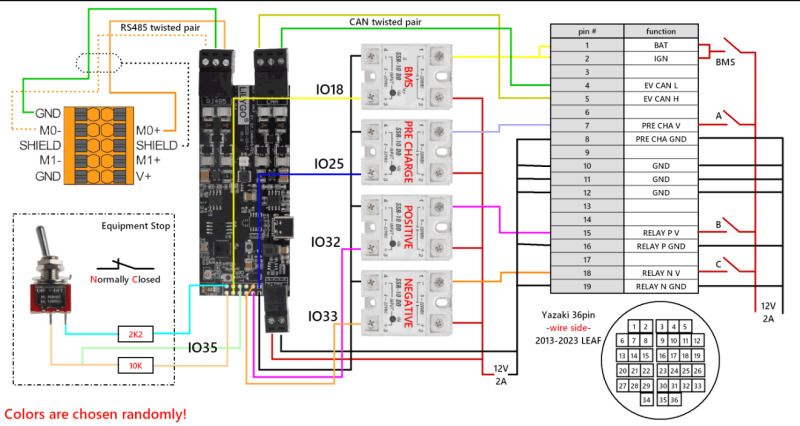
The referenced Battery Emulator project is an open source effort to create a suitable interface between these EV batteries, with the mentioned Nissan Leaf being just one example in the project Wiki, with the connection scheme shown in the top image. It’s also noted that the Leaf battery BMS is not designed to operate continuously, so they need to be restarted every day or so lest they become too inaccurate.
These and other things are all solid reasons why you have to be absolutely certain that you want to integrate these high-voltage battery packs into your 12 – 48V low-voltage DC system. You’re after all assuming all the responsibility of setting up a system that’s both safe and reliable, so having a good read through something like the Battery Emulator Wiki and sourcing first-hand experiences from the folk in this community would be a very wise first step.












My plan is to group the individual cells into a 24 volt system. Parallel cells can be treated as a single cell, so it makes for a simple BMS at 24v (6 cells)
Completely off-grid for 10 years. I took the opposite approach to battery management with 9 Tesla G-85 5.2Kw modules in my setup. I limit my charge discharge cycles to between 50 and 75% of the spec capacity and use zero official battery management. If a module fails just replace it.
Been running for years, taking readings at the beginning and end of the solar day and I have generated 20 Mw including 7 Mw battery cycle power and calculate 96% efficiency. The batteries are always at ambient temp.
I am a happy camper.
An often overlooked fact regarding the cost of batteries: if you limit your charging window to 25%, what you’re doing is paying four times for the capacity. The rest of the battery is essentially dead weight, both physically and financially.
For older chemistries that only last a thousand cycles at 100% DoD the difference should be recoverable within the calendar life of the battery in daily cycling. For newer types, the attempt to prolong the life of the cells by using a very narrow charging window is futile, because the projected cycle life is 30-40 years and the battery will fail from old age before you manage to use up even half the cycles.
Optimally, you would size the charging window big enough that you’d end up using all the potential cycles before the battery is projected to die anyways. Use it or lose it.
I think Gary means he is using between 50% and 75% of available capacity, not the difference between. I agree that you should use as much of the capacity as possible, but you should also treat it like an EV; keeping the state of charge between roughly 10% and 80 to 90% makes good sense for the longevity of the battery.
What is 0% and 100% in a lithium battery are rather arbitrarily defined depending on how many charge cycles you want to print in the spec sheets.
It doesn’t matter if you manage to keep the battery running longer in terms of time, because you have to replace it eventually anyhow. What matters for household energy storage is the throughput cost: how many kWh of charge in and out per dollar. It’s an optimization problem: faster and deeper cycling wears the battery out sooner, but cycling too slowly means you get fewer cycles in total, therefore less throughput.
Fortunately for the homeowner, a 24 hour cycle is rather mild on a modern lithium cell. It’s going to take you 10 years to go through all the cycles even at 100% DoD, Limiting the cycling window to 80% of the capacity could in theory increase the cycle lifespan to 12-13 years, but you’re not getting significantly more total cycles out because the battery is going to hit its calendar life span soon after and you have to replace it anyways. The 10-90 cycle or even 5-95 cycle is probably going to be optimal.
definitely agree with your engineering analysis here but i want to challenge one of your assumption.
i’ve reached the age where i ponder the number of times i will replace the roof of my house over the lifetime of its occupant. roof is between zero and one times, barring catastrophe. dish washer i might replace 3 times, if past performance is any indicator. hydronic boiler stresses me out, the last one only lasted 10 years. and on and on. so if i was looking at energy storage / production, i agree i would look at throughput…but i’d also be pretty focused on calendar lifespan.
though i bet you’re right, again, that you can’t do much better than 10-15 years even if you only optimize for lifespan and nothing else. sigh.
The bigger problem is that the cells are going to drift out of balance without a BMS that is capable of online re-balancing. Whether that comes built-in with the modules wasn’t specified.
The charging windows of series connected cells will drift, so one cell can end up grinding 0-80 while the other is doing 20-100 and they will wear unevenly, putting the module out of commission sooner than expected. This drift is both a cause and a symptom of badly matching cells.
No. What MATTERS is not treating every single thing like it is a disposable wear part specified for cost efficiency.
Acting like supply is infinite and disposal is never a problem, is why we have to live in a global landfill.
You are not a fighter pilot dumping afterburners ‘for the mission’.
Time is NOT money.
You don’t need to baby everything, but running things raggad and replacing hem often because it makes a line in a spreadsheet 2% higher is major asshole behavior.
Electrical is infrastructure.
You DO NOTrun infrastructure raggad and replace it, even if it is the cheapest way to do it.
If I was to use an EV pack Id go for a tesla model 3 rwd. 60kwh LFP is worth 75kwh Lithium Ion and is much safer around the homestead.
Fun fact: LFP is also a Lithium Ion. Perhaps you mean NMC (or any of a number of other common chemistries) ?
I have 82kWh of LFP online, though it did not come from an EV.
Yes, Technically, LiFePO4 is a subtype of the broader lithium-ion family, but the industry separates them because their performance metrics and use cases differ drastically. Ourside the pedantic arena of HAD comments its pretty well understood by most that when someone speaks of Lithium-ion they are most probably talking about NMC and not LFP. But enjoy your lil gold star!
I’m a EE and big fan of DIY solar. At the same time, I have an UL 9540 certified Lithium Iron Phosphate (LFP) that I’m probably going to have to sell because my city won’t let me install it inside my house. My recommendation, if you want to make sure your home insurance company will pay up if your house burns down, is to keep any battery experiments far, far away from any insured structures. And please… share your clever workarounds and war stories.
We ended up having to go with a 5 foot cube (4 foot internal) concrete utility vault placed 25 feet from the house and property lines. Its got a sump pump in case of water infiltration, an air intake/exhaust system, and a fire suppression system. We call it our power bunker.
Indeed, making use of inexpensively sourced energy storage is a tempting hacker challenge for both technical AND safety reasons. The hacker has to have a true Engineering mindset for safety and not be blissfully unaware or gamble that bad things won’t happen. The “what-if” factor must be addressed. Look up StacheD Training YouTube channel who almost exclusively deals with Lithium deflagration incidents, cause and effect. Regulatory and insurance mandates follow bad occurrences.
Due diligence or just prudence is to put your “field-assembled/unlisted” storage system behind a firewall (garage) from your living space, or in a separate, vented out-building. LFP produces H2 gas and many other nasties that will kill. The H2 will rapidly disassemble your structure when it is between 4% and 75% concentration and finds a spark. NMC cells provide H2 and Oxgen resulting in rocket like flame-thrower output. The downside risks are just as important to manage as are the joys of the desired technical outcome.
LFP only produce hydrogen gas during fault conditions or failure (such as overcharging, short-circuiting, or extreme thermal abuse), not during normal, healthy operation. The risk is minor and easily abated as it takes a fair bit of effort or incompetence to get hydrogen to gather in any meaningful way.
I am using a Tesla M3/Y battery pack at home in a city, completely off grid. Love the Battery Emulator project!
Sorry but i’d rather not. I know it is a different environment but if you want to see what will eventually happen just go look up theros boat accident, it didn’t end well for them.
Big difference between powering your home with an EV battery and climbing into a 44ft long 16 foot wide boat and attempting a 21 day voyage, not hugging the coastline but 30+ miles off shore.
I mean lets be real. Parking an EV in your homes garage and charging it isnt much safer than using a battery from one as a DIY powerwall.
yeah i would not be keen to park an EV in my attached garage. or an ICE vehicle either. relatively common source of fire.
tbh i’m a little nervous about all the tablets always sitting on chargers around the house too
But but but… It’s a matter of different regulatory jurisdiction. Yup doesn’t make much sense. (Same with lithium cells that are built in to your phone v. Loose). I very briefly thought of putting my household battery on wheels so it qualified as a vehicle.
but but but…I dont care about regulatory jurisdiction.
but but but…it makes total sense. Theres a big difference in the potential damages and hazards of your laptops battery and a 60kwh array. Laws, Codes, and Regulations are there to demand proper precautions as the common person cannot generally be trusted to possess common sense.
But but but….thats neither here nor there
The gambler threw up an alarm because of a boat related disaster. It really doesnt compare to using batteries for home power. At sea you are trapped in a very small space where fire can travel quickly, your only escape is the sea, and help has little chance of arriving in any kind of reasonable timeframe.
not at all a comparable situation
I just pay my electric bills. How embarrassing…
Transference of risk (to the utility company) isn’t embarrassing, it’s just a more interesting topic on the ‘actuary-a-day’ website.
I pay my electric bills, too.
I also have a professionally installed 9.8kW photovoltaic array on the roof and a professionally installed 7kWh battery system in the garage. The electrical parts of our house mostly run from the battery and inverter. The inverter automatically draws from the external power line at need, or dumps what energy we don’t need (when the battery is full) back into the net.
I make stuff and do stuff. I don’t make and do things that can go “bang” and take out my house and my neighbors’ houses.
I live in what is (for my experience) a densely populated area. House insurance and liability insurance would not play along if my home made battery and inverter caught the house and/or the neighborhood on fire.
If I were in some of the places I lived as a child, I’d probably be more inclined to do such things. 20 miles out of town, next neighbor so far away you need binoculars to see if they are home. In those conditions, I’d have space to put in a “bunker” for the battery system and probably have a much larger PV array. There’d be room to put things far enough from the house that the only hazard of the inverter or battery going “bang” is the loss of power.
At the fairly ridiculous cost of electricity sold in ‘tiers’ that put a blanket limit on what the power suppliers think you should use it makes a lot of fiscal sense to get a small trailer and put some lead-acid batteries and solar panels on it connected through a generator socket into a few circuits in the house.
For low drain devices like TV, lamps or charging laptops or phones.
Also your power is not set to continually rise in price. You may also want to live dozens of miles from town or a few miles from a power pole.
Once the data center implosion happens and electricity becomes cheap again, you won’t be hearing as much about this sort of thing. Meanwhile the Strait of Hormuz has somehow made electric cars cool again even in places where they listen to songs about cut-off jeans and long-necked beers.
You found the one negative thing to the data center/AI collapse. Energy projects like MS trying to have the last reactor at 3 Mile Island brought online, or Fintechs looking to build their own power infrastructure (that would also support the national grid), will end up getting sidelined and push all investments in those projects back. The middle east tension will rise (again), and everyone will start fighting over resources that have to be dug up and burned.
It’s not gonna stop there. You just have to shift the policy back to reducing CO2 and shutting down fossil fuel plants without any plans to replace them with reliable energy sources and boom – we get power shortages and unstable rising prices again.
” …the one negative thing…”
Uhh… Global economic disaster?
Stock market collapse?
Manufacturing shutdowns making maintenance costly or impossible?
We are even expecting food shortages in high population areas because never in the history of global investment has a bubble been so deeply invasive into every industry at every level.
We will be lucky to not have another world war, simply as a distraction for the population to not tear itself and their governments down.
The investments into energy infrastructure will never be finished in time to beat the bubble bursting anyway. People are already realizing what a nothing-burger AI actually is.
It can’t succeed any more than a department store mannequin can run a marathon.
No amount of sports wear or Instagram training montages will ever make it possible.
The sooner we all realize it’s all smoke and mirrors, the sooner we can start running damage control.
demand is definitely one half of the conversation but i think supply will keep it in our minds. batteries and solar panels are each getting cheaper and some people want to live ‘off grid’ even when the grid is cheap and miraculous
Hurricanes in the south, Winter storms in the north, various regional instabilities in the grid resulting in brown and blackouts…..Theres a lot of appeal to stabilizing your own personal power supply even if grid power prices descend.
Theres also an interesting trend rising where developers are starting to wade into the “neighborhood utility” game as incorporating solar fields is often cheaper than extending powerlines especially when tapping USDA development funds to finance it.
Is there though?
We don’t get hurricanes where I live… yet. Tornados are getting more common though.
Anyway… if a hurricane did take our our local power. I’d be without power until the utility companies can repair and restore it. If I had a barn topped with solar panels.. and the hurricane took that out. I’d have to replace all those panels.
Don’t get me wrong.. I love the idea of self sufficiency and not concerning myself with prices I cannot control. But I also understand that the more I have the more I have to lose.
A hurricane taking out your barn is a possibility. A hurricane causing tree limbs to fall on a number of power lines is a near certainty. Im 50, Ive been through over 20 hurricanes in that time. My home is on high ground, while the neighborhood in front of my property has flooded a dozen times over the years water has never reached my doorstep.
The road that leads from the main thoroughfare to the neighborhood our home is built behind has a bridge that floods out regularly. The flood waters through that area often rise above the powerlines, As a consequence We lost power during nearly every hurricane, tropical storm, and flood event that struck our area before getting our solar installed.
We havent had treefall damage to our property since Hurricane Elena in 85 after which we removed several trees from our property. The remaining woods provide a good windbreak so unlike the houses in the neighborhood we dont get hit as hard by wind. Its very common for them to end up bluetarped having lost shingles. More and more homes are replacing their roofs with metal roofing which seems to do much better in resisting the wind, so I dont know how bad properly installed solar would do for them, but I suspect as long as it didnt suffer impact damage the wind wouldnt be an issue there either.
If our solar was damaged, we would lose power and have to have it repaired. Thats why we made sure that our homeowners insurance covers them as well. The more I have the more I have to insure. I dont lose much either way.