
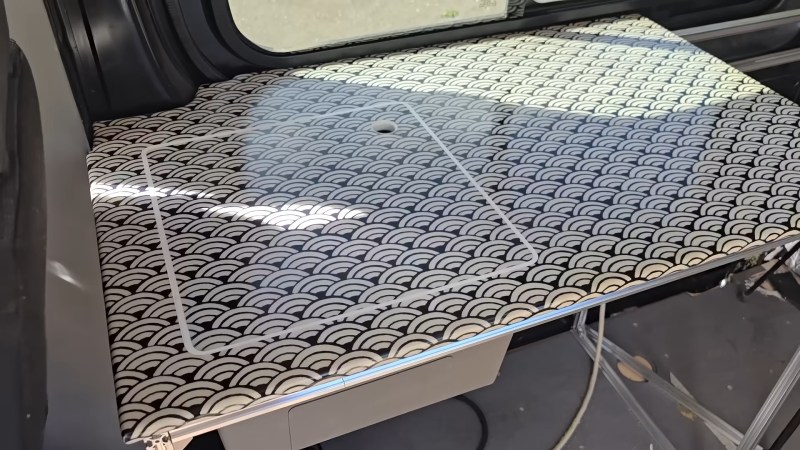
You’ve seen fiber-reinforced-plastic before, no doubt, but perhaps never quite like in this video by [Whitburn Studio]: it’s still got the usual resin, but instead of glass or carbon fibers, he’s using printed Japanese cotton to create strong, lightweight and good looking parts for the interior of his RV– specifically the countertops.
The technique is very similar to the sort of moldless composite work Burt Rutan pioneered in aircraft use. The fiber-reinforced plastic is formed around a positive ‘buck’ that remains inside the final part, adding stiffness and some backing. Unlike Rutan’s designs, which used pure Styrofoam inside, [Whitburn] is using a sandwhich of two layers of thin ply (3.6 mm) with XPS foam in between. Adding plywood means you don’t need many layers of fiber– again, that’s a decorative cotton, here– to get a surface that won’t dent into the styrofoam when you drop a coffee cup on it.
Indeed, with the plywood providing much of the strength, he’s only using a single layer of cotton and a second of fiberglass– though the glass fibers are really there to protect the pretty print from oopsies while sanding, rather than for their mechanical properties, by the sounds of it. Everything is held together with clear epoxy resin, which also fills the weave of the fabrics. Multiple coats of that are required to get the smooth, shiny surface he shows off at the end, but all that sanding and buffing really pays off. That’s also where you have to be really careful to avoid oopsies– go through the cotton and you have to start over.
Aside from the aesthetics, since this is going in a vehicle the weight is an important consideration– the bigger of the two counters he makes, pictured here, weighs in at only 2.4 kg or 5.2 lb including the cutout covering the sink. That’s pretty good all things considered– a lot lighter than a cement countertop, or even one made of DIY resin tiles.












duraplast?
Gonna get me a 601!
No one will ever convince me that covering fabric in epoxy goop isn’t gross and terrible.
A resin table exposed to 40-60°C heat of a car interior in summer, often in direct sunlight.
It’s going to be used for preparing food and is stored within 1-2 meters of a bed.
Yeah, I’m not sure I’d like to spend 8h sleeping next to that thing, inhaling epoxy fumes. Doesn’t mean it’s safe just because it doesn’t stink anymore.
and do not forget that because it is in an RV there will be a lot of UV so enjoy that yellow countertop in 6 months.
With that said there are a few papers out there covering many many different materials with epoxy (i wish i could locate them now sorry they are a good read) IIRC woven bamboo cloth was actually very impressive on its strength.
Shouldn’t the windows have UV blocking film that prevents it from leaking inside?
Glass windows block (most) UV
kinda depends on the resin, no?
anyways, i have more faith than you in my stink sensor. the properties that make offgassing dangerous tend to both make it noticable and relatively brief. there’s a ‘V’olatile in VOCs for a reason.
anyways, fiberglass in cars is already a road-well-traveled
Once the epoxy is cured there really shouldn’t be any further fumes even with heat in a vehicle – the proper handling of the two part does matter heaps, but once its properly cured it won’t matter everything is cross linked and the only way its a hazard to you while sharing a space under conditions you are still alive and healthy anyway is actively damaging the surface.
The real problem here is its possible it will soften and bend under load+heat or UV yellow quickly if the epoxy isn’t selected correctly for the conditions not that its going to be a big fume problem afterwards. That said given the insanely cheap price of pre folded custom sheet metal these days I can’t see why you’d use this method for RV – it might end up a tiny bit lighter but the metal version you can do so much more with when your inevitably a project vehicle needs tweaking, and damage is much easier to repair invisibly.
Wait until you find out what the RV is made of, along with sailboats and other craft designed for sleeping in.
Yeah, it’s nasty stuff, isn’t it? We should probably stop using it.
Can we talk about the washer hack he’s using to trace the outline between the 1:33 and 1:40 mark? What using a washer around the pencil achieve here?
It gives you an offset – since the wood can’t touch the side but the washer can, you get the wood as close as possible and then the washer works to bring the outline within the edge of the wood by a fixed amount.
Nice woodworking tip! Thanks for the explainer! A woodworking tip article here on HaD would be a nice idea
not so weird…the gold standard of countertops is formica – paper with melamine resin
The gold standard refers to the absolute best way to do or measure something, Not the bottom dollar, factory built tract home way to do something just good enough to get by.
Formica and other laminate countertops are cheap and low-quality. They can burn easily from hot pans, scratch if used as a cutting board, and suffer from permanent water damage or peeling at the seams. They are NOT the gold standard, They are the LOW BAR.
Quartz resists stains and bacteria easily
Quartzite is a natural stone that handles high heat and scratching better than engineered surfaces.
Granite offers unique natural patterns, strong heat resistance, and long-term durability at a fair price.
Porcelain slabs resist UV rays, scratches, and extreme heat without burning or fading.
Any of these are far superior choices. Any of these fit the “gold standard” for countertop material far better than formica.
Saw this the other day. Now seeing this again makes me wonder if this might be an interesting way to repair motorcycle fairing plastics. Or at least mask their repair a bit in an interesting way.
Hey, someone’s working with a DIY Micarta-type material. Neat!
For all the people worrying about durability, I’ve seen Micarta radios left in garages and barns for fifty years look as good as the day they came off the line. I’m not sure it’s a significant concern, this is a fine application of the technology.
Self-healing
https://phys.org/news/2026-08-composite-retains-response-strain.html
I was sure I’ve seen something similar before:
https://hackaday.com/2017/08/01/how-to-do-beautiful-enclosures-with-custom-fiberglass/