
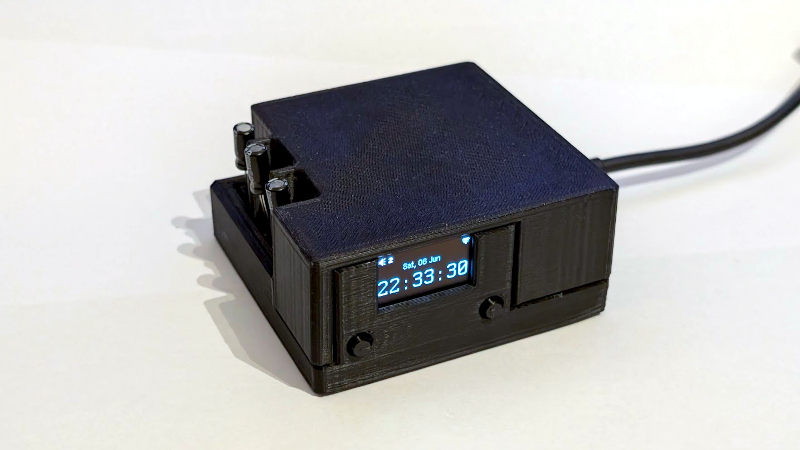
Every now and then a project comes into the Hackaday feed that has so many levels of wrong about it that you really shouldn’t do it at home, but is amusing enough to feature anyway with a warning. So it is with [ArcaEge]’s Capacitor Alarm Clock, which wakes up its unfortunate owner by blowing up electrolytic capacitors with reverse voltage. If you survive, you’ll certainly be awake!
It’s inspired unsurprisingly by an [ElectroBoom] video, and the premise is simple enough. An ESP32 serves as the clock, and triggers a relay for the alarm, which in turn overloads a suitably low-voltage electrolytic capacitor in a socket. The resulting explosion which appears in a video we’ve placed below the break, wakes the slumberer.
We don’t have to tell you that this is not the safest of hacks, and is presented here only for your entertainment. But it does provide a few points of interest, for example in identifying the difference between capacitors with a vent, and those without.
This isn’t the first time we’ve seen a project based around exploding capacitors, and that one maybe was a don’t-do-this-at-home too.












I think this project would actually be safer if it fired .22 rifle blanks instead.
and don’t get me wrong– given that the whole project is supposed to be dangerous and stupid, that’s essentially a compliment.
I love the smell of Rifas in the morning.
With a big enough capacitor/charge you also can clean the entire room, see the next/previous article with the gripper on wire.
Years ago, I retrofitted a Tazmanian Devil alarm clock with a Lazer Tag target so that I could “shoot” the alarm clock when it went off to activate the snooze. Combine that with this and you could have a shoot out first thing every morning! 🤠 🤣
Magic capacitor smoke.
(I love the smell of PCBs* in the morning)
* polychlorinated biphenyls
There are always those little blanks that power powder-actuated tools.
certainly louder than the caps or snaps you might have once found at the local joke shop. Still fairly dangerous if mistreated though. Better to save the capacitors for a project that won’t set off the local gun shot triangulation every morning.
How big a capacitor can you go?
Come on, you can make it!
…waiting for sound comparison at a dedicated YT channel, similar to “china cracker tests”.
I’ve bought and made some pretty large capacitors over the years, having a power supply that’s capable of causing them to shatter the neighbors windows is another matter. I miss living out in the middle of nowhere, I’m a little too close to the local military bases for anything too big.
Can’t stop smiling 😁
In my electronics class, the guy that ran the lab would sometimes — but not always — go around at night at put electrolytics across the power strips (which were turned off). After the first time, we made dang sure we check each power strip every morning before turning on the ‘scopes and meters and such.
Call it him being an a-hole or him teaching us safety, we learned something.
Many years ago, I was a service tech at a car audio manufacturing shop. On our benches, we had large 50A Astron power supplies for powering the devices we were repairing. There were a few times, as a prank, where someone would wire an electrolytic cap backwards to the supply and hide it under a coworker’s bench. When the victim would return from lunch and click on their power supply, the firecracker would go off between their legs and everyone would enjoy a good laugh.
In one of the technology (r&d) labs at a major cap manufacturer, there was a box to run an ‘ignition test’ on their and their competitor’s caps, usually tantalum. Fairly robust with full containment, heavy duty contact clips, fuses, etc. It ramped voltage until the device under test shorted with the usual expected fire. Since that company’s tantalum formation process used a much higher voltage than competitors, it was more of a ‘detonation test’ which could be somewhat impressive.
This is the reason I got a sunrise alarm clock that wakes me up very gently without scaring the crap outta me.