
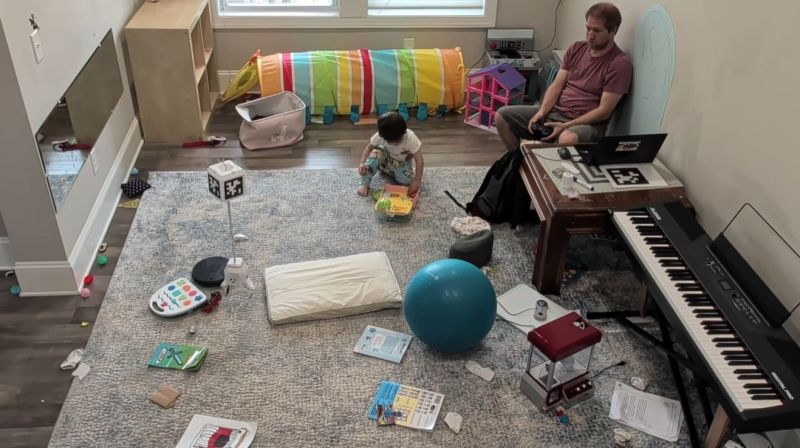
 One of the joys you get to experience whether as a proud parent or pet owner is that a lot of things get left around haphazardly. You could of course pick every piece of discarded clothing, half-destroyed toy and detritus yourself, but as a parent of three children himself [Nathaniel Nifong] opted to use his engineering background to potentially over engineer a wires-suspended robotic claw to do this picking up for him.
What he calls Stringman robots requires an anchoring point at four corners of a room, after which the robotic crane can then scour across the ceiling, identify targets to pick up and move these to predesignated drop-off points. It’s an open source project with the LeRobot-based firmware available on GitHub in addition to build instructions for the physical hardware. There’s also a pilot run of ready to use hardware and kits for those who want to trial it, but aren’t interested in building it themselves via [Nathaniel]’s company website.
The basic idea is that this crane can run for an hour or so and deal with the mess in its room without having to do anything yourself. The process isn’t perfect yet, of course, with the underlying diffusion transformer to implement machine vision requiring more refinement. The gripper itself struggles with objects like books, which can be a concern for parents and bookworms, and of course while the crane is operating the wires will dip down as a potential risk to anyone in the room.
Compared to an overhead crane like a traditional bridge crane this wire-suspension crane is probably more stable, but either is an interesting engineering challenge when applied to a household. Next it would probably also be cool if items could be put away where they belong instead of dropped into a bin, as so far that task will still be left to deal with by the adult humans.












For another older take on this check out Scanlime’s TucoFlyer/Cam project: https://youtu.be/JU6omrP2iFU?si=DGoenQvspqSxzgah Much detail in the related videos and git repos — follow the breadcrumbs
The github link is dead (as are many of the others).
Whatever happened to scanlime? I hope she and Tuco are doing well and simply off the internet.
Yeah, she went silent on scanlime.org and youtube, livestream and twitch channels 4 years ago, but apparently still alive on mastodon at https://misc.name/@scanlime
Her git repos are at https://git.approximate.life/
This is worthy of Wallace and Grommit.
That could be bad news for the baby!
No, AI puts baby in the corner.
Hahahahahahahahaha
Not to rain on your original parade…. But i have been developing an idea using NEMA driven spin casting reels to drive a Smart Phone gimbal gantry to use as a sort of PANAFLEX setup for video capture without a camera man.
Much of my thinking so far is in the idea, But… I have the four motor and the reels all in one spot and i run glide pulleys to mounting lugs on the very corner of the room, I found that if i kept the four in one place i could move it to another place much more simply. The one thing you will have to start thinking about is adding a rotary encoder wheel on the four drives to get precise position info on the four lines.
I was even looking for monofiliment with the black/clear pattern on it already… Not no luck on that.
I put my machine on the floor in the corner of the room and run lines up to pulley there to string out to the corner ones and then return to the pod winch…. I tend to keep the pod high at the celing and use the winch to lower the gantry to camera height… Pan and tilt on the gantry and a smartphone and a cam app you can get some pretty good pans from such a rig.
I was using the fishing reels in a base to allow it to be setup outside as well if the need came up for that.
Sounds like the idea needs a little grounding, as they say.
NEMA is a standards organization, defining things like ratings for weatherproof enclosures and standard equipment mounting sizes. You mean some kind of motor?
Panaflex is a motion picture film camera.
Skycam/Cablecams are a pretty mature technology now. Lots can be learned from studying their designs. https://en.wikipedia.org/wiki/Skycam
The big long arm camera…. some have seats for an camera operator… Most just have a camera on a mount at the end…. It can telescope and pan real wide…
Formula1 use them in the big sweeping corners…. They also use the three line shuttle cameras….on the pit lanes….
That is where i got the idea to use nema stepper to run the spin casting reels….
Watching those shuttle pace the cars down the pit lane…. Cool idea…
I have a real good image stabilizer in my phone so most of the shaky is filtered .
It’s all win win for doing a video camera rig for someone short on human help.
It’s called a camera jib.
It’s a better option to use the four to position, and ADD another to run the gripper altitude…
So you do the same, Just the part with the targets on it you keep it up close to the ceiling, Make it say 16″ square and with that added axis to lower the gripper you can limit the wire intrusion from the corners down to the sled with a short static length line to the gripper….
But it’s six axis not five… But you get better clearance and control because the upper lines can be run absolute after it’s calibrated giving you a better speed and accuracy of movement…. i would say a 16″ sled flying over a 4″ mount on the gripper that will give you some stability….. Think of the position sled as a old quad copter chassis bare with the lines tied to it’s motor holes… then add a winch and four holes to the centre of that… to raise and lower your gripper head…. on four lines below that.
It will greatly reduce the line intrusion to the space.
Of course, with a bit of ingenuity, you could make a machine to make that. Some testing would be needed to find the best way to mark the line in a way that doesn’t wear off so quickly.
Seems like he’s treating the symptom rather than the cause. My parents taught me to put things away from s young age.
Exactly. It’s actually easier to train the kid(s) than the “AI”; “You’re done playing with that, put it away.” Then ignore their tantrum, they’ll get tired of screaming. The wife and I raised two ourselves. It’s not hard, it’s called parenting.
This looks more like an excuse to build/tinker with something (completely understandable) than actually solving the perceived problem.
“I trained a neural network to put away my kids’ toys.”
There are more fun things in life than constantly picking up. I don’t mind having a bot do some of the work, because I feel like I’m still teaching my kids discipline in other ways, but it’s a good point.
Suppose you like to do BMX tricks in your back yard….. and want to COOL video that sort of thing…
Grinding, tricks… all of that…. If the system is all in one place and the AI is added to run the cam…. a high return vis glove to give AI hand commands you can even run it just using simple gestures and omit the wired hand controller.
i have seen small crossbow launchers HAM radio guys hang antenna from trees… This would work real good in a forest clearing with the right pulley mounts, You can put a lot of line into a normal fishing reel….
A bat tracking microphone a Night Vis camera… Try to catch a bat feeding on bugs using strobes….
All sorts of fun stuff for a program controlled camera like this.
Just keep in mind the encoder part of the feedback. An Epson Printer has a polymer disk with two sets of signals on the disk… a clock and an angle one. Perfect for this use case.
For BMX, the typically solution is a quick camera drone.
Now make it pick things out from between keys on the piano. No racing toy cars on the keys!
Love the idea and hope it goes further, but it doesn’t seem like it really works yet. Why not start with a simpler task like “pick up all the balls”. That doesn’t even need AI. They’re predictable and easy to locate because they look the same from every direction. Honestly what does this even need so much AI for besides classifying he objects? Picking them up can probably be done with a simple algorithm, and then the motion pathing is easy because you can just go up, go to the target then go down.
Because when all you’ve got is a hammer, everything looks like an AI task. Plus it’s what all the cool kids are doing.
I agree, I’m surprised by the desire to use AI for the control; that seems of little value. I thought this was a fairly solved problem.
“…a lot of things get left around haphazardly…” is passive understatement.
Reality is “no thing within the reach is ever stationary”. Things. Keep. Moving. All. The. Time. And breaking, while at it. Gravity-assisted breaking, lets-see-what-this-is-made-from breaking, tired/bored-of-this-smash-it-into-pieces breaking, you name it. : ]
We’ve tried all kinds of creative approaches and the simple rule “once used, return to its original place” works when followed diligently and without thinking. It is actually relatively easy to teach kids, though doesn’t apply to pets, sadly, and kids seem to mimic pets, while pets could also be mimicking kids.
Regardless, The Other Rule is “promptly get rid of things no longer being actively used” that pre-empties hoarding. Our kids had long grown up and are moving out, however, few year back I was throwing away one of our old “emergency packs” and found it containing four extra diapers we never used. I asked my wife “why?” an the answer was “diapers soak up spilled things very quickly, so I kept them around in case something gets spilled and needs to be cleaned quickly without creating a mess”. Right. Hoarders we truly are. : – [
(with little kids “emergency packs” are to be kept around fully at all times, because when it is 2am emergency room visit you don’t want to scuttle around looking for the items in this list – extra diapers – bottled water – paper towels / napkins – packaged snacks – fidget spinners / plush animals – 4×6 index cards and crayolas. Ask me how I know, oh, don’t forget to grab two/three bananas when running out the door, emergency fuel for the ER waiting spells)
I believe there should be a manual mode as others stated. Then “ok its the end of the night lets pick up the toys” lol . Maybe purposely build a tall pile of toys before bed. LOLOL I would have a blast
Hi All, I’m the creator of this robot, and I’m thrilled everyone found it so interesting. I’m determined to make it an actually useful household appliance and battle test it against real messy rooms. If you think you’d like to print one yourself, there’s a detailed guide at https://neufangled.com/docs/arpeggio_anchor_build_guide/ along with the STLs and other files. I also sell them assembled at https://neufangled.com/store
Thank you for the awesome hack and sharing everything, this is sure appreciated by all of us, random strangers of no particular importance/relevance. : – ]
He needs to use Dyneema instead of whatever wire he’s using. It won’t stretch and is extremely strong.
Thanks, but I just really like this fishing line. It’s never stretched on me, the friction is extremely low and it has almost no memory. It’s called Power pro super slick V8.