
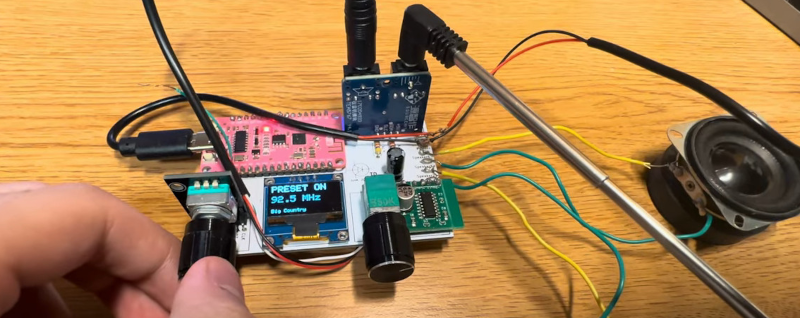
It used to be a rite of passage to build some sort of AM radio receiver. Many people started with a crystal radio, of course, but you’d graduate to maybe a TRF or superhet design. FM radio projects were not as common, because demodulating an FM signal was harder, as was making things work in the 100 MHz range. These days, though, you can get everything on a chip like the TEA5767, and [turtushig22-blip] has an open design that uses that device on a breakout board, a display, a knob, and an external amplifier. An ESP-32 pulls it together. You can see two videos about the project below.
Unlike older FM radio designs, the TEA5767 doesn’t require any adjustments. RF goes in, and stereo audio goes out. You can control the device through I2C or a 3-wire serial interface.
Software-wise, you send a five-byte control word and the chip sends back five status bytes. You don’t set the frequency directly, but provide a PLL divisor. For example, with a 32 kHz reference crystal, setting 100.1 MHz would be: 4*(100.1 MHz + 0.225 MHz)/0.032768 MHz = (about) 12247.
The radio uses a 225 kHz IF and can autonomously seek stations. You can select whether the search is up or down, and the minimum acceptable signal strength. One unusual feature: the TEA5767 can select the positive or negative mixer output, which might be useful for image rejection in some cases.
The output is purely analog, and there’s no RDS/RBDS decoder. So don’t expect station information on the OLED display. Still, a nice, easy FM radio build. Naturally, not the first TEA5767 build that we’ve seen. Or even the second.












Well OK, but it’s an antique IC that’s been EoL for well over a decade, almost two!
Shouldn’t promote old inferior stuff, though most cheap breakouts & modules are probably built with ‘modern’ cheap clones, replacements from 2nd-srces.
Instead there are better FM-chips still in active production, e.g. Si473x family.
Of which e-g- Si4735 actually seems quite popular also in DIY/”Maker” scene.
Also featuring a really decent library for the ‘duino crowd (search “pu2clr/SI4735” on github)
But if it were 40 year old tech, it would be retro and cool again
heh figures. in 1998 i got a TV tuner card and in my (successful) struggle to get it to work with a very young video4linux stack, i was absolutely astonished by the number of I2C chips on the board including one very much like this TEA5767 chip.
Have you seen the KT0936 chip. Tuning and band is set with DC voltages.
Somehow connecting up pre-built hi-tech modules like this doesn’t feel like it has the same magic as building a crystal set, including winding the coil yourself, and hearing your first radio station even though there is no battery. Not dissing this project though, can you even build a functioning crystal set these days?
You can but there is little to listen to on AM these days. Also the threshold of kids amazement is higher than ours was ;-) I am not suggesting this is the new crystal radio project. I would think most kids today get a blinking LED Arduino or something over a radio project.
You must not be in the US. Here there is plenty to listen to on AM if you live near a major city. Even if you don’t there are still quite a few 50000 watt stations which can be accessed from far away.
I think you’d be surprised how low of a threshold it takes to amaze kids. And building something with mom or dad is really what is more important here. Even if you get a kit and just help them build it, it’s the time you spend together that will always have the biggest payback.
There might be AM signals on medium wave or long wave to be heard during night time.
Some museums operate an AM station, too. The German museum in Munich has/had one, for example.
Crystal radios for ultra shortwave reception do exist, too.
FM signals can be detected via slope detection.
https://www.welt-der-alten-radios.de/detektor-ukw-detektor-195.html
https://makezine.com/article/maker-news/fm-crystal-radio/
So…this gives some kid (kids come in all ages), who knows nothing about electronics, the same—or more—satisfaction than building a crystal radio?
I enjoyed the article and the project, and you ask an interesting question for sure which prompted me to consider this quite deeply. So genuine thanks :) and also my apologies for being so verbal in my thoughts to reply to it.
tl;dr “Yep”
I will put an addendum to your question (as the kid of any age is likely already playing around with ESP controllers, code, and controlling modular blocks)…
“could duplicating this project spark a nascent wonder in radio that open the doors to bigger things?”
Will the project give satisfaction? That special real reward of a working project I think every HaD reader could understand – that then encourages further exploration and soon turns to the highly desirable spark of wondering “But how”, giving the impetus to look even deeper.
I can credit the source of my spark, and a lot of the wonder I held as a child to the utterly magnificent Professor Julius Sumner Miller and his “Why is it So” show broadcast on children’s TV here between the cartoons. An amazing man and educator on TV for 23 years. Thankfully some of his episodes do remain like https://www.youtube.com/watch?v=qRGHTyS9QbU or https://www.youtube.com/watch?v=nDDIRju4TpM (hopefully not geo-locked)
For some reason he could connect to me in ways my school teachers couldn’t; I absolutely went further and of course in those lifelong learnings did have the amazement of hearing a cacophony of radio from nothing more than a water faucet, germanium diode and piezoelectric earpiece, my own body providing the final part of that circuit. Untuned of course.
Some do come to this spark of wonder maybe rubbing a balloon on their best friend’s head and laughing at the result, then wondering “But how” maybe leading to a diode and piezoelectric earpiece.
Some will find the spark when they see the elegance of V=IR written on a page.
And, relevant to your question, Some kids of all ages will come with existing coding knowledge and already be using ESP/ARM cores, breadboards and modules, and see this and think, ‘oh, I can achieve this’… and then when it works, get the reward from “YAY! I did it” and all the likes they get, which might just lead them explore deeper and maybe stumble over Édouard Branly’s Coherer and then as they think about those iron filings wonder “Hang on… But How?”
Sorry for being so verbal, mistakes of grammar, and making you read the incoherent ramblings of an eccentric.
I got an earknob radio kit in the 70’s, taught me nothing about electronics or RF. I was a kid with 4 other radios in the house already, anyone think I would do Ohms Law, I was maybe 7. Only takeaway was that some coils of wires can do radio… magic. In retrospect I didn’t even realize, back then, that it did not need batteries.
I can quite wrap my mind around it. I want to say: “Sometimes there are technologies that make it into the home before commercialization.” but that is not quite right…
10 years ago that crystal radio experience was probably running a 3d printer for the first time. Early 80’s it was running some code on an 8bit micro.
LLM in 2023 should have been that thing, but somehow it was not.
Where I live, crystal radio sets were sold way into the 90s.
In the 90s, CB radio was at its height, too. In FM on 40 CEPT channels.
It was a time in which parabolic mirrors for satellite TV reception became more and more mainstream, too.
The mailbox scene (BBS) was also thriving, still.
Old man loves radio stuff. So thanks for that.
I’ll give a try.
Would be cool to use multiple radios, if they can all be connected to the same antenna without issue. Then use RDS to store alternative frequencies and monitor which one is the strongest.
More useful for a portable radio. I was planning to build this for one of my old cars, but I bought a new car before I got that far into the project.
Not you.
FYI, there are RDA5807-based modules with (mostly) compatible pinout that can be used to add RDS easily.
I’m so curious about how easy it might be to do this. It’s been a thought banging around in my head for a while now, and it makes quite a lot of sense for long drives.
Though I think it may need way more intelligence than you might think, because sometimes you’re just in an area without the previous station you’d been listening to, so what’s a good fallback preference?
Congratulations, you bought a radio…
Is this a project someone might want to make? Sure, I think it’d be great if I was designing a CNCed case and wanted to put the best working radio inside while being able to design my own UI/UX.
But is it really the same as building a crystal radio? If you gave it to a student will they say troubleshoot a commercial radio, or explain its general operating principle? All that’d learn is there is a black box for everything, and your job is to thoughtlessly solder it to your controls, and not venture far beyond the mundane. A very cynical lesson for an aspiring hacker.
I don’t think the comparison between this sort of project and say.. a crystal radio is all that useful.
Someone might say the crystal radio exposes the builder to the underlying electronics at a lower level where the chip might be a black box. And.. this is true.
But.. we live in a world full of chips. And learning how to interface one and get it to do what it does oneself, building one’s own physical UI.. that can also be a ‘magic’ experience opening one’s mind up to the possibilities of what they might be able to build. I know that I will never forget my first Arduino!
“I could add bluetooth control to this and control it by my phone… And it wouldn’t be junk just because my phone updated and there is no updated app…” That’s just an example of the thinking this sort of project can imbue on the novice tinkerer cementing them into the hobby.
It’s not that one is a better start than the other. They are both good openers. It’s just that they open up into different aspects of the hobby.
All that said.. I think if I was designing a “rite of passage” project for some young (or not young) beginner I’d go with a chip that did AM, FM, SW and maybe even LW. Not that any of those bands have the healthy selection of stations to listen to they might have had decades ago. But hey, at least the more stations you can tune the more likely you are to find SOMETHING worth listening to.
And while the internet definitely reduces the wow factor of receiving a shortwave signal from across the planet.. if one is not going to sit there and listen to the conspiracy theory about how the pope was replaced by bigfoot or whatever the shortwave station is broadcasting today, if one is only going to listen for a minute to get that satisfaction of ‘my project worked’… it still might be at least a little more satisfying to know one’s project received the ranting from across the world vs across town.
And.. if you need a follow up project then maybe a BFO to turn all those Donald Duck SSB signals into ineligible speech?
Or.. if there is nothing human worth listening to maybe listen to whistlers and learn about natural noise on the LW band and the atmospheric or weather phenomena that cause them.
Agreed.
Yes, until now.
That technology is shortlived and may vanish eventually.
A crystal radio set -or basic electronic knowledge- is universal and time less.
In a thousand years, people will still be able to make wool socks, tables, chairs and basic electric things from scratch.
Passing on the knowledge about the basics of a magnetic compass,
a light bulb, a toaster or a crystal radio/RF buzzer
makes as much sense as passing on the language, morse code, the written word/the alphabet and mathematics.
I forgot the second most important thing after light bulb and the crystal detector (diode precursor)..
– No, not the transistor. The electro-mechanical relay (based on the electro magnet/the electric coil)! 🙂
The relay paved the way to simple logic circuits. Such as elevator circuits.
A basic, fumctional relay can be built at a kitchen table.
All it needa is some insulated wire, two metal contacts and metal screw or nail.
i have a vague idea of how to make a tunable capacitor, a point contact diode, a hand-wound coil…the bulk of a crystal radio set. but i do not have any idea how to make one of the high-impedance earphones…maybe i could learn? but.
i really really do not have any idea how to use it to listen to any music after all the AM stations have gone off the air.
i don’t think they’re so timeless.
When did we switch from talking about what is a good starter project in the really real world to doomsday prepper fantasy?
Wow, these comments take me back a ways. I got my start in electronics when a 4th grade teacher loaned me one of the big dry cell batteries and some wire over the weekend. I wrapped a nail with the wire and made my first project, and electromagnet. I went ont to the crystal sets, then my first use of transistors for an amplifier, (when transistors first came out). Now that I dated myself (77) for those that don’t remember those days, yes, and on to tubes, etc. Point is, it got my curiosity going. Got my Ham license at 14 which greatly expanded my Verizons from my little town in Iowa. These simple things started my lifetime career in electronics. I still play with chips and circuits today, and still find that amazement is there. incidentally, there are still clubs around that have fun building all manners of crystal sets. A simple start is all it takes, and I’m trying to pass that on to my grandsons ( when I can interrupt YouTube and get them off the IPads, that is)
Anyone else remember the humble zn414?