
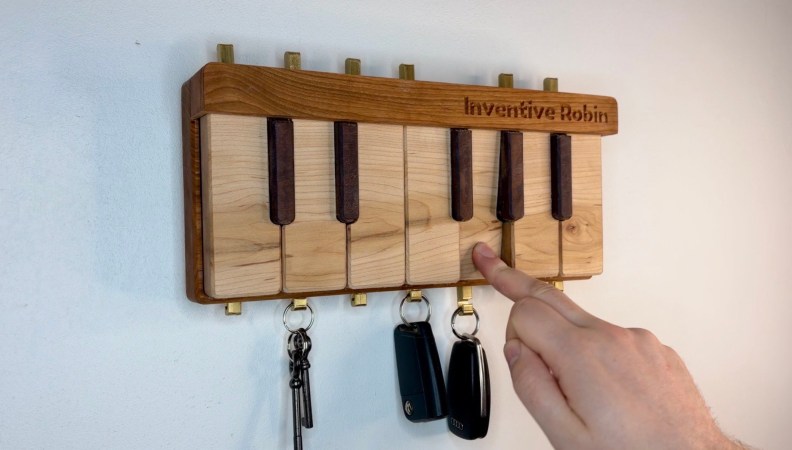
Wooden Piano Keys Hold Your Less-Wooden, Not-Piano Keys

There are many ways to deal with keys: a bowl next to the entryway, a junk drawer, or you can just leave them in your pockets and hope you remember to check on Laundry Day. [Inventive Robin] has come up with his own, unique take on the key holder concept: he’s got piano keys to hold his car keys, CNC’d out of some nice hardwoods.

Of course, it’s not just a fake one-octave piano with hooks glued to it; that wouldn’t be quite enough to catch our fancy. There’s a mechanism hidden under the “white” keys– made of maple– that lowers the brass hooks when you press the, er, wooden actuator, so you can retrieve your, uh, lock-openers. Keys, that is. They’re both keys, of different sorts, because English is a wonderful language. In any case, pressing the maple key a second time lifts the brass hook, trapping the likely metal key hanging on it.

The mechanism was carved from acetyl sheet on the same Shapoko CNC machine that handled the wood, and was assembled with purchased metal rods, springs, and some plastic standoffs. It’s very satisfying to watch it work unenclosed, so check out the build video embedded below to see that in action– jump to 4:46 if you don’t want to get the whole design brief.

It’s not the most complex of hacks, but it’s beautifully done inside and out, and [Robin] is clearly happy with the result. It’s nice enough that visitors might want to photograph the key holder, but perhaps have them do it sans keys– those photos could potentially be a security risk.

Continue reading “Wooden Piano Keys Hold Your Less-Wooden, Not-Piano Keys”
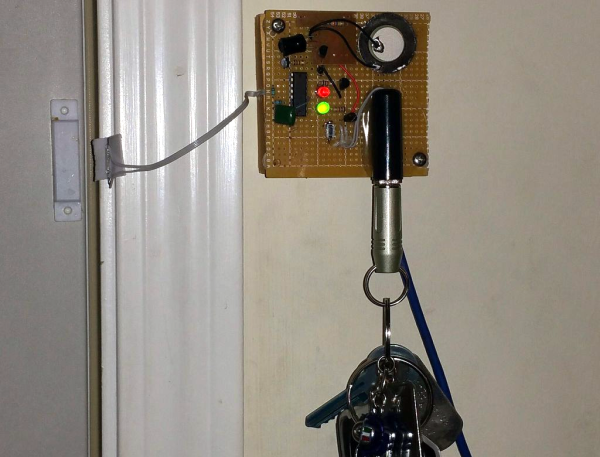
Always Misplacing Your Keys? You Can Fix That With Some Logic Chips

Every time he came home, it was the same thing. As soon as he crossed the threshold, his keys just disappeared. There was no other logical explanation for it. And whenever it was time to leave again, he had to turn the house upside down to find them.

One day, [out-of-the-box] decided he’d had enough and built a door-activated alarm system out of stuff he had on hand—a decade counter, a cheapo reed switch-based door alarm, and some transistors. When the door is closed, the decade counter’s output is set to light up a green LED. When he comes home and opens the door, the reed switch closes, triggering the decade counter to shift its output to the next pin. The red LED comes on, and NPN transistor grounds the piezo, sounding the alarm. The only way to stop it is by inserting a shorted 1/4″ phone plug conveniently attached to his key ring into a jack on the circuit board until he hears that satisfying click of safe key-ping.

For those times when immediately plugging the keys into the wall isn’t feasible, or if his keys should disappear before he has the chance, there’s a momentary on the board that will stop the symphony of robotic cicadas blasting out from the piezo. It’s also good for family members who don’t want to play along or haven’t yet earned their 1/4″ plug.

Be sure to check out the build video after the break, which is just through that door there. And keep an eye on your keys, eh? Hackaday is not responsible for lost or stolen personal articles. Should you lose them, we can only suggest making a new car key from the spare and printing replacements for any standard keys.

Continue reading “Always Misplacing Your Keys? You Can Fix That With Some Logic Chips”

Hackaday Links Column Banner

Hackaday Links: July 5, 2015

It’s the fifth of July. What should that mean? Videos on YouTube of quadcopters flying into fireworks displays. Surprisingly, there are none. If you find one, put it up in the comments.

The original PlayStation was a Nintendo/Sony collaboration. This week, some random dude found a prototype in his attic. People were offering him tens of thousands of dollars on the reddit thread, while smarter people said he should lend it to MAME and homebrewer/reverse engineer groups. This was called out as a fake by [Vadu Amka], one of the Internet’s highly skilled console modders. This statement was sort of semi retracted. There’s a lot of bromide staining on that Nintendo PlayStation, though, and if it’s a fake, the faker deserves thousands of dollars. Now just dump the ROMs and reverse engineer the thing.

Remember BattleBots? It’s back. These are my impressions of the first two episodes: Flamethrowers are relatively common now, ‘parasitic bots’ – small, auxilliary bots fighting alongside the ‘main’ bot are now allowed. KOs only count for the ‘main’ bot. Give it a few more seasons and every bot will be a wedge. One of the hosts is an UFC fighter, which is weird, but not as weird as actually knowing some of the people competing.

Ceci n’est pas un Arduino, which means it’s from the SRL camp. No, wait. It’s a crowdfunding campaign for AS200 Industries in Providence, RI.

Wanna look incredibly sketchy? Weld (or braze, or solder) your keys to a screwdriver.

The UK’s National Museum of Computing  is looking for some people to help maintain 80 BBC Micros. The museum has a ‘classroom’ of BBC micro computers still in operation. Caps dry out, switching power supplies fail, and over the years these computers start to die. If you have the skills and want to volunteer, give it a shot.

USA-made Arduinos are now shipping. That’s the Massimo Arduino, by the way.

Win $1000 for pressing a buttonWe’re gauranteed to give away a thousand dollar gift card for the Hackaday store next Wednesday to someone who has participated in the latest round of community voting for the Hackaday Prize.










