
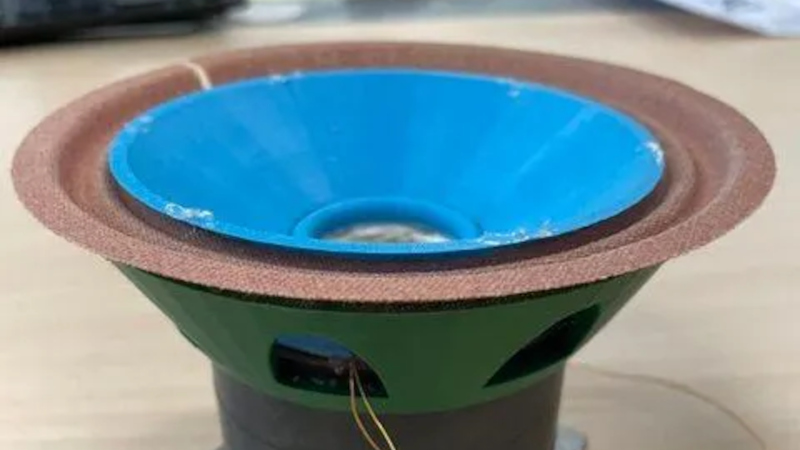
A loudspeaker is a vital component of every device that plays sound, but while its operation is simple, it’s a surprisingly difficult device to build. [Rvanderouderaa] has made an Instructables post showing a speaker design that it’s claimed, had an impedance that varies by volume (Dutch language, Google Translate link).
In all moving-coil speakers, a coil of wire is held in a radial magnetic field. To this is attached a cone, and when a current is passed through the coil the whole thing moves to create the sound. The tricky part of making one comes in making the cone itself, and in particular the suspension system that holds it in place while allowing it to move backwards and forwards. It’s normal for these components to be moulded from thick paper.
This design uses a 3D printed frame and cone, with the 3D printing providing excellent rigidity. The suspension system is a circular corrugated sheet, and it’s made in this case using papier-maché made from wet toilet paper, and a 3D printed mould. We particularly like this technique.
This is an impressive build, simply for having made a recognizable and working speaker in the first place. There’s no demo video so we have no idea how it sounds, but for us the point is more in the construction than the reproduction.
If speakers interest you, we’ve taken an in-depth look at them in the past.











The inductance of a voice coil depends on the iron post inside the voice coil and the magnets that surround it. If the magnetic field configuration/strength and the magnetic properties of the materials are not uniform over the whole range of motion, then increasing the amplitude changes the inductance.
As impedance varies significantly by frequency, wouldn’t it inherently vary by volume as well? Bring able to control that variance might have some advantage. Perhaps a DIY field coil speaker, if one were so inclined?
When I was 14, I was rebuilding the speaker coils. Restored a dozen speakers.
A real cool project that will give a pretty good result would be reproducing the body of a Radio Shack Minimus 7 speaker with a 3D printer. With the right infills you can get a pretty nice small speaker from the right driver choice.
Originally cast with aluminum, I bet the PLA version would work at that spec. with a real hefty weight reduction.
Then think…. BOSE 901 series V and your trusty 3D printer.
Just thinking Hi-Fi Out Of the Box stuff.
These projects make me think. 3D print here, 3D there..
What happened to environmentalism and the worries about micro plastic and plastic pollution in general ?
In the 90s, where I live, there was a big fuss about recycling paper, saving the rainforest, the whales and helping at closing the ozone hole.
Why aren’t there more projects in these days involving cardboard, wood or metal and a good old fret saw?
Shouldn’t this have priority and be more recent than ever? 🤷♂️
This current trend for plastic solutions feels so reverse to everything that was thaught in the years before.
PLA, which is most wide spread printing plastic, in my knowledge atleast, is made from renewable resources like corn starch or sugarcane. The process involves fermenting these plant materials to produce lactic acid, which is then polymerized to form PLA. So its pretty much plastic made from crops. Biodegration is questionable tho, since it requires 60C and may take up to three decades.
They just started making plastic from fresh green stuff instead of oil.