
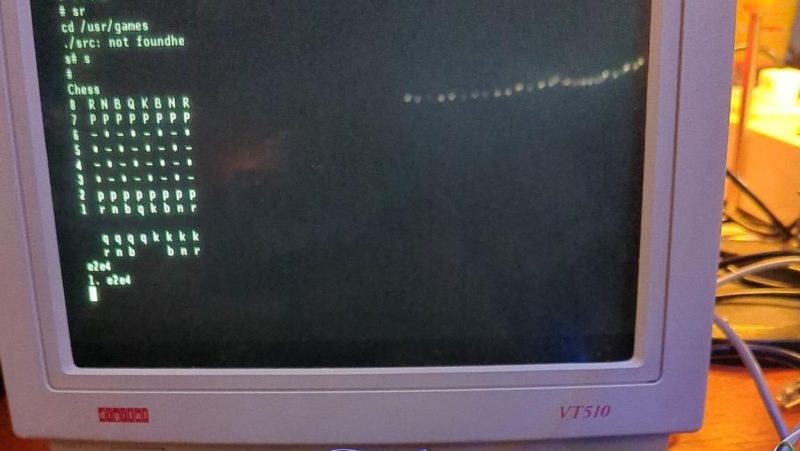
The PDP-11 was a 16-bit minicomputer that was very influential in its time. That’s what inspired [vanheusden] to start working on an emulator for the machine in 2018, which has since been developed to run on a wide variety of platforms.
The emulator, named “Kek,” is quite capable, able to run Unix 5 up to an d including Unix 7 in multi-user mode, along with BSD 2.11 Unix depending on what it’s running on. It also supports classic hardware like RK05, RL02, RP06, and RP07 disks, the KW11-L line time clock, and the DC-11 serial line interface. The emulator can also run on a wide variety of platforms. It’s possible to run it on a standard Linux machine if so desired, or you can run it on BSD, MacOS, or Windows if so desired. Beyond that, you can even get it going on a Teensy 4.1 or an ESP32 if that’s more your jam. Modern microcontrollers are just that powerful that emulating a PDP-11/70 just isn’t a challenge anymore.
We love seeing old machines emulated and brought back to life. It’s funny to see how often it’s done on microcontrollers instead of full-scale PCs these days, too. Video after the break.












Bob Supnik’s SIMH emulator has been able to do all this, and a lot more, for over 30 years.
A 30 year old esp32?
SIMH does not target ESP32 or Tinsy baremetal like this does, although there seems to be other ports
SpriteTM’s esppdp is a port of simh that does run on esp32. In fact I have a Lilygo T-Deck with bsd211 on its tiny screen sitting on my desk right now. It supports a 80-column console on the little display, can handle builtin keyboard and bluetooth keyboard. Connects to wifi. Pretty neat, even if it’s hard to call it practical. Performance-wise it kinda feels maybe not too far from the original, I don’t know. It’s not super fast.
It would be interesting to compare these two versions.
At the Simulation Services Department at Ontario Power Generation we (with P Perry) used simh to model the whole PDP-11 control hardware for the Darlington Nuclear Power station. This included RAMTEK displays, countdown registers, RM03s, DELIA devices etc. This has been in service for over 20 years in the full scope simulator. We also used the ERSATZ (e11) PDP-11 emulator in development. The simh experience was a real collaborative experience and it turned out extremely well. It amazes me that there is still interest in the PDP-11 but other ancillary devices are needed for a useful system. Simh did that.
I would love to see a 30 year old esp32
A pdp11 can also run easily on a Raspberry Pico(2):
https://github.com/Isysxp/Pico_1140
That was the start of my 70s Board project: https://github.com/bastetfurry/TheSeventiesBoard