
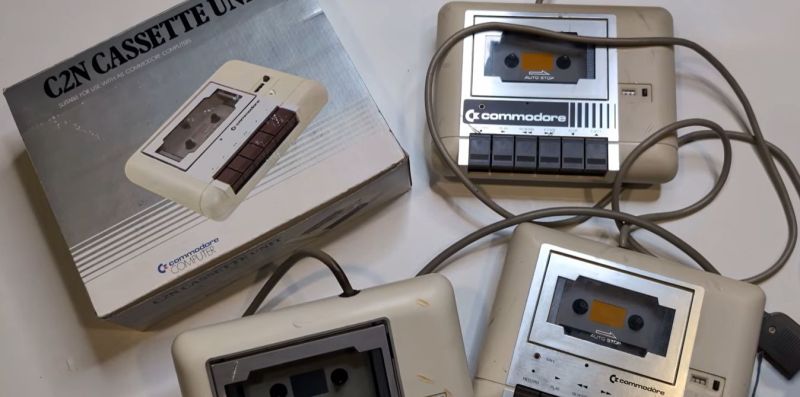
The phenomenon of cable-shaped indents in the plastic cases of retro systems is one that’s probably painfully familiar to many a collector of such systems. Although in these situations neither side got hot enough to cause any melting – especially while disconnected in storage – it still has that same melted appearance. The real cause here is not heat, but plasticizer migration, as detailed in a recent video by [Run Stop Restored] over on YouTube.
Plasticizers are an additive to many plastics that aim to make it more flexible (‘plastic’), as well as improve other characteristics of the base material, with PVC in particular relying on plasticizers to give it its desired properties for applications where PVC has to be flexible. Here the flexible cable insulation of these devices generally uses PVC, which over time can migrate to other polymers when brought into close contact for extended periods of time.
The – usually ABS – enclosures of e.g. Commodore tape drives as in this video demonstration thus get correspondingly inundated with the same type of plasticizers that ABS is also highly susceptible to. Since in storage the cables tend to be wrapped – tightly – around the device they’re attached to, this results in a solid contact which thus enables this gradual process to work its magic, whether it’s a Commodore datasette or a power supply brick.
Correspondingly the PVC insulation becomes brittle as it loses its plasticizer, with the process sped up by higher environmental temperatures. To prevent this, never wrap a PVC cable around a device, and keep it physically separated from susceptible plastics like ABS as much as reasonably possible. Along with a cool environment this should prevent plasticizer migration from ruining what used to be a pristine case.
This problem is particularly significant for retro gear from the 1980s and thereabouts, before phthalate-free plasticizer alternatives were developed, along with other changes such as more stable formulations that prevent this migration process. Adding a coating can also help, especially for protecting older gear, but flexible PVC in particular should be viewed with suspicion and treated carefully.












Noticed something similar with those cheap cables. It’s not so much brittle, but it feels different.
Does it help to clean sticky old cables using IPA?
That could be the rubber breaking down, kind of like soft touch plastics
You know, I’d seen this in action and just assumed at some point I left a hot soldering iron on, but this makes sense.
The 2020s equivalent is tech that has that soft, almost rubbery exterior. These tend to melt in humidity to turn into a sticky mess after a few years. In Florida I have so many old cameras and the like that are now fuzzy, because the exterior became an adhesive over time and dust or mold sorta “grew” onto the exterior… it’s so gross.
Even if the device still works, it’s e-waste unless you are willing to cover it with masking tape to make handling it tolerable. I’ve tried goo-be-gone and it never quite gets it all, because it’s like the housing is MADE of glue at this point. Device housing manufacturers need to be more cautious. I’d rather go back to beige yellow aging housings than deal with this sticky mess.
You can soak the sticky plastic enclosure in IPA for about an hour, after that you can just peel it off and you have the glossy plastic without the rubber coating left. I did this to rescue a few old devices.
+1
don’t ewaste something that works and can be cleaned with little effort and put it back for use. I for one use a magic eraser (self destroying sponge that has very mild sanding capabilities) along with IPA ; works like a charm, especially on old Thinkpads and the likes.
Thanks for the suggestions. Lost of enclosures these days can’t come off without breakage due to glue so I was looking for something less destructive. I will try this.
You mean India pale ale beer?
Of course. Clean your vintage electronics with beer.
Yeesh.
The belts in VCR and Tape Drives are affected likewise
glad I’m not the only one hating that “premium” rubberized coatings. they are completely unnecessary and in most cases, not functional.
the problem is that every tool nowadays is covered in some sort of rubbery substance to “give it a more premium feeling” and not only they degrade, and dirt sticks to them easier. my biggest issue with them: they don’t “slip” past other tools in the drawer. if you try to pull one tool out of the drawer it’ll drag all of the other tools in contact with it. and since they’re also covered in this crap, they will also stick to tools under them.
imo the best grips are early 2000s “silicone” grips. these are soft enough to grip easily, and won’t degrade. they won’t slip in your hand like older clear “acrylic” ones. and they do get grimey but you can easily wipe them with degreaser.
You can turn this to your advantage. Lots of people throw away (or sell cheap) nice hardware ruined by “soft touch” paint. A few paper towes and IPA, combined with a little elbow grease and you have something nice that will last you a long time. All my cad machines have 3Dconnexion devices that I’ve rescued and the function great.
gah!!! i have a pair of binoculars…binoculars can last for decades but one of the 3 plastic surfaces on the outside of the thing is that awful surface. really disappointing decision. i know i can eventually remove it but that’s labor and of course the last thing i want to do is play with solvents around my optics.
This was very enlightening. Years ago, I discovered that some ordinary insulated hookup wire had “melted” the plastic box it was in. I think the box was polystyrene, but I’m not sure. I never understood what had caused it.
Leaking plasticizers are a known problem for more than half a century, they can damage most plastics even without direct contact. Also rubber parts will absorb the fumes and turn into goo after a short time. Many nice things were ruined just by storing them in an airtight bag or box.
Oh, so THIS is the underlying reason why soft-body lures left contacting a hard plastic bobber seem to melt into the bobber when left in a tackle box for a couple years.
Huh. Noted.
Yeah! You’re right!! I really thought that was heat because the tackle box always got left in the barn. …… world model updated.
+1
Hard plastic lures and certain soft plastic baits left touching = not good at all! Thanks to the OP for teaching me why this happens!
I had a related version of this phenomenon in an older house I was living in. Green goo would seep out of the light switches in certain rooms. I later learned it’s the plasticizer migrating along a cable’s outer and inner insulation layers. Then it would flow through the light switch, picking up a little bit of copper/brass along the way from the switch mechanism.
Also mention cords on wood finishes like the top of a piano, or placing the vinyl bench on top of the lid.
When you wrap cords you might as well chuck the end in a drill and give it a whirl, it’s twisted.
Your friend doesn’t like their dildos to touch either? What’s up with friends, amiright?
Those also get softer with time though.
Lovely, thanks for that. Didn’t even bother with innuendo or anything.
So glad I just introduced HaD to my 10&13 y/o niece and nephews for the first time last week. Guess I need to rethink sharing links to articles with my students now going forwards. I thought the hardest thing to have to explain to parents was that hack≠crime.
god who cares
Another annoyance (though smaller than a melted gap in your priceless retro possession) is the same effect on its polystyrene packaging: Cables can melt large gaps into styrofoam because of its “air’y” nature. Melted styrofoam basically fuses with the cable, so that cleaning the cable becomes tedious.
I guess putting cables in polyethylene bags helps, or at least wrapping them in paper.
This is a well known problem of storing paper, film, and coins in vinyl as well.