
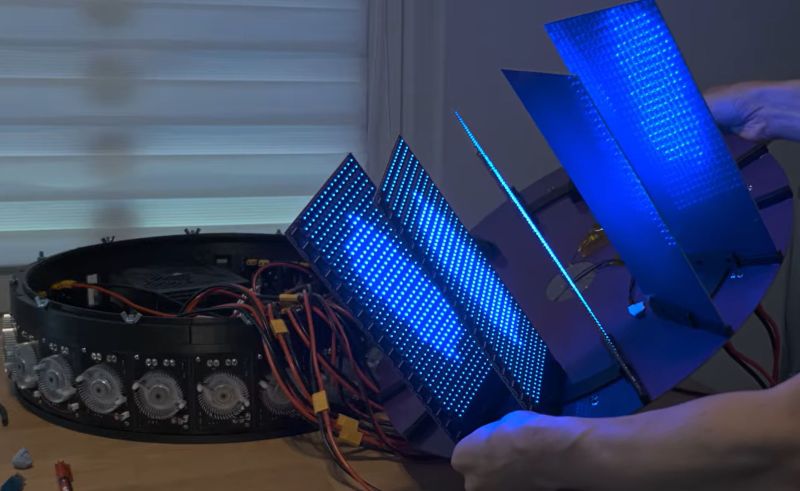
 What do you get when you take 8,192 CH570 MCUs, put them on custom PCBs, and write firmware for this interconnected gaggle of cores? In the case of [bitluni]’s project, you get something that’s decidedly cluster-shaped.
These cheap MCUs feature a QingKe 32-bit RISC-V core that’s clocked at a maximum of 100 MHz, with an RV32IMBC instruction set. This means that they support integers, integer multiplication and division, bit manipulation, and compressed instructions, but no atomic, vector, or floating-point instructions.
The basic concept was to use a single MCU per pixel, but once you start scaling up a measly 10 mA and ~$0.10 per MCU to literally tens of thousands of them, you’re suddenly talking about thousands of dollars in hardware as well as a cool 655.36A at 3.3V – or 2 kW – for something close to QVGA resolution at 320×200. Clearly this would be a rather crazy project to implement, which is why each MCU also got its own RGB LED to immediately create the pixel.
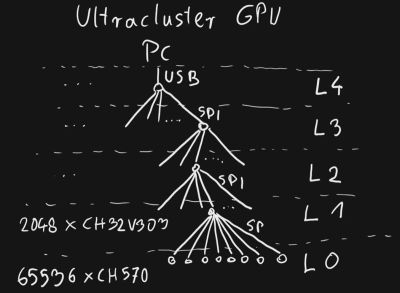 In order to fit so many MCUs, the design was split across multiple PCBs, or blades, connected to a backplane. On each blade, a group of MCUs is connected to a controller MCU, in the form of a larger MCU. With some prototype blades assembled and bodges implemented, each single MCU could then be programmed.
For the power supply, a 3 kW Corsair ATX PSU was used to supply power to the subsequent power stages. As a result, the first prototype looks like a pretty fancy addressable RGB LED matrix.
This is said to be only the first step, with this ‘Ultracluster GPU’ still getting a few more levels tacked onto it to make it into something that’s more GPU-shaped. Probably the biggest question here is whether the final version will be able to generate said QVGA output image without needing more power than what a typical 230 V, 16A European outlet can provide.
We think that [Jensen Huang] probably will be more scared of the ESP32-S3-based video card that [bitluni] made before, though at least [bitluni] seems to be having fun making more MCU-based clusters, such as this one from 2024 and this one from 2025.












I love that guy’s crazy projects and his dry humour!
Yea, he reminds me of Konstantin Chernenko who was a close friend of my father.
is more easy do that with xf316 xmos…
XU316? Was looking at these just a month ago.
I was wondering where the heck a 3kW ATX power supply came from. Here in the US our measly 115/120/whatever mains max out at about 20A per circuit, so even ignoring the whole watts-not-VA confusion, 3kW isn’t gonna happen.
Which at this moment makes me sad, thinking about how many bazillion little MCU’s and blinkenlights I could run, twinkling away, if I had Eurovoltage =))
Most electric dryers use a standard 14-30 outlet, which delivers 240V/30A max, and installing one is routine residential electrical work. Derating for continuous use, you can still get 5Kw out of one of those.
Never use the word “standard” for 240 outlets here =)) See https://xkcd.com/927/
But yes, I mean, I have a NEMA-whatever-it-is in my garage for my 240V welding machine. But then I don’t know if Corsair makes a 5kW ATX PS here Stateside. :)
Hey, since the US electrical system is really a split-rail 120V system with ground somewhere in the middle you can use a 240V outlet to get the same thing. While the most common plugs for 240V are dryer and oven plugs there do exist smaller 240V plugs. The 6-15R and 6-20R provide 240V and ground at 15 and 20 amps respectively. They each look like a slightly wonky standard receptacle.
US-wise houses use split-rail, rental units usually do not. Unless your rental neighbor has the other rail, and you can ask nicely to jack into his/her rail in addition to, you are stuck with one rail one neutral.
Having said that, 20 amps is not always the upper limit, and I remember running things like baseboard heaters (I know, I know) in winter and feeling wires going quite noticeably hot without tripping the mains breaker. In the hindsight, should have went with the sealed oil radiator instead (it warms slowly, but eats less while having at least some heat inertia in it), but who thinks that far into the future when the budget rather too thin.
That’s not how it’s worked in any rental unit I’ve ever been in. Always there’s been a dedicated split phase panel or sub panel for my unit. And I’ve lived in some old/oddly converted apartments.
You do have euro voltage! Just need to grab both legs at the panel. We even have 4 more amps available by default on number 12 with a two pole breaker.
Actually, at my home I have a 3 phase 400V 16A circuit used for connecting induction stove which I modified to also charge my e-scooter. That’s 20 kW of power available. American 4,8 kW looks puny compared to that.
Impressive! My 100A panel tops out at 24KVa, but I doubt the pole transformer I share with four or five neighbors would provide that for long.
Use a stove/oven/dryer/hot water heater circuit – they are typically 240V with 30-50A depending on the wiring.
Less common is 110V with 30A+.
I want to see the software he writes for this in the next video
Surely there must be many niche applications where you can do serious work with many small cores doing something?
Also compared to his last cluster attempt, SPI+DMA is a much better choice for the communication bus. iirc he used UART in the last attempt?
I’m curious about his SPI setup, is he accessing them individually, sequentially on a shared bus, or in parallel across a shared multi-lane bus.
The biggest performance bottlenecks I see are the clocks of the cores themselves and the speed of the communications.
Flip that around.
Dude gets to spend months having fun creating a completely impractical cluster thing with the only obligation being a minute of fluffing PCBWay for building him some decent quality boards and WCH for providing thousands of free parts.
If I had the opportunity and was comfortable in front of a camera I’d do the same.
“…but no atomic, vector, or floating-point instructions.”
So anything but a GPU.
Not even a decent CPU.
Why, oh, why?
10c/CPU makes it compelling…
Plug a vew of them together = (sort of) vector array
Hold on here…. What if You take the MCU’s and use them to drive chains of addressable RGB.
You can get back the full pixel set and get a natural hardware acceleration by driving limited number of addressable lines, Sort of like the Webber Lights guy does to make large arrays. This is the start of a system like that, but way more channels before the RGB serial data bottleneck.
It has a neat outcome if you throw long chain RGB into the final result….
It would give you a reason to upgrade your supply thinking big time.
Hell of a light show if you did it…. Say 33 neo pixels instead of one.
Why “gluing”? Last time I’ve checked, we’re still soldering the MCUs.
Awesome: Nod to the Cray 1 for the round design, and cool you added all the LED bling, what is a home made computer without them :-)
Rule 1 of maker video: show the finished product first so I can decide if I want to watch you ramble on for 30 minutes making the thing.
What if it’s about the journey, and not the destination?
“product”
Thinking about it, if the display itself handles a few standard primitves used everywhere (buttons, text fields, picture frame, in a dragable window), couldn’t that, driven by a beefed up microcontroller with a minimal OS that just gives instructions like “paint button with text xyz in frame 1234”, suffice for general cumputing in industry & home? Stuff like maps/CAD/PDF could be handled in spacialized a vector field.