
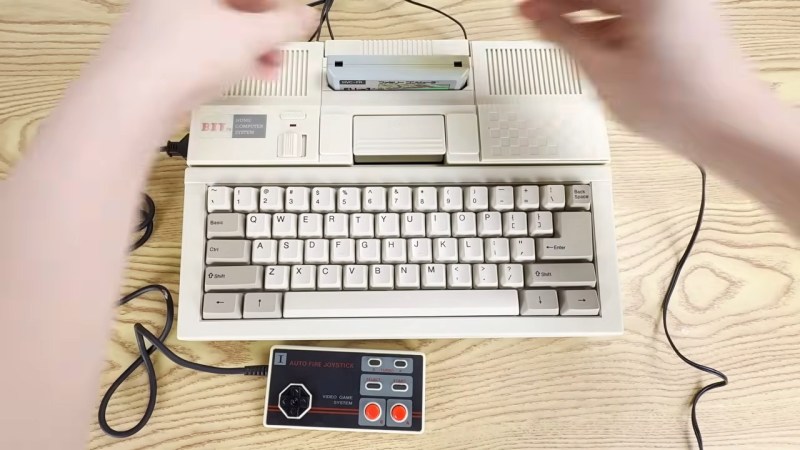
While the original name of what much of the world knows as the NES was the Nintendo Family Computer, or Famicom for short, it was very rarely used as a family computer. Sure, there was a basic cartridge and an add-on keyboard sold in Japan, but it was always a sideshow to the games.
Nintendo recognized that when they brought their Entertainment System overseas. Most of the various famiclones — which date back to the mid-80s — are the same. BIT in Taiwan had a different idea: their Bit 79 would be a full home computer. Picture a C=64 that plays Nintendo games, and you might not be too far off. [Inkbox] tells the full story in his latest YouTube video, and it’s a must-watch for anyone interested in the history of 8-bit machines that are totally unknown in the West.
BIT were both game makers and system cloners; you may even have seen one of their NES or Atari games, as they were exported widely. By 1989 they’d already gone through a surprising number of Famicom clones, but those were pure clones and just played games. The Bit79 is obviously different — for one, it’s got a built-in keyboard in a wedge case. Apparently a pretty good one at that. For another, it starts with a bootloader that lets you choose between BASIC on ROM and loading the cartridge. For a third, it’s got a full 8K of RAM, quadrupling the Famicom’s offering– plus an additional 2K for the PPU, in what you might consider an early example of video RAM. Both CPU and PPU are knockoff chips made in Taiwan by UMC. The system even has what looks like a DB25 connect a printer. There’s also an expansion port, but no evidence that add-ons were ever sold, despite reports of a 64K memory add-on.
Back to the BASIC ROM for a moment– it’s not Famicom BASIC, as was clear in the manuals. [Inkbox] dumped the ROM to find that it is actually AppleSoft BASIC, of all things. That’s not only an odd bit of piracy, it’s also a big miss, since Apple’s BASIC doesn’t have any commands to make use of the PPU the way Famicom’s version does. POKING the registers during the vBlank interval is apparently not an easy thing to do. Perhaps that’s why we’ve never heard of this machine — well, that, and the fact we’re not located in East Asia where it was sold.
While the Bit79 didn’t sell particularly well, apparently it inspired a whole wave of “educational computer” famiclones in 1990s China that are largely unknown to the English-speaking world, making it an important part of computer history.
While BIT Corp is long gone, if you want to play around with their great experiment in turning a famiclone into a home computer, an emulator is available online, and the ROMs are preserved on the Internet Archive thanks to [InkBox].
Thanks, too, to [Stephen Walters] for the tip.












“While the original name of what much of the world knows as the NES was the Nintendo Family Computer, or Famicom for short, it was very rarely used as a family computer.”
While absolutely true, the “computer” part of the name wasn’t for you, it was for the retail stores.
It was a trick, a loophole, as right after the videogame market crash, absolutely no retail stores would carry anything labeled as a video game.
Did you purchase your NES in a store? If so you absolutely relied on it being called a computer to do so.
So the name served its real purpose, and NES is a cultural icon because of it, instead of a device no one outside of Japan might have heard of.
I think that qualifies as at least the name being used, even if not using it by its name.
I guess that makes sense to the US market, yes.
But I think I once read that the Japanese were not afraid of “cutesy” or playful design.
The original Famicom was in red/white color, which may or may not has a link to the Japanese identity (flag colors etc).
But anyway, it was a color scheme used by toys, too.
The original Famicom also was made very minimalistic, the plastic was very flismy.
Like a toy, not like a hifi stereo or VCR.
To many average Japanese households, the Famicom was a common, affordable item and the only kind of “computer” there was.
That’s why even business software was available to Famicom.
There were modems and financial software on cartridge.
On other hand, the optional Famicom keyboard/Basic was probably more used by people trying to get a hold in video game business.
To home users into real computing, the MSX computers were a better choice.
But I’m from Europe, neither Japan or USA. So I can hardly explain it.
While we were considered “western” by Nintendo, we were somehow in-between.
Our PAL/SECAM NES was based on the US design, while our Super NES was based on the Japanese design.
(The power brick often was a 9v AC transformer in both cases, the consoles had internal rectifiers/voltage regulators.)
Culture wise, we were somehow semi-compatible with both USA and Japan.
Ie, our kids and parents were not so “prudish” or easily offended by certain topics/concepts.
Children over here were less being wrapped in a safety bubble etc.
They also weren’t alienated by foreign culture so much (rice balls vs hamburgers etc).
To name an example, let’s take Pokèmon (popular Nintendo franchise).
To whole western audience (not just US), the backstory of Mewto in first Pocket Monsters movie was changed and it was made evil.
It now was a story about good vs evil, basically. Like in a western movie..
For an movie aimed at an US audience, this change made sense, I suppose.
But children/teens (people) in Europe of the time (late 90s) were not strictly thinking in good/bad or black/white patterns yet.
Story lines with depth were not automatically doomed to fail at the cinema.
The audience would have understood the original Japanese story about a hurt, lonely being seeking a place and purpose in life just fine.
Alas, Nintendo did put all of us in same pot.
That also happened with video games before, I think.
I guess there was not much experience about how to market things outside of Japan.
So perhaps to the Japanese, anything “western” is perceived as pretty much the same.
So it’s no wonder if the US is a role model to western things to them, maybe.
I’m just glad we got both of the good designs for NES and SNES. ;)
I believe you’re confusing a few things there. The Japanese “Family Computer” name predates the Video Game Crash of 1983 that didn’t happen in Japan. In the West, the NES was very deliberately neither marketed nor labeled as a “computer”.
Instead of vBlank integer, I believe it should be vBlank interval.
Good catch. That interval is probably not an integer value of any normal timebase, either.
his evidence that this is applesoft basic seems a bit shaky: it appears to be based on the presence of nonfunctional “TEXT” “LGR” and “HGR” statements. The first and last of those are indeed applesoft statements, but the statement to initialize low-res graphics was “GR”, not “LGR”, and there’s no evidence (at least that I saw in in his video) of the “HGR2” statement, which initialized full-screen high-res (as opposed to high-res with a text window). It seems possible the basic is a clone, rather than a direct copy, of applesoft, and perhaps those statements are evidence of planned features that never got implemented.
Fair enough. Perhaps “inspired by” or “compatible with” would be more defensible statements. Unless there’s an engineer from BIT still around who happens to speak English and stumble across the controversy, we may never know for certain exactly how their version of BASIC came to be.
yeah, and I didn’t mean that to sound quite so critical. As you imply, it sort of points up how tricky this sort of technological archaeology is, and it raises interesting questions (along the lines of the ones implied by the remarkably high quality of the casing and keyboard) about the design and engineering process and goals behind the box.
Another little observation along the “it’s probably not EXACTLY applesoft” lines: per the video, the BASIC prompt on the BIT79 is “>”, which was the Apple integer BASIC prompt, whereas the applesoft prompt was “]”.
I don’t think it was ever implied it was exactly Applesoft BASIC, as he clearly shows that some commands don’t work, so it has obviously been changed in certain ways. So I guess the real question is, if that version of BASIC wasn’t based on Applesoft, which version of BASIC was it based on? Because like he said, HGR, GR, and TEXT were there in ROM, even if they couldn’t be used, it means they were useful at one time, so what other versions of BASIC used those commands? None to my knowledge.
MIcrosoft basic is the most disassembled 6502 basic, it should be easy to match some of the code if it was from Microsoft https://github.com/mist64/msbasic