
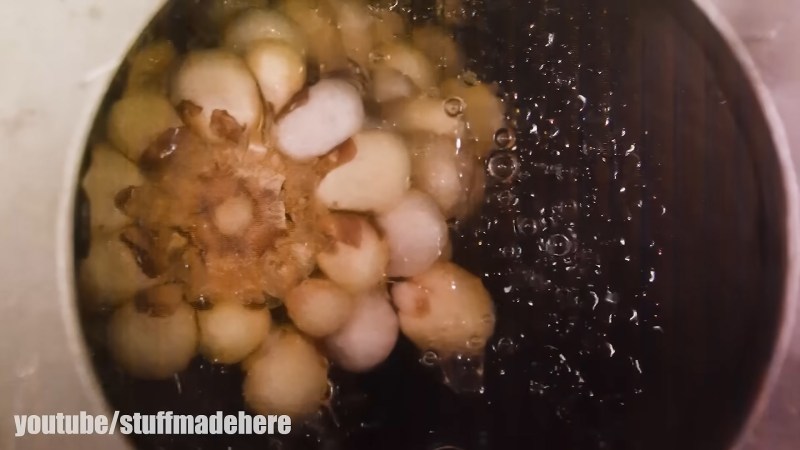
Steam power is a staple of the steampunk aesthetic, thermodynamics, and a checkpoint for the budding mechanical engineer studying heat cycles. But because food is largely made of water, steam is also common in the culinary arts. So it’s no surprise that when thermodynamics is applied to cooking, exciting things can happen.
This particular example of steam-powered culinary happenings is inspired by industrial potato-peeling machines. By adding high-pressure, high-temperature steam to a pressure vessel with potatoes inside, heat can transfer more easily to the inside of the potatoes. Because the pressure is so high, however, the water in the skin won’t boil. This is fundamentally the same concept as a pressure cooker. However, what’s different is that instead of a pressure cooker’s slow release, these industrial peeling machines rely on explosive decompression, flash boiling the water underneath the potato’s skin. This rapidly expanding steam rips away the skin in a nice clean sheet.
But, to [Stuff Made Here’s] disappointment, there were no videos of the process on the internet. But, fortunately for us, being an engineer of complicated machines means that there is one now that you can watch below.
The machine itself is, on paper at least, fairly simple. It consists of a boiler, connected to a fruit chamber by a valve, and another valve to vent the steam out of the fruit chamber. However, engineering a pressure vessel that can safely withstand over 1,000 kPa of steam with a window for filming when you can’t weld very well is another matter entirely. The boiler is two stainless steel plates with a cylinder in the middle, with face seals used to keep the chamber steam-tight. A custom jig was needed to machine the pipe ends flat enough to mate with the seals. It’s held together with threaded rods. However, because the rods and the vessel body have different thermal expansion coefficients, Belleville washers are used as expansion joints in the system.
The fruit chamber is welded together because it experiences lower pressures. This also allows for a less sensitive O-ring seal on the door, reducing the work required to use the door. A glass piece inlaid into the steel door provides a view, held in place by pressure and 3D-printed brackets. A stand holds the fruit centered within the window for our viewing pleasure!
The results speak for themselves, though operation is complicated and dangerous, and it can only peel one fruit at a time; the skin of nearly every example placed inside is perfectly removed. Experiments include apples, potatoes, grapes, lemons, strawberries, blackberries, and (pictured above) popcorn on the cob. It’s quite a fun demonstration of the thermodynamic principles at play!
Thanks [DjBiohazard] for the tip!












Can you do a weekly food hack? This was a nice change of pace.
I like this idea!
+1 Love this stuff. More please. Food processing and agricultural processing all started as hacks.
Some food hacks are creepy though. Don’t research how they stun chickens before processing them into nuggets 😭
In the immortal words of Denis Leary: “meat tastes like murder, and murder tastes pretty dam good!”
fLk!
There aint nobody here but us chickens, there aint nobody here at all.
Billions more than humans.
Pretty sure all cooking is thermodynamics…
Good for getting labels off plastic bottles too perhaps