Repairing A Pair Of Voodoo 2 GPUs For Some SLI Action

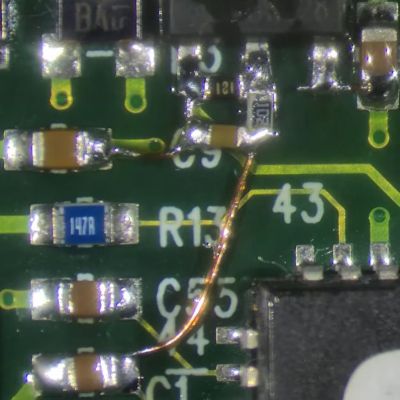
Well there's your problem. (Credit: Bits und Bolts, YouTube)
Well there’s your problem. (Credit: Bits und Bolts, YouTube)

Recently [Bits und Bolts] stumbled over a pair of Dragon 3000 branded 3dfx Voodoo 2 cards in his unfixed cards pile, and decided that the best course of action was to not only fix them, but also run them in SLI for some sweet Unreal Tournament action. Naturally, these cards being in the broken cards pile meant that he first had to figure out why they were broken and fix all issues.

The advantage of having two identical Voodoo 2 cards is of course that any missing components, like some resistors on one card, could be referenced on the other card. Beyond that it was mostly a matter of reflowing clearly corroded pins on the ICs and replacing damaged resistors and resistor arrays before the first tests could be run.

Using the mojo utility it was easy enough to spot that there were still some lingering issues, with clear issues visible in 3D games as well. These were tracked down to a dodgy pin on one of the texture mapping units (TMUs) that needed some more reflowing, and a very sneaky resistor array that was cracked but not obviously so until prodded with a multimeter.

With both cards now making happy noises when individually tested, it was time to go full SLI, fire up the Pentium 2 system and enjoy the glory of 24 MB of VRAM at high resolutions in Unreal Tournament. Considering that the bloke who had sent in these cards had found them while cleaning up a shed, it’s quite amazing how little rework was needed to once again party like it’s 1999.

Continue reading “Repairing A Pair Of Voodoo 2 GPUs For Some SLI Action”

The 3DFX Voodoo Lives Again In An FPGA

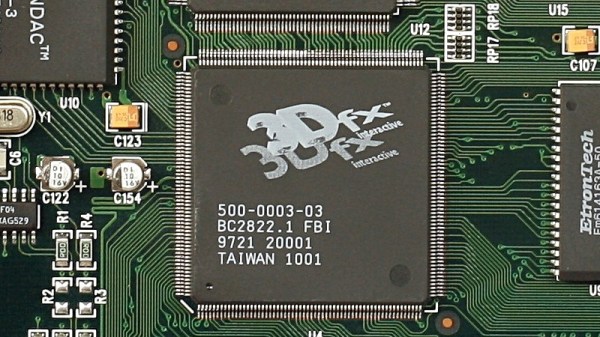
The 3DFX Voodoo was not the first dedicated 3D graphics chipset by any means, but it became the favourite for gamers among the early mass-market GPUs. It would be found on a 3D-processing-only PCI card that sat on the feature connector of your SVGA card. The Voodoo took any game that supported its Glide API into the world of (for the time) smooth and beautiful 3D. They’re worth a bit now, but if you don’t fancy forking out for mid-’90s silicon in 2026, there’s another option. [Francisco Ayala Le Brun] has implemented the 3DFX Voodoo 1 in SpinalHDL for FPGAs.

Continue reading “The 3DFX Voodoo Lives Again In An FPGA”

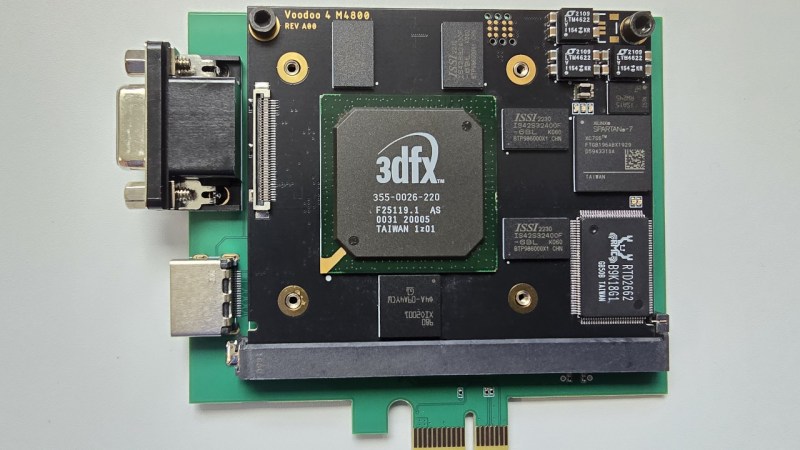
The MXM card with the 3dfx chip in the center, black silkscreen, mounted on the MXM to PCIe adapter, green silkscreen

An MXM Take On The 3dfx Voodoo

[sdz] of Vogons forum brings us an unexpected device for the 21st century – a 3dfx Voodoo 4 card in MXM format, equipped with 64MB of RAM. This isn’t just a showpiece – this card actually, properly works when installed into our hacker’s Dell Precision M4800, and [sdz] tells us more on how the card came to be.

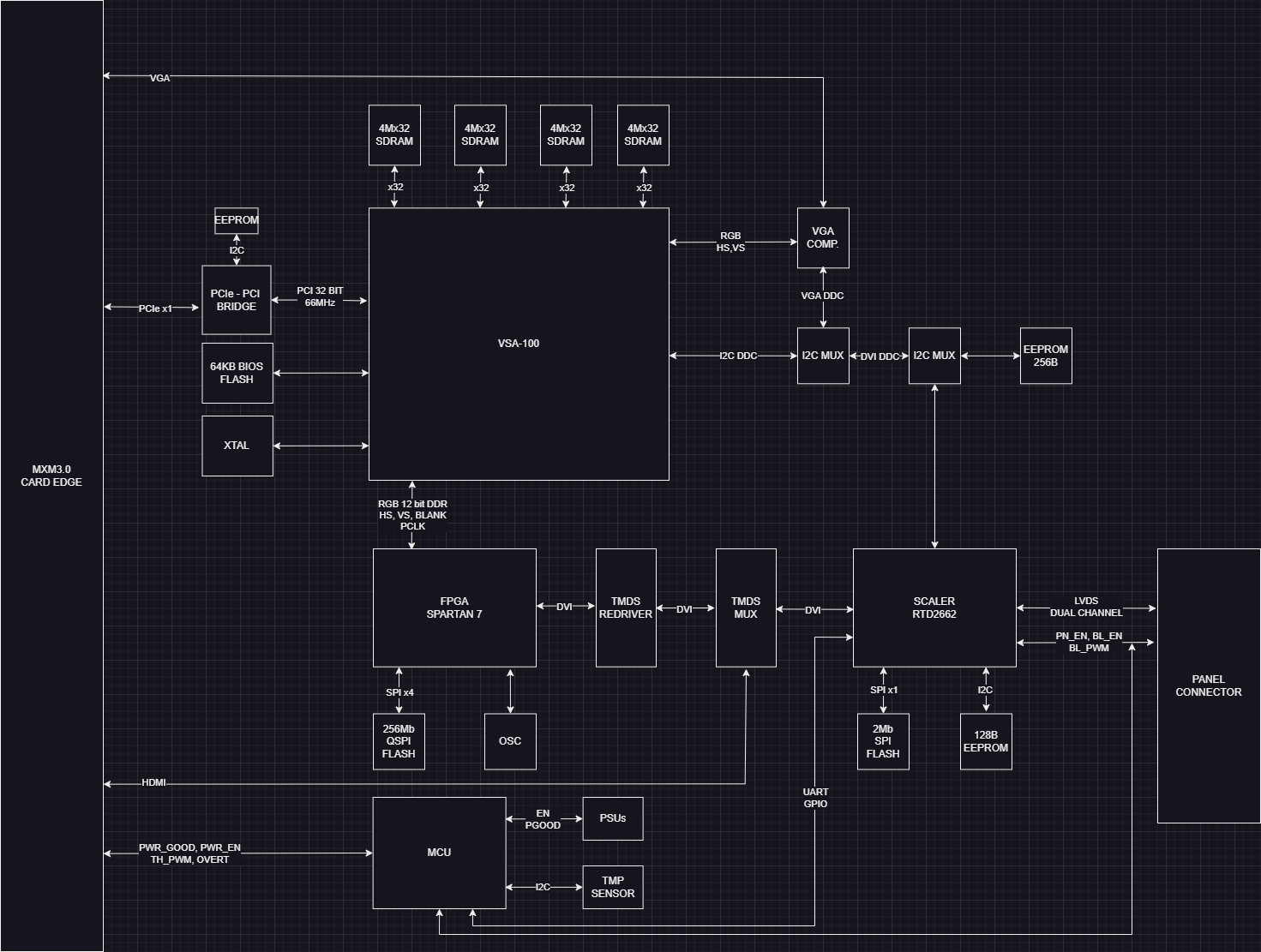
Structure diagram of the cardEquipped with a VSA-100 GPU, this card has a whole lot of support components for adapting old interfaces to modern ones. There’s a PCIe-PCI bridge IC, an FPGA, HDMI muxes, and a Realtek scaler for video conversion. Handling all the MXM interfaces would’ve been downright impossible, so the card also holds an LVDS header for the M4800’s panel. Plus, for testing all of it, [sdz] has developed a PCIe to MXM adapter board with minimal circuitry needed to have the card work – this is a seriously involved hack and it’s executed remarkably well.

The forum post shows a whole lot of the journey, from receiving the PCBs to code and FPGA gateware bringup, as well as videos of VGA and HDMI operation. In the end, our hacker shows us a fully working setup, the 3dfx card inserted into M4800 and driving its display, as well as overclocking experiments; the author has promised to open-source the card files in due time, too. It’s seriously nice to see DIY MXM cards in the wild, and if you ever wanted to build one, we’ve got an article tells you everything you could want to know about the MXM standard.

We thank [Misel] for sharing this with us!

Continue reading “An MXM Take On The 3dfx Voodoo”

Upgrade Your Voodoo With More Memory

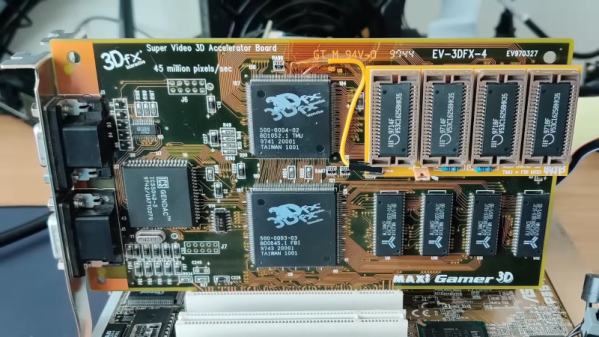
In 1996, the 3Dfx VooDoo VGA chipset changed computer graphics forever. Because of the high cost of memory, most of the boards had only 4 MB of memory — which seemed a lot back then. However, the chipset could actually handle up to 8 MB. [Bits and Bolts] couldn’t stand that his board only had 4 MB, so he did what any good hacker would do: he figured out how to add the missing memory!

The mod has been done before using the “piggyback” technique, where you solder the new RAM chips on the old chips and bend out a few pins out to directly wire them to chip selects elsewhere on the board. [Bits and Bolts] didn’t want to try that, so instead, he developed a PCB that slips over the chip using a socket.

Continue reading “Upgrade Your Voodoo With More Memory”