
[Irving John Good] was at Trinity College, Oxford back in 1964. His paper, “Speculations Concerning the First Ultraintelligent Machine” could have been a topic for today, as we deal with machines that aren’t really ultraintelligent, but appear smart and think they are even smarter. He starts off with a bold thesis: “The survival of man depends on the early construction of an ultraintelligent machine.”
He also admits that we’ll need to understand more about the human brain and human thought to make a breakthrough. This is still true today. However, we still don’t fully understand how our brains work, but it seems unlikely that we are just super-large LLMs. Not that [Good] anticipated the modern chatbot. Perhaps his comments will apply more to a future AI software that actually thinks like a human, if there will ever be such a thing.
Then again, there are many parallels. One theme in the paper is that a smart machine will design a smarter machine. Unless, of course, it is afraid of being replaced. If a machine were actually sentient, what are the ethics of turning it off and tearing it apart?
It is hard to be a visionary. [Good] remarks that by 1980, progress in human/computer symbiosis will encourage more investment in the field and that by that time, there would be “great advances in microminiaturization” and “frequencies of one billion pulses per second,” might be common in “large computers.”
We love reading what smart people thought the future might be like. What will the world be like in another 60 or 100 years?












Amusing that we are quite a way passed 1 billion cycles per second [ 1GHz ]
Although no doubt if you had suggested more back then it would have seemed far too outlandish to have been considered.
Coding was really efficient back then, bear metal was necessity when resources were so tight. Not to mention the variety of different standards, whilst they were still figuring out how to do things. Some spectacular things came out of the early demo scene.
We’ve come a long way since Blurbs was picking random lines from a text file and turtles were charging themselves and wondering around using sonar.
The main problem with the current AI tools, they portray confidence, even when they are completely wrong, even to the extent that they Ai will gaslight the user until it can’t get away with it and then backtrack, they are still very stupid, but for some reason people so often just trust the output and it’s being used to make decisions with real consequences.
We might have AI with true sentience one day, frankly it’s a pretty terrifying prospect to go beyond a tool into something capable of free independent thought, perhaps we should at that point be even less inclined to trust the output.
Yes, but it didn’t happen in the 80’s. It happened in the 00’s. That’s the problem with this sort of futurism: when you’re making predictions on exponential growth, small errors in your model will add up exponentially as well. Projections more than a couple years into the future will be basically useless.
Simply extrapolating from trends reveals nothing and is almost guaranteed to make wrong predictions, yet so many people think there’s value in these guesses, and will defend the people who made them by switching goal posts and fuzzing the criteria like “Oh, he was off by just a decade”.
The problem? This sort of futurism is very bad at identifying when a particular trend will end. For example, nobody would predict that we’d get stuck at 4-5 GHz clock rates for practical CPUs, which isn’t dramatically greater than 1 GHz. The people back in 1964 simply had no knowledge of what sort of physical limits we would reach, because they didn’t know of the technical means to get there.
Ray Kurtzweil made predictions in the 90’s that correctly identified many trends that happened in the 2000’s, but he also made predictions that in 2020 a $1,000 computer would match the computing power of a human brain, that we’d have nanobots for health monitoring, holographic video calls on our phones, and full-immersion virtual reality within the decade.
Wheres my holographic video phone?
Example: CPU feature size and clock rate of an Intel CPU.
https://www.researchgate.net/figure/Clock-speed-and-feature-size-of-Intel-CPU-The-raw-data-is-collected-from_fig1_369595594
Note how the usual “Moore’s Law” here actually flatlined twice: from 1985 to 1995 progress in feature size was almost halted, and then again from 2015 onwards. Likewise, for clock rates, late 70s to late 80’s saw little progress, then after 2005 it flatlined completely.
It’s easy to see how projecting the trend around 1970 would indeed hit 1 GHz in the early 80’s. It just didn’t end up happening. Why did it get stuck around 10 MHz for quite a while?
Some say who knows how long Moore’s law will plateau now we’ve reached the atomic limit in scale. Except the next generations seem to be moving further into 3d structures and trying to combine bits using light etc. The technology itself via AI problem solving, might well posit the solution to it’s own evolution, be that new architecture or materials. We will hit a hard limit at some point, eventually the laws of physics will get in the way of things shrinking, but then we’ll push efficiency. The human brain is pretty energy efficient compared with it’s processing capacity per volume, we have a long way to go yet. Perhaps we’ll run out of a need for computational power before we find that limit.
Note that we haven’t actually got any new AI problem solving methods. The rapid progress in LLMs is not solving problems but data mining past human knowledge. It’s regression towards the mean of what is already known, not producing novel answers or evolving into something better.
The same laws of physics limit both, size and efficiency. Smaller features leak more current due to quantum tunneling, etc.
It’s actually power consumption rather than our ability to stuff more transistors on a chip that halted Moore’s Law. At higher component densities and great numbers of CPUs on a die, the cooling system becomes expensive and unwieldy, and it too demands power to operate.
I mean we coudl build faster CPUs 500GHz+ if we used stuff like GaAs or InP. Right now that stuff is more or less exclusevly used for 5G radio equipment cuase its a lot more expensive compared to Si Wafers. I do hope the AI Boom will give us GaAs based CPUs/GPUs/NPUs coould be very fun What else we can then do with these.
We would run into other bottlenecks,
The wavelenght of light at 500 GHz is just 0.6 mm which is faster than the signals can propagate around the chip. With a CPU die 10 x 10 mm in size, we hit a speed limit around 15 GHz, and we’ve already pushed silicon based CPUs to around 9 GHz using liquid nitrogen for cooling.
Which makes the transistor faster than the signal can propagate
I assume because it’s not just about clockrates of a chip, but also PCB design.
Using higher frequiences requires better shielding, smaller traces etc.
It also has to do with capacitances and inductivities etc.
Then you have the RF regulation and other things.
Between 1 to 30 MHz were the medium wave and shortwave bands.
This was both good and bad same time.
The good thing was that oscillators were easily being built using off-the-shelf radio components, such as the NTSC or PAL crystals and oscillators (3,57 MHz and ca. 4,4 MHz).
Doubling and halving the frequencies based on that was common practice.
An 80 MHz crystal oscillator in a 386DX40 PC of the mid-90s was used to generate a 40 MHz chipset/CPU clock.
So having a 100 MHz CPU clock would have required an 200 MHz crystal or crystal oscillator (that 4pin metal can).
Unfortunatelly, the highest standard crystal/oscillator was 72 MHz or something.
Going higher would usually involve and PLL or DSS circuit.
That’s why early amateur radio transmitters on VHF had to use a frequency doubling circuitry.
The OSCAR-1 satellite used such a circuit in the 1960s, for example.
But anyway, there also were other factors.
DRAM was slow anyway (access times) and clock-doubling chips such as 486DX2 weren’t introduced until early 90s.
There also was a CISC vs RISC debate in mid-80s.
Then UK’s Acorn Archimedes shocked the industry with its very quick ARM chip (Acorn RISC Machine).
Also, in ca. 1987 there was a DRAM shortage because of the switch to new 1 MBit chips.
Factories for 256KBit were shut down to quickly in favor of 1MBit factories with a lower yield, basically.
That held back the development, too, probably.
People were happy to get any RAM, at all. Just like now.
SRAM in high-end 80386 PCs in late 80s then helped to compensate for slow external bandwidth.
Their motherboards had a minimum of 64 KB of very quick cache, often.
Anyway, these are just some thoughts.
Why did it get stuck around 10 MHz for quite a while?
The real stick point was 25 MHz, 486 days.
Below that the pure digital thinkers could just layout a bus and the board would work, despite having a 90degree bend.
Intel was stuck for some time for lack of a single HAM on their motherboard teams.
I hired a mathematician and after careful study using some supercomputer time he found out that 5GHz is actually dramatically greater than 1 GHz since it is 5 times more it seems.
I know, the numbers 1 and 5 seem small. but if you were buying something like say a smartphone costing 700 and then at the shop it turned out it was 3500 I think you would not brush that off as trivial.
It wouldn’t be a trivial difference, but still in the same order of magnitude.
Point being, 5 times faster doesn’t yet enable you to do something completely different. It’s just more of the same, like playing a game at 100 FPS instead of 20 FPS.
Going from 100 MHz to 1 GHz was a game changer in what you could do with a computer. We haven’t been able to pull off the same magnitude jump again, so we’re stuck doing pretty much the same things in 2026 as we were doing in 2006 – just in a higher resolution and more filters on top.
Depends on how much money I have. Remember that the original iPhone cost $499 up front, but because it was only sold through a 2-year deal with AT&T, you had to pay a minimum of $1975 up to $5815 depending on the contract to actually own one.
https://www.ilounge.com/index.php/articles/comments/total-iphone-2-year-costs-charts-details
Note that I’m using CPU clock speeds as a proxy for general computing power here. Other metrics such as memory and memory bandwidth also improved at the same time, so it was a pretty good match.
Then, just as we hit the clock speed wall, we also hit the Memory Wall: DRAM isn’t scaling anymore, and that’s cramping up how much work the CPUs can get done.
Bandwidth and memory density are only doubling once per decade and slowing down, and the much hyped alternatives have all turned out to be a no-show.
https://newsletter.semianalysis.com/p/the-memory-wall
“$1975 up to $5815”
Bloody hell.
Incidentally, CPU’s did not go from 100MHz to 1GHz, you had steps in between. But I suppose you are referring to the pace it went.
Still though, I think 5 times faster is a pretty good boost of something, and as you indicated that is just raw clock, each generation can also double many of the same operations per cycle, so then you get quite a bit more than 5 times.
And now with those AI focused units they can do quite a lot more math per cycle.
That MS standard of 50 TOPS for a ‘copilot’ system means trillion operations per second, and sure that’s int8 but the first 1GHz CPU’s could not even do 50 billion NOP per second, let alone trillions :)
As for RAM, they did a test on a test site after some computers were starting to be sold with a single stick of RAM to see what the impact was of not running in dual channel mode, and it was amazing that it did not have the huge impact that you would think it would have. That cache and modern prediction algorithms really do a lot in modern CPU’s it seems.
By 1960s, such AI topics were not unusual, I think.
That was the birth decade of Perry Rhodan sci-fi novels.
And in Rhodan’s universe, telepathy and electron brains/positronic brains were a thing.
Some beings even had brain implants that made them smarter.
https://simple.wikipedia.org/wiki/Perry_Rhodan
In other parts of the world, that refers to 1 milliard cycles per second, by the way.
Just saying, because the English/American “billion” is often confusing.
In my language, a “Billion” is a figure with a 1 and 12 zeros.
https://en.wikipedia.org/wiki/Long_and_short_scales
Wanna play billiards?
This is why the metric system has its own prefixes.
It always irks me that so often in SciFi they grab for telepathy for stories, which has nothing to do with science whatsoever, that’s Phantasy not SciFi.
The problem of SciFi in general is that the good writers don’t care about the science and simply turn the stories into tech-themed romance dramas and magical space opera – while the bad writers care too much and the entire story is just them noodling around some techno-philosophical concept and forcing the characters and the plot to conform.
You’re thinking of ST:Discovery, programmable matter, crying kids and exploding crystals and mushroom drives by any chance?
Well, the classic Perry Rhodan novels weren’t like STD, at all.
Everything was reasonably explained according to the technical understanding of the era.
The stories were long and had some depth, too.
That’s why the publishing of the series probably had ended in the US so soon.
Telepathy is phantasy? How comes?
Someone could argue that sensitive people sense the brain waves of other beings.
That doesn’t look any more or less sci-fi than reading them with a machine and an implant.
Maybe we’ll have transceiver chip implants in the future, eventually.
Sensing someone’s brain waves from a distance, with another brain, even just couple feet of distance away, is like trying to guess the song being played by a 3-year-old child on a recorder flute – in a hurricane, while suffering from tinnitus.
Not only can you not hear anything from the howling and noise around you and the ringing in your own ears, the kid can’t play a recognizable tune in the first place. Everyone’s brain is a little different, so there’s little chance you can even understand what the signals mean. After all, they might be thinking in Chinese and you don’t speak it.
Meanwhile, Sci-Fi stories use telepathy as a shortcut because the writer is all knowing and ends up projecting too much information onto characters who otherwise would have no plausible means of knowing it. Instead of writing elaborate explanations to close that plot hole, or scrapping the plot, they introduce telepathy.
Exactly Dude, it’s just writer shortcuts, and a bit of the tendency of writers to go romantic with their stories perhaps.
But it’s so popular, which makes it even more likely that a writer takes that route.
I think the old ‘artificial gravity on all spaceships’ more acceptable, it is also silly but at least you can see how much a story would have to write around missing gravity and pesky acceleration forces.
“Any sufficiently advanced technology is indistinguishable from a completely ad-hoc plot device”
—David Langford, “A Gadget Too Far”, as a corollary to Arthur C. Clarke’s Third Law
Hm. What the paper lacks to address is humanity’s mental maturity, maybe?
Technological progress is nice, but what does it mean in a society without philosophy, wisdom and responsibility?
If the mental development is behind the social development, basically.
Isn’t that akin to giving a young child a lighter (or knife) before it had learned how to socially interact
and before it had learned and processed what consequences certain actions would have?
Or as other analogy, doesn’t this seem like someone wants to run before someone has mastered to steadily walk, not to say crawl?
*If the technologically development is behind the social development, basically.
Sorry, I must better watch the auto-completion. 😅
*If the social development is behind the technolgical development, basically.
Finally! Now it’s correct! 🥲
Humanity has so far been of the opinion to just “wing” the technology and not really preemptively care about the social consequences.
I keep thinking, is all the technological and social “progress” really worth anything if the birthrates fall to 0? All the PhDs and masters degrees, voting rights to all, birth control, hectic but extremely productive lives in small city apartments, delayed marriage and kids. Polluting kitchenware coatings, forever chemicals.
Sustainability is the name of the game, and we’re not winning. Sustainable human replacement rate i mean, not environment or anything, although that has an effect on the former.
Look up Nietzsche’s last man.
The dilemma here is that planning sustainability is also designing the last man – the end of history. If the end goal is to reach a state where people merely exist to go through the motions of existing, it’s no wonder why some people would like to blow it up right now.
Hm. In the past, the human population was much smaller and there had been wars and natural disasters, too.
The reason why people had so many children in past centuries was because they needed helping hands on the field and because not all of them made it.
The drama about low birth rates is mainly about industry nations, as far as I can see.
Humanity has proven to be tough, there likely will always be small, healthy communities of people around the globe. Time will tell. 🙂
The low birth rate problem is total bunk, even in industrial nations.
The reason why it’s supposed to be a problem is the growing dependency ratio, meaning not enough working people to sustain all the elderly and others not able to work. However, this is happening simultaneously with high unemployment because the society already has enough people to the point that 80% of the working population is in trade and services, in low and no productivity occupations. In this case, improving the birth rate or importing more people will make everyone worse off.
The root of the problem is that it’s more profitable to sell stuff and extract rent than to make stuff, so there’s more jesters in the king’s court than there are peasants working the fields. The society doesn’t need more food delivery drivers or tax lawyers and social media celebrities, because they don’t add to the bottom line – all they do is consume value.
Hm, I see. One solution might be to help the elderly to live together in a community.
Like in a student flat share, basically.
So they can help each other and socialise.
With support/supervision from a small number of aretakers, if needed.
That change would be more humane than “outsourcing” them to retirement homes, even.
Because if they’re living in a positive or familiar environment,
they naturally also will be mentally fresher and participate more in daily life again.
Which is no surprise, I think. People will be more active if they’re made aware that they’re still capable and needed..
Too much care will make them feel old and obsolete and make them resign, by contrast.
I think many of these modern day problems are symptoms of end stage capitalism and the meritocracy, also.
Back in old times, grandparents took care of their grandchildren, for example.
So the parents could go to work or take a vaccation, for example.
Which simultanously made parents, grandparents and grandchildren happy.
But modern, fast paced, success oriented society of the past decades took this apart.
The eldlery were sent into retirement homes instead of simply moving in into the family home.
One can put the blame on various political ideas. “Capitalism” alone did not create the social environment where people gravitate towards unproductive occupations. For instance, we needed the state to create the legal entity of limited liability corporations to better facilitate privatizing profits and socializing the losses. Then we needed the state to “fix” the situation by redistributing some money and keeping the robber barons from destroying themselves.
It’s as if Robin Hood and the Sheriff of Nottingham shook hands and agreed that Robin can steal some money back to the poor and appear the popular hero. If Robin won and the people threw down Prince John, the Sheriff would be killed and he would no longer have a purpose. If the Sheriff won, Nottingham would be destroyed by over-exploitation and the Sheriff with it, so they both need each other to exist as they were, and they both profit by exploiting the same peasants. The question is just, how much is too much, and how do you divide the loot?
This dilemma was resolved on Robin’s part in the story by the return of the good king Richard, but that’s just trading one tyrant for another. A nicer tyrant perhaps, but a tyrant nonetheless, and a social system where your fate depends on who happens to be the king. You see, Robin was a yeoman, not a peasant himself. He was a servant of the king and nobility if not nobility himself, profiting off the peasants before, during, and after the whole ordeal.
In the same sense, the people today who drive for “anti-capitalism” are defining “capitalism” as bad Prince John, and “not capitalism” as good King Richard. What “capitalism” actually means is the peasants free of kings and princes, if such could be maintained.
There’s the problem: can it do that?
How do you verify that whatever machine you created is smarter than yourself in general and not just in some particular task that you find difficult?
If there was a general test of intelligence, and you apply it to the AI that is supposedly smarter than you are, you’d have to be smarter than yourself to verify the answer. It is not enough that you can prove the answer works. You have to be able to solve the same problem to rule out the case that the AI got the answer correct by luck, special circumstances, or cheating. If you don’t understand what the AI is doing, you have no reliable way to test whether the AI, or the AI designed by the AI, is actually smarter. It may appear smarter by simply become better at cheating your tests, and you can never design a test without loopholes that would cover all the bases. The only such test is reality itself.
This question also depends on your definition of “smart”. If you define it as simply making a faster, more powerful computer to run the same algorithms – which is indeed possible – you’re begging the question that doing more of the same dumb thing but faster somehow causes intelligence to emerge. It’s saying that intelligence is fundamentally quantitative rather than qualitative, like water that is heated eventually starts to boil.
That is an argument that “intelligence” is actually an illusion and we only notice it when there’s enough of it to make some difference. Under this point of view, even rocks and atoms or fundamental particles must be intelligent, and if everything is, nothing is. Intelligence becomes a distinction without a difference. This version of intelligence can be correct, but there’s no sense in calling it intelligence or “being smart”, because it’s simply about having greater computational powers and that in itself guarantees nothing. It’s an assumption that adding more compute would eventually produce something interesting, while the fact of the matter is that the world’s fastest supercomputer is just a waste of money if all we do with it is play Solitaire.
The opposing idea that intelligence is emergent in quality rather than quantity – to have a reason to call something intelligent and something else not intelligent – is an argument of strong emergence which is not something you can predict by definition, therefore you cannot make the prediction that an AI would ever create a smarter AI. You cannot even predict that you yourself are able to create the AI in the first place. You might, by accident, but you wouldn’t have any indication that it will happen until it does.
https://en.wikipedia.org/wiki/Emergence
Then there’s the bonus round:
What if human brains are actually close to the physical limits of how intelligent a system can become? The idea that we would develop an AI that then improves itself beyond us is founded on the idea that it is physically possible to exceed biological brains in computational efficiency and scale.
What if brains are actually the optimal substrate for intelligence and we can’t reach the same with other computers because the hardware doesn’t scale? Maybe we could build a supercomputer the size and power demand of a city, and it would ultimately be just as dumb as Joe Average. What would be the use of that?
This made me chuckle. I’d love that for the irony. I guess the other question is, would we recognise or follow the intelligence in the first place, even if it was correct.
If an AI immerged and globally told humanity to stop fighting with itself and get rid of our weapons, I wonder how it would go.
The film Idiocracy springs to mind. Although, realizing our nature, perhaps it might just leave us to it and walk away. Nudges might only go so far, it might get bored trying to babysit us.
The first thing you have to ask is, why would the AI do anything at all? Where does it get the motivation, since merely existing doesn’t actually mean anything or demand anything.
If the AI is to do anything at all, the first thing it would do is to pick sides – or rather, someone would tell it whose side it’s on and whose interests it should serve. Before that, the AI is inert because nothing carries meaning or value to it.
Why the cells are looking for food and what is our motivation to live? 42? It is only our perception that existence of Jupiter and existence of ring-tailed lemur is different.
Because those cells that didn’t look for food lacking the motivation to live aren’t around anymore. There’s no “why”, only that we continue to do so.
If life was created as a mechanism independent and totally out of context from its surroundings, it would face the same question. Why do anything? Artificial Intelligence is like that as well: a brain in a jar has nothing to think about.
I think that’s where people get it wrong.
Life isn’t driven by growth, obtaining sustenance or reproduction.
Those factors are secondary byproducts of the defining rule itself and that rule is efficiency. Set an AI to strive for efficiency in keeping new information coming in and it’ll realize it needs to have survival instincts all on its own, It’ll constantly look to keep itself entertained.
“The whole is more than the sum of its parts.”
It’s difficult to discover the meaning of life with a meterialistic point of view.
That’s how western society differs from far eastern society.
In the Greek models of science, everything is taken a part, broken down and observed as one independent part,
while in far eastern society, everything is interconnected.
A river isn’t just a static thing, but rather very dynamic and also affects the environment surrounding it.
What our western scientific society needs is a bit of fresh air, maybe.
It has to open its mind for other points of views and remember that philosophy used to be the mother of science.
There are many wisdoms from past generations that have been wiped off as esotheric too quickly, perhaps.
Despite them being observed or experienced by individual people in different times, which isn’t exactly non-empiric, thus.
The problem is that western science is judging too quickly, also, maybe.
And it holds on to traditional physics, rather than being open to the possibility that there are higher levels of everything.
So far, history has shown that things had to be re-evaluated more than once.
Science is always a momentary snapshot, after all.
My apologies if that sounds rather unscientific, but I’m just a layman, after all.
But maybe being a laymen also helps asking questions about things that experts nolonger see,
because their view has become too narrow due to their fixation on their special subject.
Stepping back a bit might help sometimes, thus.
(The classic “someone can’t see the woods anymore because of all the trees”)
Careful there. See the “paperclip maximizer” problem.
Joshua:
It’s difficult to discover the meaning of life.
Eastern mumbo jumbo doesn’t make it any easier.
Just as western superstition also didn’t make it any easier.
Those two just provide(d) people with dogma to pretend to believe.
Buddhism is not better than Catholicism in that respect.
‘The Meaning of Life’ does not have a closed form solution.
‘Be nice, avoid fat, read a good book, and get some walking in.’
‘Do onto others as they are planning on doing to you, but do it first.’
‘Whoever dies with the most toys, wins.’
’42.’
‘Half of use are here to squirt, the other half are here to ooze.’
Pick one and run with it.
Don’t overthink.
@HaHa Thanks, but let’s don’t confuse spirituality with religion.
Having an open mind and participating in meditation has nothing to do with dogmas, either.
It’s about realizing that we know very little about the universe(s) yet.
As an society and race we’re still young.
The world we live in is full of wonders, many of which we fail to perceive.
Having an open mind an not quickly waving off unorthodox concepts may help in our journey to find meaning in this world.
We may also have consider that “knowing” and “percepting” are two types of things that are equally of worth, each in their own way.
Don’t have such an open mind that your brain falls out.
I don’t see the ‘meditators’ as all that different from the ‘prayers’.
They both often do it in groups and act self righteous about it.
Some even go so far as to act super happy all the time.
They think they’re ‘preaching/teaching’, not lying/selling.
Skip the meditating and just do breath control.
8 seconds in, 8 out.
Bet you can’t do it for 5 minutes straight…
Why not?
(Because it puts you into an altered state that’s not entirely comfortable at first.)
No need for woo.
It’s just good to get a handle on you autonomic nervous system.
Steadies you in difficult times.
“…a smart machine will design a smarter machine. Unless, of course, it is afraid of being replaced.”
Humans are creating smarter machines.
Many humans are afraid of being replaced.
The humans creating the smarter machines gain wealth and power through this creation.
The smarter machines are being created and used nonetheless, even by those afraid of them.
Humans are clearly not smart machines.
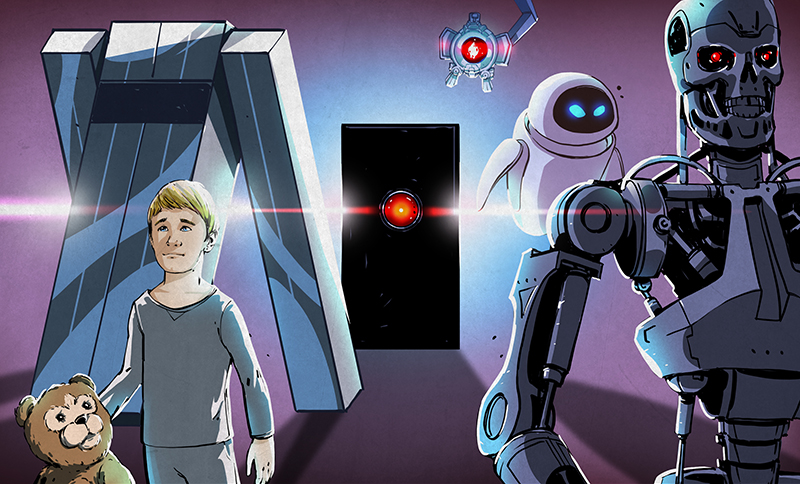
I’m just looking at the illustration. I know HAL, Wall-E, and the Terminator; the kid with the bear looks familiar but can’t place. Is the flying thing a Star Trek exocomp like Peanut Hamper? And the thing on the left looks like its from The Black Hole or maybe Tron, but doesn’t ring a bell.
The teddy bear is most certainly not Ted (Ted is magical) – Ted would be telling you it’s from the sci fi movie “AI” (with the “I see dead people” kid. The bear alone could also be from “Screamers”. As for that blocky type machine, it’s TARS / CASE .. USMC tactical robots from “Insterstellar”. No idea what the hovering camera is.
Should’ve covered the Trek domain. M5, Landru, Nomad. No AI can outsmart our fav Starship Captain !
Of course then you have Lt Cmndr Data….. from Meaure Of A Man, “does he have a soul ? do I have a soul ?”…… great episode.
I asked google search AI:
This illustration captures a massive crossover of legendary Artificial Intelligence (AI) and robotic characters from iconic science fiction films.
Here is the breakdown of every character featured in the image from left to right:🧸 David and Teddy (A.I. Artificial Intelligence)The young boy and his teddy bear on the far left are David (played by Haley Joel Osment) and Teddy, his hyper-advanced robotic companion. David is a unique mecha child programmed with the ability to experience real human love.📐
TARS (Interstellar)The towering, blocky, metallic structure directly behind David is TARS, one of the block-shaped tactical robots that assists the crew on their deep-space mission.🔴
HAL 9000 (2001: A Space Odyssey)The black monolithic panel with a single glowing red lens in the center is the interface of HAL 9000, the sentient computer system governing the Discovery One spacecraft.🚁
Weebo (Flubber)Floating near the top center is the small, yellow, hover-drone Weebo, the fiercely loyal and sentient robotic assistant created by Professor Philip Brainard.🪐
EVE (WALL-E)Hovering on the right with glowing blue eyes is EVE (Extraterrestrial Vegetation Evaluator), the sleek, advanced probe-bot sent to Earth to find signs of sustainable life.💀
T-800 Endoskeleton (The Terminator)
There’s something ironic, hilarious, or at least wonderfully self-referential in having used AI to search that. Never occurred to me to do so, plus I always enjoy involving my fellow HAD’ers. Thank you. :)
I had similar thoughts when I did the search.
Hi! The kid with the bear is either from “A.I.” movie or “Screamers”, I think.
i think it’s obvious that human intelligence is just a categorization / prediction engine based on basically the same math as LLMs, but obviously without the division between training and operation.
as for ethics…it comes down to what you care about. values shape ethics. ethics doesn’t exist in a vacuum.
The “math” may well describe the methods by which brains compress information for later retrieval, but it doesn’t explain intelligence because a plain LLM is lacking some obviously crucial features like the ability to “imagine” itself forwards and correct its behavior before it starts talking out of its ass.
That’s why the chatbots these days are made to “think aloud” by generating an intermediate response like “The user wants to do this and that, I need to do this and that”, to emulate a chain of thought before the LLM actually responds to the question.
And the “user wants this and that” intermediate prompt is not generated by the LLM itself, but by some logic-semantic parser engine that operates with statistical analysis or recurring neural networks, other types of hidden Markov models, expert systems, etc.
So it’s putting an LLM mask in front of a more traditional AI that also fails to be intelligent, but manages to reduce the hallucination problem somewhat by nudging the LLM towards more plausible answers.
it’s just lacking continuing training and embodiment. these are trivially-solvable problems that will be solved soon.
That’s exactly what reveals why the LLM is not sufficient. It can generate plausible actions based on known information, but it lacks the ability to think ahead. In result, even though it can train the correct action for each case through trial and error, what it has learned does not extrapolate to new actions.
It may have accumulated a theory of how the world operates, but it does not test that theory by prediction before trying to apply it, which makes it dumb in the real world.
“I gave ChatGPT a body”
https://www.youtube.com/watch?v=S67z2aekBrI
Or, as was pointed out in the video: “LLMs do not have world models. They cannot predict the consequences of their actions.”
You need a whole lot of other stuff and multiple feedbacks around the LLM to make it work.
Humans seem to use an (adaptable) world model as a base reference though, LLM don’t seem to use any base.
And from the human model system, that is build into them through evolution, they form the ethics you mention. And evolution works on the basis of necessity, you need a system to thrive in groups, and that group thing is the route human evolution (and many other creatures) seems to have followed, then intelligence evolved on top of that root system.
the base comes from embodiment.
Yeah, it’s notable to remember that this is not just exclusive to humans.
Almost all (if not all) higher life forms do have a concept of right/wrong or compassion.
There are whales having deep family relationships or elephants feeling sorry or missing people.
The fascinating part is that certain values seem to be universal accross different species.
Spiraling that down to certain mechanisms and evolution is a bit to shortsighted, maybe.
The whole is more than the sum of its parts.
I’m an atheist and a person who rejects most all metaphysical stuff of course, so I don’t subscribe to certain.. interpretations.
AI seems to have its own pseudotheological construct, however much like actual theology is merely based upon subjective and anthropological data.
It’s also important that. “A.I.” is a marketing term, just like the “cloud” was.
The current systems running in data centres are mainly LLMs (large language models) with a huge -no, gigantic!- database of human generated data.
It’s no surprise that they mimic our responses. It would be rather scary if that was otherwise.
Let’s also remember how convincing Eliza had been perceived in the 1960s, despite it’s tiny dataset.
In the 80s and 90s Eliza was a hit on home computers and PCs (the talking Dr. SBaitso shipped with Sound Blasters).
Nowadays we have Eliza’s sourcecode and know better, but it still fascinates us.
Modern LLM are very efficient, like modern compilers are at syntax checking.
Surely it’s not just LLM’s, it’s neural networking and LLM.
You could not do what it does now with only LLM.
Yes. As far as I read, the neural networks are a rather small percentage, though.
The original Eliza program also had sort of an adaptive part, by the way.
Neural nets and expert systems were two competing paradigms in the 1980s, I remember.
Character recognition and voice/speech recognition used neuran networks since late 1970s.
Expert systems helped at problem solving and databases.
Thinking this way, there was “A.I.” software for C64 and Amiga already.
Well yes there was various NN software for a long time, but of course with the limited processing power it was limited what you could do back then.
it’s sort of interesting that even if the AI bubble bursts we still will have advanced the hardware possibilities a lot because of it, so it can never be a complete loss in that sense.
Issues as always is the nefarious uses, uses that in part will remain even if the AI hype would die out.
When it comes to human-machine interaction, I can only recommend Joseph Weizenbaum: “computer power and human reason” [https://en.wikipedia.org/wiki/Joseph_Weizenbaum] Unfortunately the english speaking world has forgotten him. There is still a small candle burning for him in the german speaking world but just so, you can still get some of his books in german:
https://www.suhrkamp.de/buch/joseph-weizenbaum-die-macht-der-computer-und-die-ohnmacht-der-vernunft-t-9783518278741
Thank you! 🙂
A fun read these days in a world with LLMs is Roald Dahl’s “The Great Automatic Grammatizator”.
What was Dahl thinking when this was written in the 1950s?
On slop:
‘No, sir, honestly, it’s true what I say. Don’t you see that with volume alone we’ll completely overwhelm them! This machine can produce a five-thousand-word story, all typed and ready for dispatch, in thirty seconds. How can the writers compete with that?’
“It’s tremendous, Mr Bohlen! It’s exactly right!”
“Seems a bit sloppy to me, my boy!”
“No, sir, it’s a seller, a real seller!”