
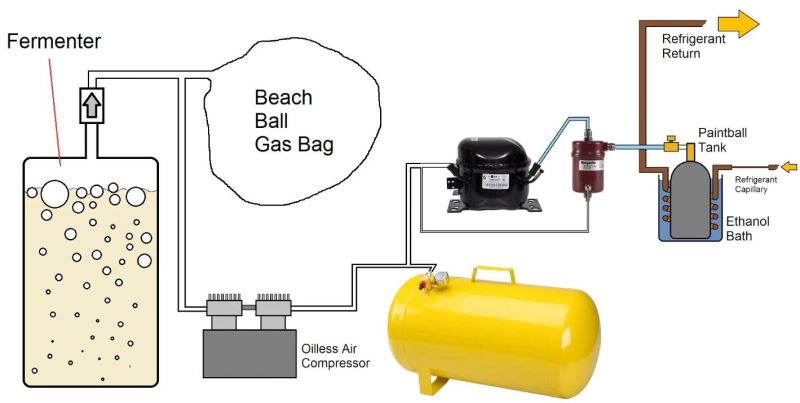
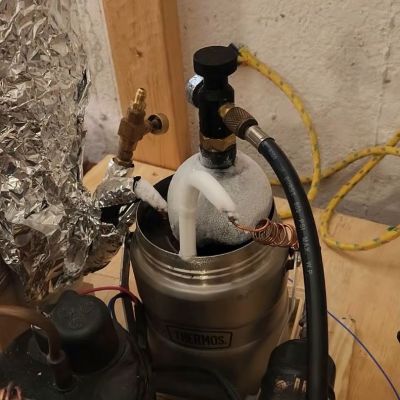
 After previously using the fermenting of sugar to obtain ethanol fuel, [Hyperspace Pirate] figured that it’d be a waste to just blast the other half of the yeast production in the form of carbon dioxide into the air. This poses the slight problem that gaseous CO2 is fairly bulky, while compressing it into a liquid isn’t exactly for the faint of heart. This of course means that it’s a fun challenge, involving a beach ball, vapor-compression and various compressors.
Although at room temperature compressing CO2 into a liquid requires quite extreme pressures, if you lower it to freezing temperatures it becomes quite feasible to use more typical off-the-shell compressors.
In the video both oil-less and regular compressors are used, mostly because ultimately you want to get pure CO2 into the bottle, without oil or water. Here a few methods are explored, including a pre-cooler with the oil-less compressor as it cannot quite hit the same pressures. With a typical compressor linked to an oil-separator you can directly fill the tank, which is pretty nice, though even with this removal of water turned out to be a chore.
Desiccating the gas that comes out of the fermentation vat, is attempted using a converted water filter that’s filled with desiccant beads, but as the later tests show, this isn’t quite good enough to prevent moisture to make it into the bottle and clogging its nozzle. Of course, moisture here is more acceptable than oil for most applications, so with some more work this could be quite a feasible method to fill bottles with liquid CO2 for various nefarious applications like paintball guns and more.












Why not sell the CO² to some company for emission rights? It would be cheaper and more passionate than simply compressing it in bottle.
…Passionate?
Very few people realise that when CO2 is emitted during fermentation, it’s global warming potential transfers to the atmosphere from the beer, making the outside world hotter and leaving us with cold beer.
i was wondering recently if there were any country music songs about warm beer, Hyundai sedans, and jeans that had not been cut off
Or gas up your greenhouse with co2 for your plants 😎
Why carbonate a greenhouse when you can carbonate an algae racepond? 😎
could theoretically make a highly efficiency brewing system using one of those drink carbonators? seems like a decent use of the gas, if you ferment something that can be used to make a drink that is.
high pressure co2 is corrosive so the choice of materials used becomes important
I’m afraid DIY high-pressure refilling a gas canister is on the list of things I won’t do. A high-pressure rupture with metal shrapnel can really ruin your day.
If you overfill a CO2 tank, the burst disc will rupture and safely release the pressure. Just make sure the tank certification isn’t expired and don’t try to fill a damaged tank.
To fill a tank you have to build some plumbing that will run at full unregulated tank pressure.
That opens up lots of fun opportunities for metal fatigue, unless carefully considered.
If I wanted to play Russian roulette with metal fatigue, I’d build a bowling ball mortar.
“To fill a tank you have to build some plumbing that will run at full unregulated tank pressure.”
Someone clearly didn’t watch the video, since that pressure drops drastically with temperature.
Water and CO2 under pressure can create carbonic acid, which very probably attacks both carbon steel and aluminium (two alternative materials commonly used in CO2 bottles). If that’s the case, it may corrode the bottles from the inside and eventually they could blow up with no warnings…
Exactly the reason why the inside of carbonated drink tins are coated with a thin layer of plastic. To have a barrier between the weak acid and the metal containers.
i dumpster-dived one of those devices that filters oxygen out of the atmosphere, concentrating it in a tank for medical purposes. it does this by trapping the nitrogen and possibly other gasses in a metal matrix that periodically needs to be purged. it would be extremely cool to then compress that into a liquid, but something tells me oxygen compression is an order of magnitude more difficult