
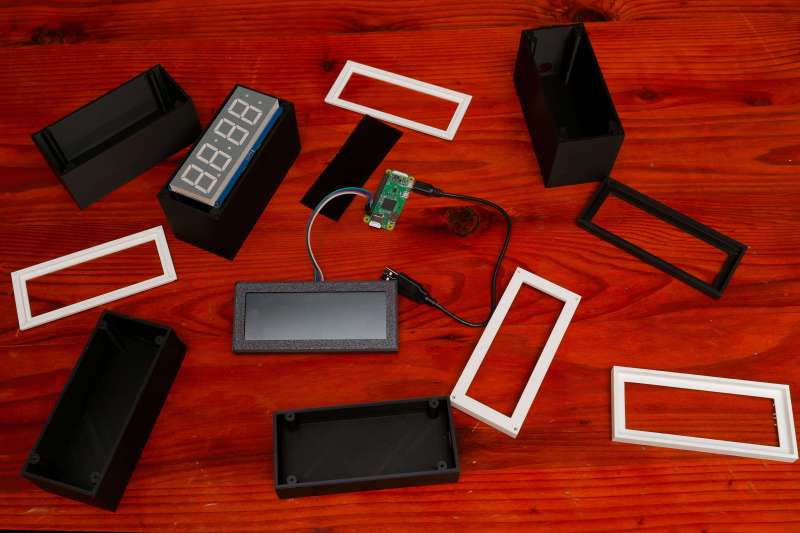
We’ve all done it before: a simple project that escalated to the point of extreme overengineering.
But what’s less common is [Lee Hutchinson]’s digital clock, whose case is (somewhat-successfully) designed by LLMs!
A clock needs time synchronization, and a digital one needs some code to drive the display. An avid systemd user, [Lee] had no trouble at all setting up all the users and services needed to keep the time synchronized. Some rusty Python skills with some aid of the dreaded Claude Code later, [Lee] had a script to actually show the time too.
But now comes the interesting part: the case. Now, [Lee] isn’t really a mechanical engineer, and he doesn’t really like Autodesk Fusion’s UX. Most projects would see their creators just grit their teeth and get on with it. But here, in an experiment we haven’t often seen before, [Lee] connects LLMs to Fusion’s new MCP server feature! Did it work? Surprisingly enough, yes. Kind of. The local Qwen model got most of the way there on one request, but still made mistakes for the other. However, another pass with the more powerful Claude models got the job done.
But there’s much more to the story; [Lee] goes into more detail, and talks about the assembly process, over at Ars Technica.












Umm, OK. We all know Fusion has a built-in LLM/AI, right? In fact, I used it to design a 6-cell LiPo battery box. Not proud of that—I wanna get better at Fusion, but it got the job done quite well.
Actually I wasn’t aware, that’s interesting.
…and Fusions AI is Claude.
It’s actually useful in writing scripts. I got it to write one to apply a laser cut MDF finish. Told it to look for the largest two faces and apply MDF to those, and a black finish to everything else aka the burnt edges. Works well and automates one of those little annoying tasks.
Neat. I’ve used a few different models to write OpenSCAD for some objects. It’s remarkably fast to go from a dimensioned engineering sketch on paper to a part I can manually tweak if needed. It’s also really cool to be able to write things like “smooth that edge so that I can print without supports” and have it more or less work. It’s not perfect, but for something fast, hard to beat part to prototype in minutes.
I use chatgpt to make 3D models for KiCAD in openSCAD, too. I don’t get it to do everything, somethings are quicker to do myself in FreeCAD, but for things like pinheaders, ChatGPT is MUCH faster. It even makes the pins gold and the plastic bit black.
“But there’s much more to the story; [Lee] goes into more detail, and talks about the assembly process, over at Ars Technica.”
Which is news in itself considering their AI positioning.
Yeah, I stopped reading Ars Technica a while back. The atmosphere is very Reddit echo-chamber. If you disagree with the hivemind, you get flamed and downvoted to oblivion. Downvotes are meh, but when it results in your comment being hidden, it’s pretty lame. If I ever find myself there inadvertently, I always check the hidden comments. You never know when it’s a hateful edgelord or someone smarter than the hive.
Lee is a long-time writer for Ars. May be he’s even a founder?
And the basic skills that would have been acquired in learning to use the CAD software to make a simple box were lost, and instead, thousands of kilowatts of electricity wasted.
I cannot agree with anything you’ve written here. It is precisely the boring things that I have made a hundred times over that I would prefer to have AI do on my behalf. A simple box with bosses is on that list. For people who have not been required to use CAD before AI, they’re becoming capable of doing so without all the wasted time and materials required to fail your way to CAD success. Doing things the good old fashioned way is not necessarily better. It is long, painful, and wasteful. We only justified that expenditure of time and resources in the past because it was the only way to achieve success. Now we have options.
A simple conversation with an LLM where each side sends 5 messages only uses between 1-4 Wh of electricity. Not thousands of kilowatts. Sheesh.
https://cloud.google.com/blog/products/infrastructure/measuring-the-environmental-impact-of-ai-inference
So many things to learn. So little time.
Hold on.
I’ve heard this argument before.
“And the basic skill of cursive writing that would have been acquired was lost.”
“And the basic skill of fire stove cooking that would have been acquired was lost.”
“And the basic skill of letter writing that would have been acquired was lost.”
I am ALL for stopping the commercialization of AI.
AI making money is a pipe dreaming that is hurting all of us.
Gatekeeping a skill to be the cool kid who learned it before it went mainstream on the other hand….
CAD work is something that i wouldn’t automate using an LLM even if it could do it perfectly. I design electronics for a living and also as a hobby but it’s such a pleasure to design enclosures in CAD for my projects to 3D print after the design is done and I’ve sent the file over to a PCB fab to get manufactured.
So much scope for creativity and innovation. Its very fun, and as a bonus, i get to use what I’ve made
Depends on the application, and depends on how much you want to relegate to the AI. I like using it at times to take care of the first draft, get rid of a lot of tedious routine tasks, but finish it all up with a human hand and make sure there’s no mistakes manually. Mixed-use is my favorite application so far, it’s not ready for solo work.. yet.
Also yes, I still enjoy the chance to do things myself… just not the boring parts :)
I’ve always been a believer in making the machine do as much of the ‘tedious and routine’ work as possible since I started out with mainframes in the early 80s.
Recently I’ve been using Lumo to search for hardware reviews which I had it summarise and compare, then choosing which ones to read myself.
This is how I learned that recent ASRock X870 motherboards had an SoC power management issue which resulted in burnt CPUs, mostly Ryzen 9000, 9800X3D and 9950X in particular. This still hasn’t been completely rectified yet.
I feel this way about routing in KiCAD. I don’t really want an auto-router even if it worked perfectly. Routing is the fun part! Of course any time I wanted to get a boring but necessary board done, I would be happy to use a perfectly working auto-router on it. I like routing, but it’s not the only thing I do.
I’ve done enough pcb enclosures for one lifetime, however. I’d happily leave that to an AI. It’s not like I am milling the thing myself. I also just 3D print them. I don’t refuse to use tools because it’s popular to do so.
I cannot agree with anything you’ve written here. It is precisely the boring things that I have made a hundred times over that I would prefer to have AI do on my behalf. A simple pcb with routing is on that list. For people who have not been required to use PCB tools before AI, they’re becoming capable of doing so without all the wasted time and materials required to fail your way to PCBsuccess. Doing things the good old fashioned way is not necessarily better. It is long, painful, and wasteful. We only justified that expenditure of time and resources in the past because it was the only way to achieve success. Now we have options.
I’m interested in the article, I am not interested in you. Nobody asked for you
I second that sentiment.
AI is a new tool. People, especially hackers, like playing with new tools. If this particular tool fills you with dread, you should probably get to know it better. It’s not going away. Adapt or fall behind.
Indeed.
That sort of neo-luddite attitude is just as bad as the ‘AI Is Fantastic And Can Do Anything’ idiots.
From the Arstechnica article, that is quite some beatdown:
“I would have gotten annoyed, angry, or just tired of endlessly reading StackOverflow posts criticizing what I’m trying to do for being dumb and wrong.”
“Modifying the model meant doing battle with the absurdly user-hostile nightmare that is Autodesk Fusion, so I girded my loins and dove in—and hit another wall. Parametric modeling, especially when weighted down with decades of AutoCAD’s stupid UI/UX choices, was even harder than programming.”
Does that sound like a Hacker to you?
I’ve had a lifelong interest in automating CAD more effectively, specifically focusing on unifying CAD with specialized analysis tools, then evaluating the gap between the predicted system performance and the physical system. What I’ve been able to do with Claude Fable is mind-blowing.
Over a weekend, it designed a complex electromechanical system, did a complete material downselect, built a pyFeMM model for magnetics, performed FEA, created a KiCad schematic/PCB of the drive circuitry, and wrote a script in Fusion360 Python to build the entire setup in CAD, which it could run through the MCP. It defined a standard YAML file detailing the design space parameterization, which it used as the common-denominator input for all the tools needed to prove the design.
It then built an optimizer to find a design that met all my requirements. It orchestrated all the compute for me, executed all the experiments, and wrote a detailed, 15-parameter study with a design justification for every decision.
This was over the weekend on a Max 5x plan; I solved similar problems during my PhD, and it took much longer (many many months) to pull everything together into a unified design workflow. The design required about a week of extra manual work to fix/improve, but after the parts were fabricated, it actually worked within a few percent of the predicted spec.
This clock is cool; I’m glad someone is learning that this type of design is possible, but there’s so much more this new workflow can accomplish, and I think we’re going to end up with really amazing systems emerging over the coming years because of it.
Are you able/willing to publish it? With regard to CAD and PCBs, I have yet to see any results from any LLM that are not trivially simple like this clock.
Be care filling a paintball cylinder with 800 psi rated lines. A full CO2 tank usually hovers around 1800-1900psi. I imagine the safety net there is the 2nd stage compressor has limited output….. Those deep freezer types are only pushing a couple hundred psi at best. Looks like you were pretty resourceful and probably learned a great deal.
That would be a useful reply in the next story.
The orphan comment glitch has gotten so bad it’s sending comments to completely different articles!
https://youtu.be/6trAkQY5_kc?si=yTt_6OXiEaK0xR1N
I experimented with a FreeCAD MCP server, going down the rabbit hole of JSON schema for defining parts constraints (mounting holes, tolerances, etc). Got something “semi” usable for a K2B enclosure w/LCD screen but honestly seemed like a hardish problem to make progress on, the visual -> text gap is pretty wide.
I’ve had some very good luck with hooking up Codex running GPT 5.4 with CadQuery to write code to create CAD files. It’s done remarkably well for primitive-based modeling. It’s not final-quality stuff, but it can get you to a 90% solution really quickly. It even properly abstracts and names variables to make the models more parametric. I feel like we’re just scratching the surface on this stuff.
Honest take: AI CAD still means babysitting fillets. MCP into Fusion is lovely if you already live in Fusion. For everyone else the win is tweaking the part in a browser and sending it to a printer without the Autodesk tax.