
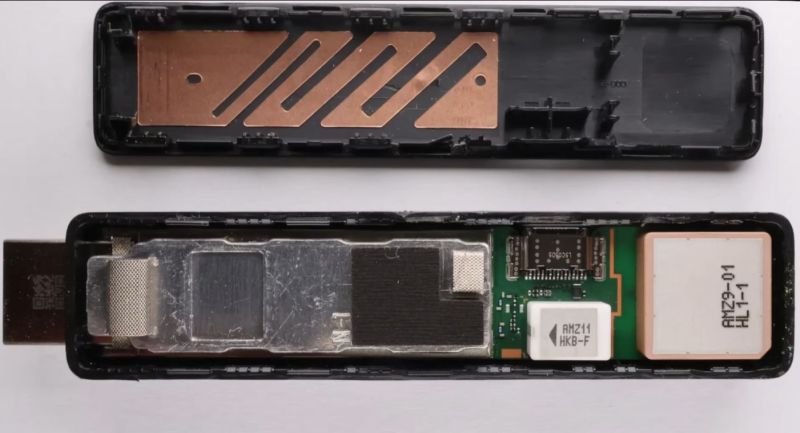
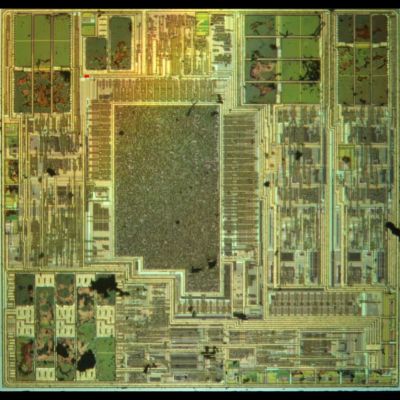
After the release of Google’s Chromecast so-called ‘streaming sticks’ have remained a popular form factor, even though such technology is these days part of ‘smart’ TVs. Being curious as to what kind of hardware they put into these sticks or dongles these days, [electronupdate] decided to do his typical full teardown of a 2026 model Fire Stick HD from Amazon, including the typical nekkid die shots.
Although most of the bits inside are fairly typical, being just your typical Mediatek-sourced solution, the ceramic patch antennas for Bluetooth and Wi-Fi are a rather interesting detail, as are the purported limitations that make this the ‘HD’ version of the Fire Stick, unlike its 4K brethren.
The used Mediatek MT8698D SoC isn’t so different from the SoC in those 4K versions, with the 2025-era 4K Plus using the MT8696D, but the 4K Select using basically the same SoC as the HD version, featuring the same G310V2 GPU at 500 MHz per the Amazon Developer documentation and the same decoder block (VPU), both of which are capable of 4K video decoding. This implies that the HD vs 4K distinction is purely software-based.
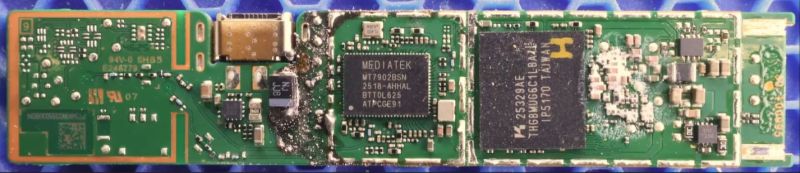
After popping open the device and noting the various ICs, the NAND Flash, the Mediatek MT7902 wireless IC, the PMIC and the aforementioned SoC all have their caps popped in order to take a closer look at their dies. For reference, as one of the largest ICs, the SoC die is a mere 5.2 x 6.45 mm. The PMIC die is more interesting as usual, as this one integrates USB-PD functionality, adding quite a bit of logic to what is otherwise a fairly mundane bit of power management features.
Overall not a very surprising design, though it does tickle that thought in the back of one’s mind whether it could be turned into a ‘4K stick’ with a few software tweaks, or perhaps more simply by installing plain Android onto its 8 GB of eMMC.












It would make for a neat SDR. Open source anyone?
How would it be an sdr? There is no radio
Are you sure about that ?
Then tell me, why else is there an ceramic
Antenna inside ?
There is no radio? How does it connect to WiFi and Bluetooth then? Why are you posting nonsense?
Not all radios are suitable for SDR use.
Yeah and it probably doesn’t have a tuner either. HaD features sdr stuff all the time, you’d figure more people would pick things up.
Obviously. I replied to the comment stating that it doesn’t contain a radio.
BTW the Nexmon project shows that a WiFi radio can become a SDR (within the supported frequencies).
Cf. https://github.com/seemoo-lab/mobisys2018_nexmon_software_defined_radio
DP Alt on the USB-C would be a nice touch.
Why? It has a perfectly functional HDMI port
USB-C to HDMI converter for any DP-Alt source. Going the other way it can be dual-display.
Chances are it’s production fused into a secure boot and only Amazon has the keys. But hey buying a computer you don’t own to buy media you don’t own seems somewhat fitting. Sigh. Otoh, our new AI overlords are pretty good at binary patching, maybe they’ll find a way in.
Amazon is absolutely locking these things down because so many people were buying them and using them to run various pirate streaming apps.
I’m feverishly clutching my pearls as I read this.
Quite a lot packed in to such a small device.
I do wonder what sort of an attack vector could be possible.
These sort of devices tend to be always left switched on and connected.
Disregarding the obvious harvesting of viewing habits.
I wonder what sort of stepping stone it could present, how many people use their phones as a WiFi remote for these things, perhaps enabling a Bluetooth entry point onto the local network that could be escalated.
Bluetooth tends to be given a lot of permissions on all sorts of devices by default, often with little ability to limit access after it’s been accepted.
One can “harvest” viewing habits from the other end.
That’s a GPS antenna???
That’s what I thought. Seems a little unusual for Wi-Fi or Bluetooth…