
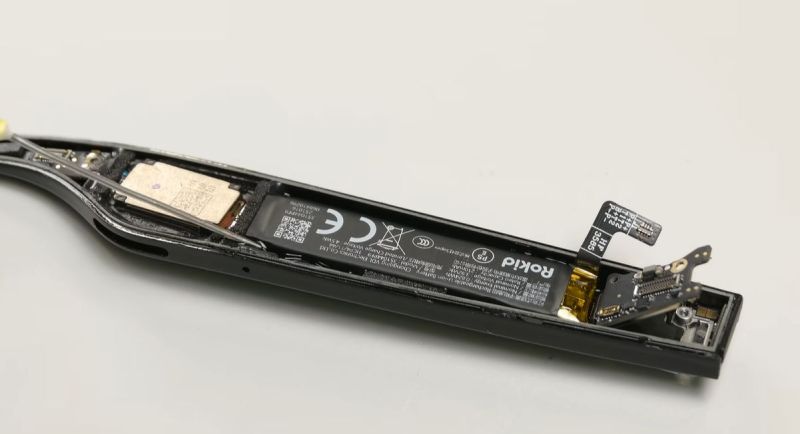
It’s often claimed that wearable devices cannot have user-replaceable batteries or even be serviceable at all due to how compact and waterproof they must be, yet there are plenty of examples belying those claims. So too for smart glasses with their compact size and the need to be fully waterproof. They would be certified e-waste as soon as the built-in battery stops being a battery, assuming these claims were true. Recently [iFixit] bought a few Chinese smart glasses to see just how repairable they are, with the Rokid one being very surprising.
The first nice feature of both two Chinese smart glasses is that they have an external battery that clips on in addition to an internal one. Internally they’re quite similar, both featuring a Qualcomm Snapdragon AR1 Gen 1 SoC with 32 GB of eMMC storage, in addition to micro-LED projectors.
Of the two glasses in the video, the Quark one isn’t that dissimilar from the Ray-Ban and Meta ones, requiring fairly destructive heat and prying to get inside. The Rokid one is however very easy to get into, with very light glue that makes it easy to get into, as well as a very servicing-friendly internal architecture including its battery. This is a pattern that extends to its external battery module, giving a glimpse at what such devices ought to look like in a repair-friendly world.
As is to be expected for an [iFixit] video, a significant part of it is spent lamenting the ills of glued-in batteries, including the recent decision by the EU to exempt many wearable devices from its new right to repair regulations involving built-in batteries. In light of the teardown of the Rokid smart glasses in this video, as well as previous Pixel Watch 4 and Fairbuds teardowns, it certainly seems reasonable to enforce user-replaceable batteries for these wearables as well.












It’s a shame we still don’t have transdermal implants like in Deus Ex Human Revelation game to make HUD right on the eyes. Imagine soldering a board and being able to look at datasheets in realtime. Or looking at a bicycle and your eye automatically detects what wrench you need to order to change tire or adjust seat. Instead we get those thicc glasses that make one look like a total derp from thwe 1970s sitcom.
Do the same with earbuds. Which aren’t easy to repair.
One of my Bose buds died. I did get in to it but there was nothing serviceable inside. Never giving them money again.
Hearing aids started out with replaceable batteries. The argument that it can’t be done is absurd.
I dislike accessory teams. They’re the original “monetization” mindset, never just making good product, always tainting the user experience.
The lifetime of these silly rings is months. We have a draw full of my wife’s Fitbits, none of them having justifiable technical improvements to each other, just e-waste.
Tiny flammable items where even the smallest millimeter matters.
I doubt it’s worth it—they’ll just get thrown away anywhere, like button batteries.
I’ve already bought some Energizer LR6 lithium batteries, and once they were dead, I put them in a small, airtight glass jar. The result:
they leaked, and the chemical seeped into all the coins that were in there, and now it stinks.
I haven’t cleaned it up yet; I’ll try using Coca-Cola to see what happens.
You put batteries, which were likely weak but not completely dead, into a jar full of metal objects conductive enough to short-circuit them? I think I see one root of your problem.
That’s right—there are lots of copper parts. I didn’t think about it after I quickly put them away.
That must be it.
Thanks—I’ll be more careful next time.
The question is if you can change the battery with a new one with same specs, not if you can take out the battery and use it in a remote or something.
The batteries degrade, of course, even the rechargable AA batteries have some lifetime.
I’ll be using ENELOOP PRO (black) LR6 batteries from now on
I’ve lost track of this product category. I knew we had smart glasses with Bluetooth earphones and built in cameras, but the displays are new. What can we do with them? Are they open, like could I display any app of my choice on them?
After my first glasses with Bluetooth earphones died due to the ribbon cable connecting the halves tearing I became wary of repairability. The Rokid pair looked acceptable to me.
Well it runs on Android, AI visual understanding of the world for the blind is one thing for the camera but The ability to translate and display the translation, also a teleprompter is a good use. To-do lists but that’s a app I made.
No, they have the same problem like VR-goggles (maybe there are exceptions?); lock-in into a closed platform, which is why they haven’t gained more ground in the software ecosystems. Looks like people do learn from experience.
Keep an eye on the Steam Frame as it should be one of the least locked down VR headsets. There’s a smooth path to buying games on Steam of course but you should be able to drop out to a Linux desktop with root or install your own OS easily enough.
Honestly the only AR glasses I cared about was nReal Air, as it was connecting via a wire to a device of your choice and had no battery to weigh you down and it just acted as a sunglasses with display and speakers (i think).
Now, it had got rebranded as xReal Air, discontinued, and apparently there is a xReal Air 2 but i couldn’t find if it can be used without their propreitary app.
You can use Air with the app but also can WITHOUT, which is a big must for me.
Since Air is discontinued, my passion has left dry for these too, but I’d love to see a eyewear HUD with magnetometer for navigation purposes.
Smart rings are part of the same circus. Why isn’t the battery built in to a snap-in section so it can be changed? Just e-waste.
Ok, so now you have a “repairable” gadget. Let’s look into this again in a couple of years and actually try to change the customized battery. If you can get a spare, that is.
I predict in the future people will be 3D printing small batteries.
Smart glasses need to be repairable.
The glass-hole will wear them in public and record non-consenting bystanders, who will rightfully tear them off the face and stomp on them.
When the glass-hole tires of paying repair costs, maybe they will learn their lesson…
If people will stomp on others property; what will happen to aids for the blind?
https://www.onedaymd.com/2026/01/top-smart-glasses-for-visually-impaired.html
The next time you talk to someone, take out your phone and point it at their face. What is their reaction?
These smart glasses have been designed to be discrete in order to avoid this reaction. It would be trivially easy to make a version for blind people which are not inconspicuous, but blind people are not the target market. The target market is people who want to record people without other people knowing.
What is happening is that those people are a disability they don’t have to launder a selfish interest by speaking for the disabled people who never asked them to.
Why are you doing that?
Just replaced the battery in my Amazfit watch.
10 minutes of unscrewing and prying ribbon cables and then the batter WAS glued onto the PCB but nothing else.
Great balance I feel between repairable and yet still functional.
Also, the design for IP67 on it doesn’t require glue.