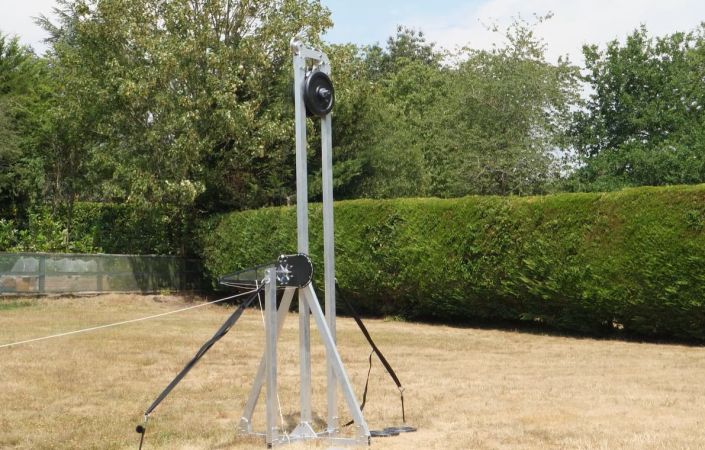
As awesome as trebuchets are, the fact that medieval engineers didn’t create versions capable of launching supersonic projectiles is a bit of a bummer. Fortunately it’s possible to correct this oversight with modern insights and technologies, as [Tom Stanton] demonstrates in a recent video.
While a traditional trebuchet is fairly straightforward, using a heavy weight moving an arm around a pivot that has the projectile attached to the other side, a few tweaks can make it much more lethal. One change is to have the projectile’s rope wound around the arm, forcing an additional pass around the arm to gain velocity. The other is to use a gearing system which uses the dropping weight’s energy more efficiently.
One complication here is that the arm now takes a few rotations to come up to speed, meaning that the release of the payload has to be controlled exactly, with only about an 0.0025 second release window. The solution was both low-tech and effective: since the arm is attached to a drum that the rope is wound onto, the moment enough rope is unwound from the dropping weight, a latch inside the drum is released to launch the projectile.
In a first test with a 10 kg weight, the projectile reached a velocity of around 528 km/h, which definitely was a good start, but also showed just how not aerodynamic the arm was. Some redesigns later of the entire trebuchet, the entire system was tested again with 10 kg and achieved a projectile velocity of 634 km/h. From there it was time to ramp up the weight to the full 40 kg, which theoretically should hit supersonic speeds.
Unfortunately the first attempt hit a mere 1,152 km/h (716 mph), which is just shy of the sound barrier at 1,235 km/h at 39% system efficiency and some components clearly breaking apart. Some more redesigns later and with a lighter projectile at 4 grams, a 40 kg weight achieved an arm speed of 2,342 rpm. The projectile now left the sling with 346.4 m/s, or 1,249 km/h, with an audible snap as the sound barrier got broken.
Even if the era of trebuchets in warfare is well and truly past, they remain fascinating physics demonstrations, with this case in point.