
The fun thing about thermopolymers like PLA is that you can blend in additives, some of which are necessary to make it at all usable, while so many other additives are either just cosmetic or arguably just plain weird. In a recent video, [Zack Freedman] goes over some of the weirdest ones that he’s come across so far.
These range from the pretty-normal-but-unusual, like CMYK sets of filament for full-color printing, to the rather unusual, like very silky PETG and foamy TPU and TPE, all the way to the WTAF ones, such as Timeplast filaments that can be used as soap as well as fish food.
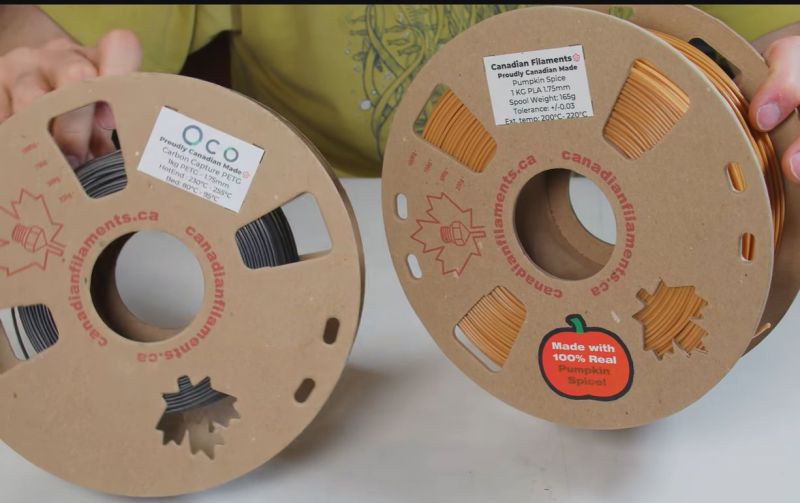
He also tried a range of filaments that vie for being the blackest filament possible, while others pretend to be paper or are made out of literal landfill trash. Some hit your olfactory senses with a hammer by smelling like all the lemons just got squirted right up into your nose, purportedly to keep flies at bay. There is also pumpkin spice-flavored PLA, for when you really need to make the holidays extra fragrant.
Overall, the range of filaments here is quite dizzying, with some being actually practical, while others are mostly about their green credentials, or about being pretty or having a specific olfactory experience. Whether any of them are for you depends. Do you have a longing for 3D prints that smell like pumpkin spice or are fish food? We’ve noticed before that [Zack] likes strange filament.












this is getting out of hand, i stopped watching after seen the soap filament
I just learned about soap filament. Thank you very much.
I think they mean the YouTube video title. Currently you can have multiple different titles and thumbnails showing to different groups and whichever one gets maximum engagement wins. I see “Insane 3D filaments for psychos”.
Do you ever wonder why comments like this are not deleted on HAD, while other comments which are based in reality are not?
THIS IS ALSO NOT REDDIT.
“comments which are based in somebodies reality are not?”
There, fix it for you.
“somebody’s”
There, fixed.
Thanks!
This person has a lot of the wrong ideas when it comes to printing.
He will randomly say things like “i don’t even print things with that little of infill” — implying the strength of the print comes from its infill — even though most competitions where the goal is to print the “strongest” 3d part has almost always been won by 3d printed parts that have 0% infill and are hollow.
I could go on but at the end of the day I question the validity of his past experience when it comes to 3d printing.
uh, what? i’m not saying you’re wrong but that runs contrary to my expectation. can you provide a citation for a part that was stronger without infill?
The idea is to thicken the walls, and use less infill, here’s a recent randomly-selected argument along those lines: https://www.xda-developers.com/dont-need-100-infill-makes-prints-stronger/
thanks! it doesn’t convince me though. the article is making too many unrelated arguments. they’re saying, i suppose correctly, that cranking infill to 100% won’t solve your problems if you don’t also address all of these other issues. but they aren’t really making the case that 100% infill isn’t marginally stronger even if you do all those other things. nor are they making the case that 100% infill isn’t marginally stronger even if you don’t do those things. (fwiw i would never use 100% infill, i am just surprised by the claim that hollow objects are stronger)
one of the many unrelated arguments is “If you examine broken prints closely, the failure usually occurs along layer lines. The part rarely snaps through the middle of a layer.” that’s not my experience! i’ve seen a lot of failures, and i do not remotely have the impression that it “rarely snaps through the middle of a layer.” there are sometimes runs along a layer line, but almost every failure i’ve seen also involves some snapping through the middle of a layer. in fact, projects i’ve made that i was certain would eventually fail along a layer line either didn’t fail, or broke within the layer. (my experience is mostly PLA).
so the article strikes me as a collection of lore.
https://m.youtube.com/watch?v=GEHNijssAKc
Here.
I kind of like the fish food idea… if it truly is clean, healthy fish food and not a pollutant. You could throw your scraps in a pond rather than a landfill! That is.. assuming the resulting part still has good physical qualities.
Is this the same person who was recently commenting about wanting all sports ended because some jocks made them do their homework? I do agree with part of what you are saying. Mental health issues are serious. I sincerely hope you can get some help for yours and so live your best life.
Oh stop. You have a right to be offended by whatever you want, but we have the right to not care.
For humidity
https://techxplore.com/news/2026-08-cone-mechanics-3d-materials-humidity.html
On strength
https://phys.org/news/2026-08-spiral-narwhal-tusks-resistance.html
Anyone ever have two print-heads side-by-side for spiral forms?
⚆_⚆ sponsorblock