
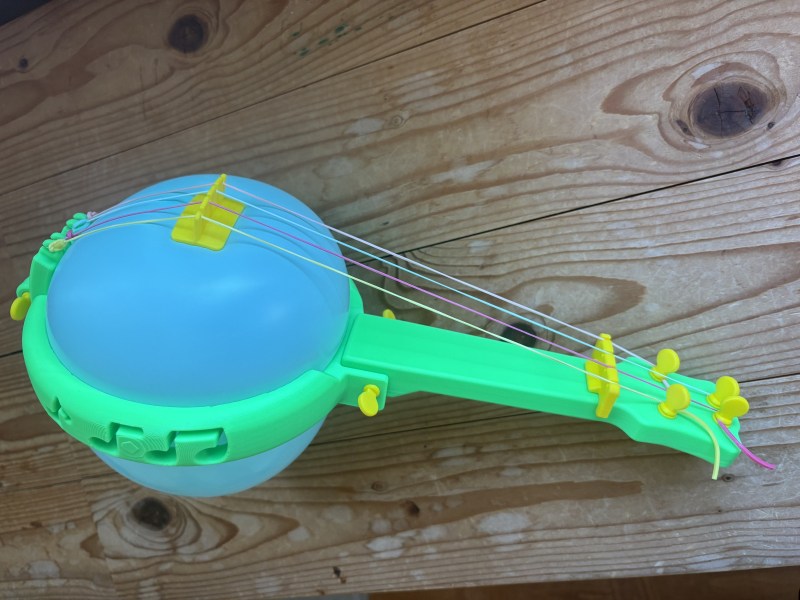
Most instruments, with maybe the exception of pianos, have consumable parts. Guitars need string changes, bows need rosin, saxophones need reeds. [Co:Creation Lab]’s balloon banjo requires both fishing line and a party balloon, lest it be semi-silent.
If you want to change the resonance, just increase or decrease the amount of air inside the balloon. Neither the balloon nor the strings need tools to adjust, but we might argue that tuning pegs are tools.
The balloon banjo was the result of a design constraint: a parent should be able to build it with their child. To that end, there are no metal screws, no recurring snap-fits in the assembly, and a single, internal, one-time-use snap fit for the adult’s tactile satisfaction. Instead, the balloon banjo uses 3D-printed screws. A six-year-old can turn them with their fingers, and it’s difficult to over-tighten them and strip the plastic threads.
Be sure to check it out in action after the break. If you would rather use extant plastic to make music, the Bottlephone 2.0 is calling.












then you will have a Balloon Banjo. You can still throw it away if you want to though.
Playing it backwards strumming the fret board, interesting demo. Obligatory poke in the eye string ends.
A harp like form would make more sense to a child. Nicolas Bras has made many variations.
Like what an alien would do if it found a guitar… I actually kind of enjoy it.
i mean it’s a hack and i’m sure it makes some amusing sounds but it’s just as vexing from the perspective of “can it make music?” as it is from the perspective of “right tool for the job?” it’s hard to imagine a more inappropriate material for a neck than 3d printed plastic. and just because it has a balloon in it doesn’t mean the fretboard needs to be non-functional (action too high by inches)
Two things behind that. The action is high on purpose — the strings have to
clear the balloon. If they touch it on the way, the resonator stops being a
resonator. And the strings it’s drawn around are soft: nylon line, elastic
cord. At that tension the neck isn’t carrying much, which is why plastic is
enough here. I still tell people to print it lying down, but that’s caution,
not a load calculation.
It’s listed as a science toy rather than an instrument, and it isn’t built
to be fretted. What changes the sound is string tension and how much air is
in the balloon. Feeling those two move in your hands is the point of it.
Yeah, I like it, it’s fanciful and fun. But when it comes to silly balloon instruments I prefer this guy’s technique:
https://www.youtube.com/watch?v=Jk7J4_bneZo
You could play pop music on it!
It kind of reminds me of the Turin from american dad