
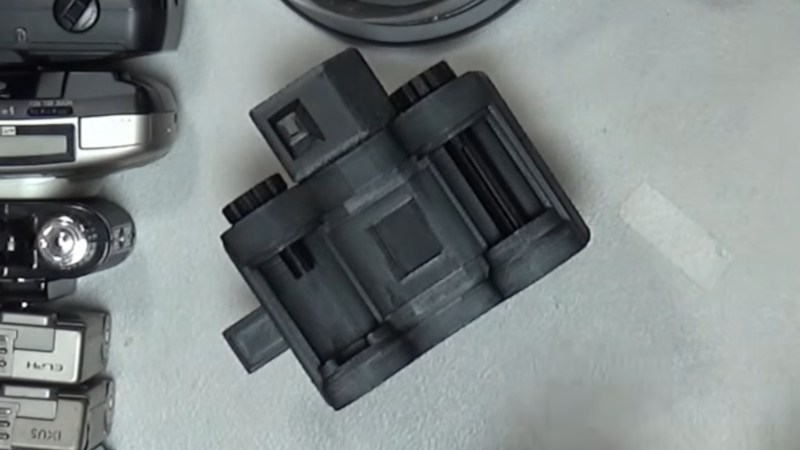
Making a film camera is a project within the reach of almost anyone, from the experimenter with cardboard and sticky tape, to the machinist with an aluminium billet. But 3D printing has opened up the world of cameras to whole new set of experimenters, and we’ve seen some very impressive builds here as a result. For all that, there’s always been a particularly tricky aspect to a home made camera: the shutter. In particular, making one with variable speed has proved almost impossible. Now [Camera Things] has given it a very good shot, with a sliding 3D printed design.
To cock it, both the strips are pulled across, before the blind strip is pushed back, and the shutter operates by sliding back under the influence of a rubber band. The clever part in this case is that the blind strip can be partially pushed back to affect the size of the shutter opening. The effect is then of a variable width strip of light passing over the film, which is equivalent to varying the speed of a conventional shutter.
Due to space constraints he’s only able to make it a half frame shutter, so he’s abandoning this design in favour of a more complicated set of vertical leaves. Sadly he’s not made the files available, but we thing proficient CAD users should be able to make their own version. The video is below the break.
It’s not the first printable shutter we’ve seen, but it remains the first variable one.












“In particular, making one with variable speed has proved almost impossible”
Evidence requires. Techniques for controlling shutter speed aren’t particularly difficult, even if you just need to add a spring mechanism.
3D printed plastic sucks. Even with not-terrible material, it took actual camera development decades to figure shutters out. Check out the 1940’s calibration procedure for a hasselblad some time.
” The effect is then of a variable width strip of light passing over the film, which is equivalent to varying the speed of a conventional shutter.”
Variable width is precisely how shutters have worked since the dawn of the SLR era. This is why you could only sync the flash to 1/60 or maybe 1/125 on even the best cameras. Any speed above that the shutter opened only partway and slid across the opening.
IIRC, Leica was advertising synched ejectrinic flash speeds of up to 1/2000 Second for its Leicaflex SLR cameras.
https://www.vintagecamerareviews.com/brands/leica/leicaflex/
This states a sync speed of 1/100 s for the Leicaflex.
There is a way to sync at faster than 1/200 or so, but that generally involves the much more complicated leaf shutter.
I can’t speak to Leica’s advertising, but the Leicaflexes had a sync speed of 1/100. 1/2000 was their maximum shutter speed, period.
(Incidentally, Leitz was one of the pioneers of the variable-width shutter; they used a two-part variable width cloth shutter in their classic Leica rangefinders as well as the Leicaflex)
You can get some pretty interesting shots of running athletes and other fast moving things, particularly of the camera is still.
AKA focal-plane shutter: https://www.youtube.com/shorts/1HTfIw65x6k
Interesting design but not really “world first” imo. There are several 3D printed leaf shutters out there with adjustable speeds (different spring tension), also saw a mostly 3D printed long-roll focal plane shutter like the Graflex Speed Graphic used, but the curtain is fabric there so not “fully 3D printed”. A spring loaded rotary shutter is super simple and again speed is variable via spring tension.
Several of these have been posted on HAD already I’m certain.